Andrey Fedorov, STON.fi Dev: On Connecting TON To The World, The Real Barrier Holding Users Back, And Why AI Agents Are The Next Step In Cross-Chain Execution



As blockchain networks multiply and liquidity fragments across chains, the question of how users move between ecosystems has become one of the defining infrastructure problems in crypto. Cross-chain execution, once the domain of technically sophisticated users navigating bridges and multi-wallet setups, is now the focus of a growing number of protocols attempting to make the process invisible. For STON.fi, the largest DeFi protocol on TON, the launch of cross-chain swaps this summer marks a deliberate shift in scope.
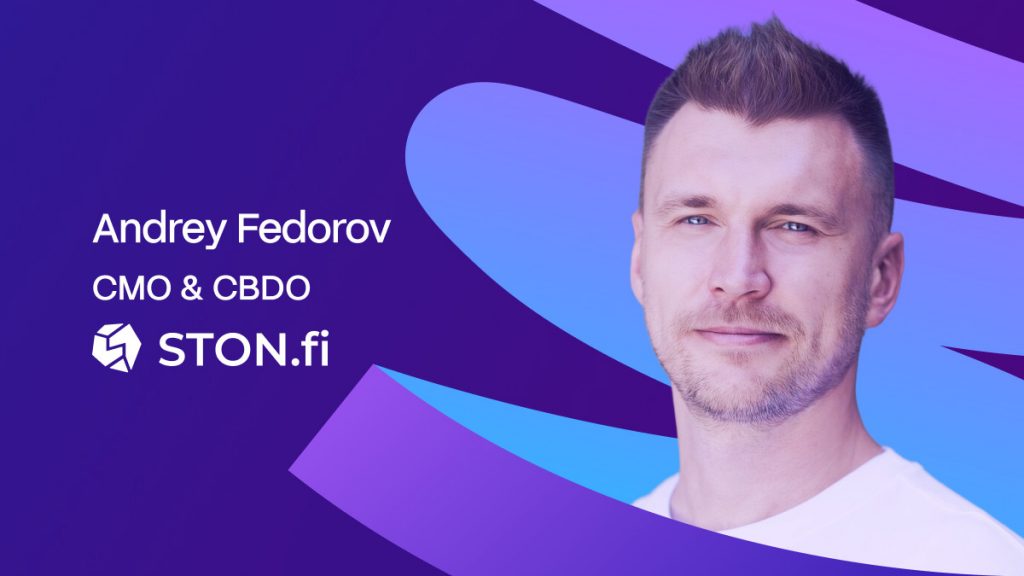
Andrey Fedorov, CMO and CBDO at STON.fi Dev, spoke with us about what that means in practice. In the conversation, he covered the architectural choices underpinning the Omniston protocol, why connecting TON and TRON was the logical first step, and what chain abstraction genuinely requires before the term becomes meaningful. Andrey Fedorov also reflected on where wallet-level fragmentation remains the real barrier for users today, and how AI agents may eventually redefine what cross-chain execution looks like altogether.
STON.fi launched cross-chain swaps this summer and is set to begin the “One Swap. Across Chains” campaign on September 15. Why is this cross-chain layer important for the TON ecosystem and its users? Why was now the right time to move beyond a single-chain AMM?
There are two sides to this. For TON, it is mostly about removing the liquidity boundary. The TON ecosystem has its own users and its own DeFi economy, but users do not live on one blockchain. They may hold different assets on different chains: USDT on TON, USDT on TRON, USDT on Base, other tokens on Ethereum, and so on. That creates a liquidity boundary around the TON ecosystem. When it is not connected to other networks, those users cannot access other ecosystems directly from TON. They are effectively locked into one ecosystem unless they manually move assets between chains, and that is precisely what cross-chain swaps solve.
It also works in the opposite direction. There are millions of users on other chains who want access to the TON economy, and until now there was no straightforward way to get there. Moving assets from another chain to TON was not easy. Now it is much simpler. To put it plainly: cross-chain is about connecting ecosystems so that users can reach the liquidity and the economy wherever it lives.

On the question of timing: I would not say this summer was the ideal window we had been waiting for. We decided a long time ago that we needed to build a cross-chain solution. The window of opportunity for cross-chain opened roughly two to three years ago and is still open. The goal was never to launch in summer 2026 specifically. The idea was to build it as soon as possible. It is not a simple undertaking: there are genuinely difficult technical problems involved, especially when you are building something that did not previously exist in the market. We launched this summer because there is real demand and we were ready.
The upcoming campaign uses gamified onboarding with miles, Priority Passenger tickets, and limited rewards. Why did STON.fi choose this format? Why was gamification the right approach for introducing users to cross-chain swaps?
There is an interesting problem with cross-chain: technologically, it is becoming much simpler, but psychologically it still feels complicated. If you tell a user they are going to use a cross-chain solution with atomic execution, a resolver network, RFQ or HTLC settlements, and so on, you will not attract them. It sounds too complex and, frankly, off-putting.
So we decided to approach the campaign from the opposite direction, using a simple metaphor. We chose an airline metaphor: direct flights between chains. It is an intuitive model. You fly between destinations and collect miles along the way, just like on a real flight. That transforms a technically complex system into something much easier to understand. A user who is not especially technical does not need to think about atomic execution or resolvers or HTLC. They just think: I am flying from chain A to chain B and collecting miles I can spend in an in-flight shop.
On gamification specifically: beyond making the model easier to understand, we wanted to give users a reason to try cross-chain swaps. Some people are genuinely motivated by the ability to move assets between chains, and we want them to learn by doing. But gamification also lowers the barrier for many others. It makes it easier to engage, to try different routes, and to keep exploring. Altogether, it comes together as a simple, understandable, and genuinely engaging experience.
TRON was among the first chains connected alongside major EVM networks. Given the range of available chains, why was TRON prioritised so early? What does this choice reveal about the audience STON.fi is building for?
TRON was a very deliberate choice. We do not select chains based on where media attention or social media conversation is concentrated. We are interested in where real users and real liquidity are, and TRON is one of the largest stablecoin networks in existence. It holds enormous stablecoin liquidity. The same can be said of TON, which also has a large user base and significant stablecoin activity. Connecting these two networks was a logical step.
There is also a technical dimension. For EVM chains, cross-chain solutions are relatively plentiful. For TRON, there are far fewer options, and the ones that exist are technically complex, difficult for users to navigate, and unclear in terms of gas and wallet requirements. That is precisely why we saw TRON as the strongest candidate to begin with.
While the industry pursues intent-based solver networks, STON.fi uses HTLC escrows and independent resolvers. What does this model offer users? What guided this architectural choice?
These are actually more or less the same thing rather than two distinct models. We also use an intent-based solver network. When a user has an asset on one chain and wants a different asset on another chain, they are expressing an intent. Resolvers then compete to execute that intent. So yes, we use an intent-based solver network, and we also use HTLC escrows. But HTLCs are the cryptographic mechanism that makes settlement safe. They are not a separate model.
To put it simply: competition determines who executes, and cryptography determines whether settlement is safe. A user expresses an intent, resolvers compete to fulfil it, and the protocol ensures everyone is protected.
For end users, none of this needs to be visible. They have an asset here, they want an asset there, they see a quote, and it executes. That is the entire experience from their perspective.
“Chain abstraction” has become a central theme in 2026. How do you define chain abstraction in the context of your product? What does a fully abstracted experience look like for a Telegram-native user?
A fully abstracted experience, in my view, is one where users simply do not think about blockchains. Today, a typical user’s process looks something like this: I have USDT on Ethereum, I want to buy something on TON, so I need to bridge assets, I need ETH for gas, I need two wallets connected on both networks, and so on. That is not chain abstracted, because the user is reasoning in terms of chains throughout. The underlying intent was always simple: I have this asset and I want that one. But the execution is not simple, and so users are forced to think in chain terms.
A chain-abstracted experience is when users never engage with that layer at all. They have an asset, they want another asset, they get it.
I would add this: we will know that cross-chain has truly become chain abstracted when the product category itself disappears from the conversation. Right now, we talk about cross-chain swaps, about moving assets between chains, about this being a new capability. That language is itself the opposite of abstraction. True abstraction will be when no one says “cross-chain” anymore. When we simply say: you have this, you want that, here it is.
Despite progress in hiding bridges and wrapped assets, cross-chain DeFi still presents friction. What remains the largest barrier for users today? What is the next frontier STON.fi intends to remove?
The biggest problem currently is fragmentation at the wallet level. Users have to manage multiple wallets across different blockchains, with separate balances, and often with identically named assets that are technically distinct. USDT on TON, USDT on TRON, and USDT on Ethereum carry the same ticker but live on different chains. From the user’s perspective it looks like one asset. Technically, it is three different assets.
The UX has improved. Multi-chain wallets mean you no longer need a separate wallet for every chain as you once did. But friction remains, because you still have to select the right network, and balances shift depending on which one is active.
I recently opened a wallet expecting a non-zero balance and saw zero. For a moment it was alarming. Then I realised I had the wrong network selected, switched it, and the balance reappeared. I work with this daily, so I figured it out quickly. A typical user would not, and that experience is disorienting. That is the main obstacle right now, though it improves every day.
TON has surpassed 100 million wallet sign-ups, many originating from Telegram. Do you believe the next wave of crypto users will enter through social platforms rather than traditional financial apps? How does that user profile change what cross-chain execution needs to look like?
Social platforms will be one of the major distribution channels, yes. But the key difference is context. Users inside a social platform are not thinking about finance. They are not opening Telegram with the intent to swap assets between chains. They are messaging a friend or reading a channel. They may encounter an opportunity connected to DeFi, but their starting context is entirely different from someone opening a financial app with the explicit intention to do something with their money.
That distinction matters for how cross-chain execution needs to behave. In a traditional financial app, the user arrives with a financial intent. In Telegram, they do not. That gap has to be bridged entirely by the product. The complexity has to be completely invisible, because the user did not arrive prepared to engage with it.
What is the distinction between embedding financial services into a messaging platform versus a traditional financial interface? Which users stand to benefit most from this?
The core difference is context. In a financial app, users arrive with a financial intent. In Telegram, they do not, and the product has to bridge that gap entirely.
For Telegram specifically, I think the best experience is one where users can send assets as easily as they send messages. That seems to be what Telegram itself is building toward. We already have Wallet built into Telegram, which makes it straightforward to send tokens to friends. Pavel Durov has announced further wallet developments, and from what has been shared publicly it looks like sending tokens to friends may become even simpler. That is the direction I expect things to move.
Your team has been running vibe coding sessions and building AI-agent-friendly documentation. What role do you see AI playing in STON.fi’s cross-chain execution in the near future?
There are a few dimensions to this. First, we use AI internally. We run vibe coding workshops and hackathons where participants use AI tools, and it works well.
Second, our protocol is AI-friendly. If a developer wants to build an application using Omniston, they can feed our documentation to an AI agent and it will integrate the protocol. We have designed the documentation with that use case in mind.
Third, and most relevant to execution: AI-driven DeFi execution has been discussed in the industry for at least two years, but I have not yet seen a truly strong product in that space. What I do see is the infrastructure improving. We now have embedded wallets and agentic tooling, and the conditions for AI agents to actually act on users’ assets are starting to exist.
The natural next step for us is for Omniston to serve as the execution layer that an AI agent uses. The agent understands the user’s intent, or even defines it on their behalf, and then uses our protocol to execute. That is where I see this heading.
Looking three years ahead, where do you see STON.fi positioned in the market? What is the single greatest opportunity that could accelerate the project’s trajectory?
Right now, most people think of STON.fi as the largest DeFi protocol on TON, or simply as a swap application. TON is where we started and it remains important to us. But the larger opportunity, for both STON.fi and Omniston, is to become an execution layer that connects TON, TRON, and other EVM and non-EVM chains. If in a couple of years people stop thinking of STON.fi as a DeFi app on TON and start thinking of it as a multi-chain liquidity protocol or an execution layer, that is our goal.
We have two products to get there. STON.fi is the consumer product. We use it for product development, UX experimentation, distribution, and as a showcase of what our infrastructure can do. Users of STON.fi do not need to think in technical terms. They just use the app.
Omniston is the second product. It powers STON.fi and it powers other applications. Our goal for Omniston over the next two to three years is that it becomes widely recognised as an execution layer: a B2B infrastructure that developers and protocols build on. That is the trajectory we are working toward.
Disclaimer
In line with the Trust Project guidelines, please note that the information provided on this page is not intended to be and should not be interpreted as legal, tax, investment, financial, or any other form of advice. It is important to only invest what you can afford to lose and to seek independent financial advice if you have any doubts. For further information, we suggest referring to the terms and conditions as well as the help and support pages provided by the issuer or advertiser. MetaversePost is committed to accurate, unbiased reporting, but market conditions are subject to change without notice.
About The Author
Alisa, a dedicated journalist at the MPost, specializes in crypto, AI, investments, and the expansive realm of Web3. With a keen eye for emerging trends and technologies, she delivers comprehensive coverage to inform and engage readers in the ever-evolving landscape of digital finance.
More articles
Alisa, a dedicated journalist at the MPost, specializes in crypto, AI, investments, and the expansive realm of Web3. With a keen eye for emerging trends and technologies, she delivers comprehensive coverage to inform and engage readers in the ever-evolving landscape of digital finance.