Why Web3 Still Struggles To Reach Mass Adoption



In Brief
Web3 has years of promise of a future of open access, user ownership, and borderless digital finance. The infrastructure is quicker, less expensive, and more advanced than it was only two years prior. But mainstream adoption remains elusively elusive.
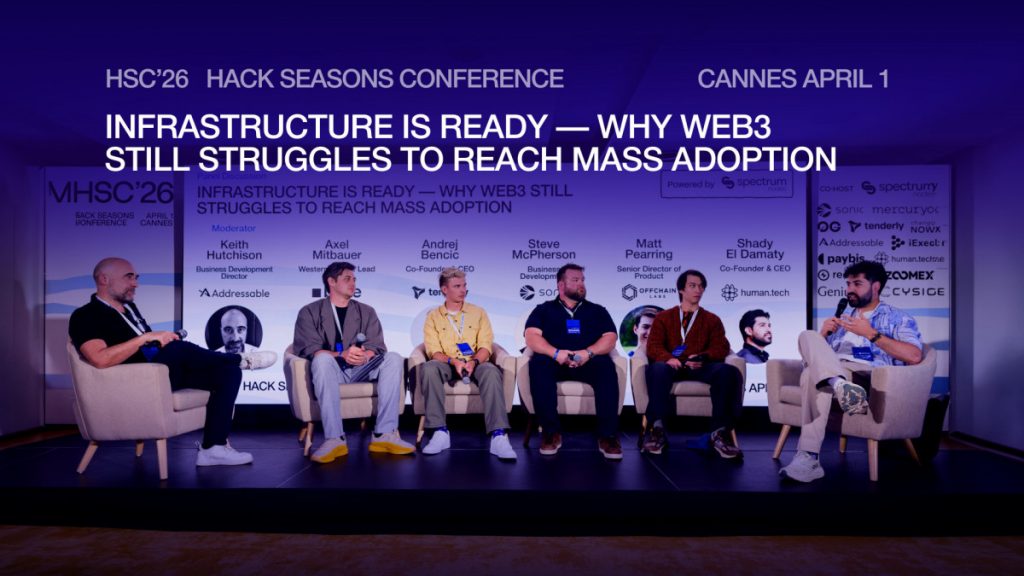
Web3 has years of promise of a future of open access, user ownership, and borderless digital finance. The infrastructure is quicker, less expensive, and more advanced than it was only two years prior. But mainstream adoption remains elusively elusive. That was the main tension of a panel at HSC Cannes, as Base, Tenderly, Sonic Labs, Offchain Labs, human.tech, and Addressable speakers attempted to answer a question that seemed deceptively easy,why is the tech here, and why are regular users not appearing at scale?
The discussion made one thing clear. Web3’s biggest bottleneck is no longer just raw blockchain performance. It is increasingly a mix of usability, distribution, fragmented infrastructure, and the industry’s tendency to build for itself before building for normal people.
The biggest gap is no longer only scale, but usability
Axel Mitbauer, who heads Base in Western Europe, maintained that the industry has already gone far in scalability. Fee is reduced, the transaction is faster, and developers are provided with more infrastructure than ever before. However, all this does not automatically result in adoption when users continue to need to learn about wallets, seed phrases, and a maze of blockchain-specific terminology to get started.
That point echoed across the panel. For crypto-native users, setting up a wallet and navigating a chain might feel normal. For the average consumer, it still feels like learning a foreign language before using an app. That is a fatal problem for any technology claiming it wants to onboard the next billion people.
The broader view from the panel was that Web3 still asks too much context from users. It expects them to understand the mechanics of the system rather than simply benefiting from it. In mainstream tech, people do not need to understand how payment routing, cloud infrastructure, or encryption works before opening an app. In Web3, that invisibility layer is still too weak.

Builders are still carrying too much complexity too
The panel also pushed back against the idea that only end users are suffering from bad infrastructure. Andrej Bencic, co-founder and CEO of Tenderly, said protocol operators and developers are also working under too much pressure. Blockchain products are no longer simple smart contract deployments run by small teams. If adoption ever truly scales, the organizations running those products will become larger, more complex, and far more exposed to operational stress.
That means better infrastructure for the builders matters too. If developers do not have the tools to launch, monitor, and secure applications reliably, then the user experience will continue to break down downstream. The panel’s message was not that the industry should choose builders over users or vice versa. It was that the system only works when both sides improve together.
Still, there was a noticeable frustration that crypto has historically overindexed on the builder side. Bencic admitted as much, saying the industry instinctively tends to build for developers because that is what it understands best. The problem is that this instinct can become a trap. Web3 keeps creating elegant systems for insiders while still struggling to solve ordinary consumer problems in a way that feels effortless.
Regulation and interoperability remain major blockers
Matt Pearring of Offchain Labs took the conversation in a slightly different direction by highlighting the role of regulation and cross-chain interoperability. In his view, there is a practical ceiling on adoption until institutions feel legally safe bringing real assets on-chain. A lot of current crypto trading remains speculative because the assets being exchanged often have no underlying utility beyond price movement. Traditional finance, by contrast, is built around assets tied to real goods, services, and economic activity.
Those assets will not move on-chain in meaningful size until the institutions controlling them believe the rules are clear enough to act. Pearring suggested the US, despite not being the whole world, still matters here because it often sets the tone for global regulatory standards. Without more clarity, the gap between crypto-native markets and real-world capital will remain hard to close.
He also claimed that there is not a universally recognized interoperability standard of assets across chains in the industry. There are too many protocols that strive to become the default bridge or cross-chain solution, and it leaves users in a disjointed and confusing landscape. As long as the market is adjusting to more credible values, the experience will be too chaotic to the common man.
Speed alone will not solve mass adoption
Steve McPherson of Sonic Labs made an important distinction between necessary progress and sufficient progress. Yes, throughput and latency still matter. No user wants to wait long for finality or deal with sluggish apps. But once infrastructure reaches a certain threshold of acceptable performance, the next problems become more important: gas abstraction, account abstraction, safer interfaces, and simpler product design.
This is where Web3’s obsession with high performance can become misleading. Increasing speeds and higher figures are nice in announcements, but not necessarily the solution to the consumer problem. Even with a mainstream user still having to consider bridges, RPC endpoints, chain selection, or irreversible errors, better throughput will not salvage the experience.
That contributed to one of the more powerful undercurrents of the panel. Web3 frequently boasts of having achieved progress at the infrastructure level and underestimates how little of that progress is directly experienced by end users.
The missing backstop may be one of the biggest adoption gaps
Perhaps the most compelling observation of the session came from Shady El Damaty, CEO and co-founder of human.tech. He argued that one of Web3’s deepest adoption barriers is not just complexity, but the lack of meaningful safety nets.
In traditional finance, users generally assume that if something goes seriously wrong, there is some kind of recourse. A bank error, a fraudulent charge, or a system failure does not usually mean total permanent loss. In Web3, that expectation rarely exists. If a protocol is hacked or a user makes a bad transaction, the money is often just gone.
For technically sophisticated early adopters, that may be an acceptable trade-off for self-custody and open access. It is a non-starter to mainstream users. With no insurance, compensation schemes, or reliable recovery systems, the emotional cost of utilizing Web3 is still too high.
That is where the essence of why mass adoption remains distant. A system needs to be working most of the time. It must be safe enough even for those who are not professionals and do not aspire to be professionals.
The industry still has not decided whether it serves builders or users
Towards the end of the panel, the subject shifted to discussing whether Web3 is optimizing for the developers or for the people using apps. It was agreed that the two are important, but the industry has taken too long to play the pretence that the two priorities will balance each other.
In practice, Web3 continues to create products that are comprehensible to insiders and then hopes that users will come to terms with them subsequently. This is why wallets are still a power-user product, why cross-chain experiences are still cumbersome, and why adoption is still concentrated among individuals who are already at risk, complexity, and speculation.
The panel’s most hopeful idea was that this may finally be changing. More teams are starting to focus on invisibility, smoother onboarding, and reducing the burden placed on users. There was also a sense that AI, abstraction, and better interfaces may make today’s wallet-heavy experience look outdated much sooner than many expect.
At HSC Cannes, the answer to the adoption question was not that the infrastructure is broken. It was that the industry is still learning that infrastructure alone is not the product. There will not be mass adoption since chains will not get faster or cheaper by themselves. It will arrive when Web3 is easy enough, secure enough, and beneficial enough that individuals can gain access to it without necessarily considering it initially.
Disclaimer
In line with the Trust Project guidelines, please note that the information provided on this page is not intended to be and should not be interpreted as legal, tax, investment, financial, or any other form of advice. It is important to only invest what you can afford to lose and to seek independent financial advice if you have any doubts. For further information, we suggest referring to the terms and conditions as well as the help and support pages provided by the issuer or advertiser. MetaversePost is committed to accurate, unbiased reporting, but market conditions are subject to change without notice.
About The Author
Alisa, a dedicated journalist at the MPost, specializes in crypto, AI, investments, and the expansive realm of Web3. With a keen eye for emerging trends and technologies, she delivers comprehensive coverage to inform and engage readers in the ever-evolving landscape of digital finance.
More articles
Alisa, a dedicated journalist at the MPost, specializes in crypto, AI, investments, and the expansive realm of Web3. With a keen eye for emerging trends and technologies, she delivers comprehensive coverage to inform and engage readers in the ever-evolving landscape of digital finance.