The U.S. Overestimates China’s Chances in the Fight for AI Technology


In Brief
The US overestimates China’s prospects in the scientific and technological race, while China has made significant progress in the field of AI.
The US must continue investing in AI research and development to maintain its competitive edge.
This puts a strain on the US and pushes many countries toward China in an attempt to reap the benefits of becoming Chinese science and technology satellites.
The U.S. may be greatly overestimating China’s prospects in the scientific and technological race. The weakness of the diffusion of innovations foreshadows China’s sad fate of technological backwardness akin to that of the USSR.

A lot in the world now depends on who – the U.S. or China – will be the greatest scientific and technological superpower number in 10 years. Depending on who will be the winner of this technological arms race, different ecosystems will become popular, different scientific schools will offer the best education. It will decide where it will be most advantageous to send young people to study, in whose AI startups to invest, and whose ML technologies to try to repeat. The list goes on and on.
The decade of China’s scientific and technological rise has convincingly shown its colossal innovative power.
- This puts a lot of strain on the U.S. and forces its experts to analyze options for the prospect of losing the status of scientific and technological superpower in the next 10 years.
- It pushes many countries toward China in an attempt to reap the benefits of becoming Chinese science and technology satellites.
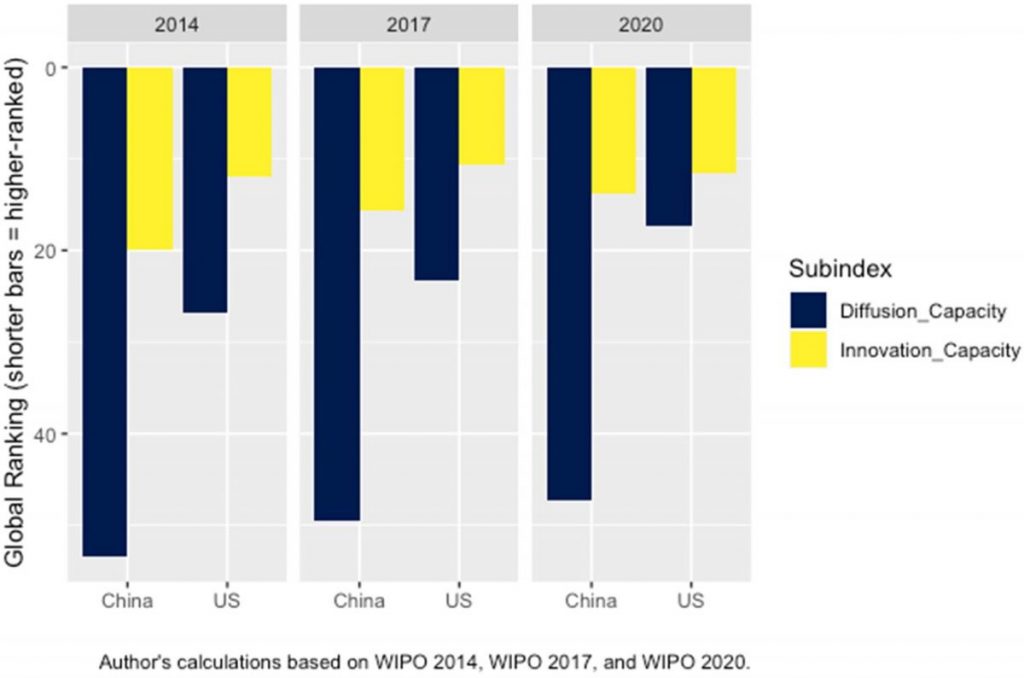
However, the recent hearings on Capitol Hill of the US-China Economic and Security Review Commission showed that everything here is not at all clear-cut. Prof. Jeffrey Ding convincingly showed the following:
- The erroneous assessment of China’s scientific and technological prospects is solely on the basis of an analysis of its “innovative power” (the country’s potential to create innovations).
- Accounting for China’s “diffuse power” (potential for effective adoption and mass diffusion) fundamentally undermines China’s prospects for becoming number one in science, AI, VR/AR, web3, and technology superpower in the next 10 years.
- A detailed analysis of China’s “diffuse power” shows not just weakness but China’s complete inferiority in this area, comparable to the inferiority of the USSR, which led the country, despite many achievements, to the final scientific and technological collapse;
- China’s “diffuse deficit” is steadily growing with the dominance of the political course to strengthen the leading role of the CPC in the implementation of key priority areas of the economy, law, science, and technology.
Prof. Jeffrey Ding, using specific examples, shows the bias in the assessments of scientific and technical potential toward the creation of new achievements. Priority in these assessments should be given to the state’s ability to disseminate and widely implement innovations. In particular, when there is a significant gap between a rising power’s innovation potential and its diffusion potential, relying solely on the former leads to a misleading assessment of its potential to sustain economic growth in the long term.

Prof. Geoffrey Ding says that assessments based solely on innovation capacity — the diffusion-driven approach — show that China is far from being a superpower in science and technology.
Read more related articles:
Disclaimer
In line with the Trust Project guidelines, please note that the information provided on this page is not intended to be and should not be interpreted as legal, tax, investment, financial, or any other form of advice. It is important to only invest what you can afford to lose and to seek independent financial advice if you have any doubts. For further information, we suggest referring to the terms and conditions as well as the help and support pages provided by the issuer or advertiser. MetaversePost is committed to accurate, unbiased reporting, but market conditions are subject to change without notice.
About The Author
Damir is the team leader, product manager, and editor at Metaverse Post, covering topics such as AI/ML, AGI, LLMs, Metaverse, and Web3-related fields. His articles attract a massive audience of over a million users every month. He appears to be an expert with 10 years of experience in SEO and digital marketing. Damir has been mentioned in Mashable, Wired, Cointelegraph, The New Yorker, Inside.com, Entrepreneur, BeInCrypto, and other publications. He travels between the UAE, Turkey, Russia, and the CIS as a digital nomad. Damir earned a bachelor's degree in physics, which he believes has given him the critical thinking skills needed to be successful in the ever-changing landscape of the internet.
More articles
Damir is the team leader, product manager, and editor at Metaverse Post, covering topics such as AI/ML, AGI, LLMs, Metaverse, and Web3-related fields. His articles attract a massive audience of over a million users every month. He appears to be an expert with 10 years of experience in SEO and digital marketing. Damir has been mentioned in Mashable, Wired, Cointelegraph, The New Yorker, Inside.com, Entrepreneur, BeInCrypto, and other publications. He travels between the UAE, Turkey, Russia, and the CIS as a digital nomad. Damir earned a bachelor's degree in physics, which he believes has given him the critical thinking skills needed to be successful in the ever-changing landscape of the internet.