


From Gray Zone To Wall Street: Spartan Group’s Co-Founder On How Crypto’s M&A Boom Is Reshaping The Global Finance Landscape



In Brief
Crypto M&A is transforming the industry—record-breaking deals, cross-border acquisitions, and token-based transactions are reshaping the market. In this interview, Casper Johansen of The Spartan Group reveals how founders can navigate sales, avoid common mistakes, and thrive in the Web3 deal landscape.
Crypto moves fast — but one part of the industry rarely makes headlines: the M&A deals quietly reshaping it. While token launches and price cycles dominate the conversation, a parallel story of consolidation, cross-border acquisitions, and institutional dealmaking has been accelerating in the background. According to PitchBook data, crypto M&A reached a record $8.6 billion across 267 deals in 2025 — nearly quadruple the value recorded the year prior. The message is clear: crypto is no longer just building — it’s consolidating.
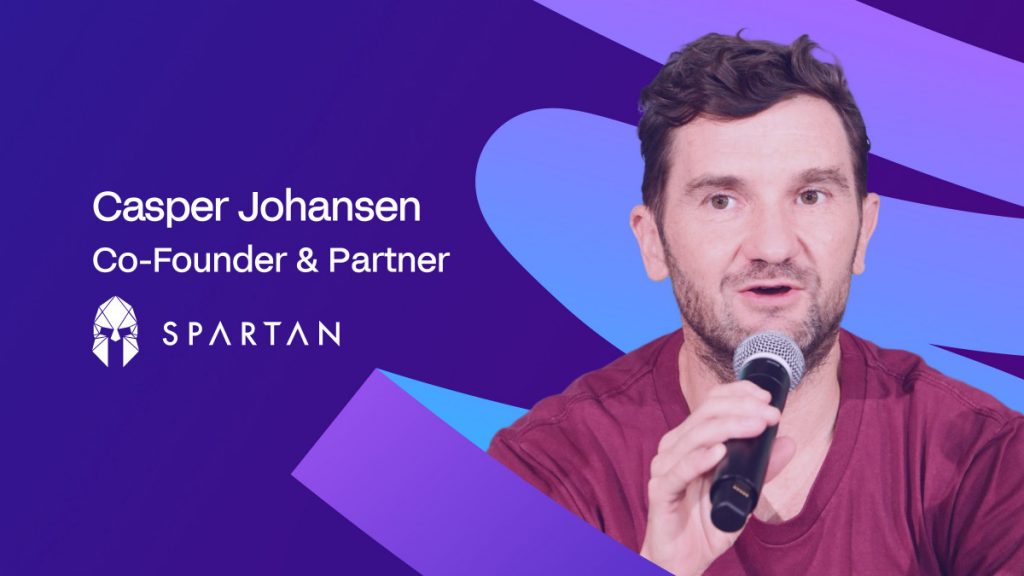
Few people are better positioned to explain what that actually looks like on the ground than Casper Johansen, Co-Founder and Partner at The Spartan Group, one of the most established crypto-native advisory firms globally. With close to a decade advising on M&A, token launches, and OTC transactions across the Americas, Europe, and Asia Pacific, Casper has a front-row seat to how deals get done in this industry — and why so many don’t.
In this interview, he discusses how crypto M&A differs from traditional dealmaking, why the exchange and brokerage sector is driving the most consolidation right now, how founders should approach selling their companies, and why the lines between crypto, fintech, and traditional finance are becoming increasingly hard to draw.
M&A and consolidation in crypto is not something that gets talked about very often — can you explain what it actually looks like in practice, and how Spartan approaches it?
Over the last 18 to 24 months or so, we’ve seen an increasing amount of M&A activity in crypto. One of the catalysts that started it was the IPO market in the US opening up, which basically meant that companies that had IPO’d, or wanted to IPO, needed to demonstrate growth — inorganic growth — which allows them to grow quicker. It’s much quicker to buy something than to build it.

At the same time, one of the things that had been holding crypto M&A back was that a lot of times the deals are a mix of cash and equity that the seller gets paid in. For a long time, sellers were hesitant to take the equity because they didn’t know when they would be able to exit and sell that equity. But now, with the IPO market opening up and the public markets being more accessible, people are more comfortable taking shares as well.
So yes, there is a lot of M&A going on. It’s a very active market, and some of it is consolidation — by consolidation, I mean similar industry or sector players acquiring each other. But there’s also what I would describe as more expansion, where one type of company buys into a different product, geography, or vertical that they’re not currently in, through M&A.
How does a Web3 M&A deal differ from a traditional M&A deal?
There are some billion-dollar deals in crypto, but in general they’re in the tens of millions, sometimes hundreds of millions. So on average, they’re smaller than traditional markets because it’s an earlier-stage sector.
Another difference is that the crypto companies being sold have often been around — right now, typically — anywhere from six to ten years, which compared to traditional sectors is a relatively short timeline. They tend to exit a bit earlier. The founders tend to be, in many cases, first-time founders, and they tend to be younger. There is sometimes added complexity in that a target company might have its own token, or be planning to launch one, so that needs to be taken into consideration.
These deals are also often very international or cross-border, whereas in traditional markets you more commonly see consolidation and M&A within a country or region. In crypto, it’s almost always international — the companies and their teams are located all over the world.
Is your deal flow truly global, or does Spartan’s strong Asia presence mean the pipeline skews toward the region?
We get a lot of our deals through referrals, and some come from companies and founders we actively seek out. But as you said, it really is a global sector. In any given year there might be a skew, but in general our business would be roughly a third in the Americas, a third in Europe, and a third in Asia Pacific in terms of the clients we work with. That means we’re very used to working across as many as 15 or 16 hours of time zones, coordinating calls, transactions, and meetings.
The crypto sector in general is very international right from the start, so many people are already accustomed to that, which does make it easier to operate as a global business. Obviously, doing international M&A means dealing with many different business cultures — the US has a certain culture, the UK has one, Western Europe has one, Eastern Europe has one, the Middle East has another, Russia has one, South Asia, East Asia, Australia, Japan — they’re all very different in terms of how people communicate, how you should communicate with them, and how people approach transactions.
Our team has a lot of international business experience and has been doing cross-border M&A for over 25 years. I think that’s an incredibly important aspect, because otherwise deals can fail very easily due to miscommunications between the different sides.
Is there a type of deal structure that works particularly well in crypto and Web3 that you wouldn’t typically see in traditional M&A?
It’s actually quite similar to traditional M&A in many respects. There are usually three main deal types: an all-cash deal, an all-equity deal, and a mix of cash and equity. We see all three in crypto, just as in traditional M&A. The one difference is that, as mentioned, some companies have tokens, and we have done deals where the consideration has been a mix of cash, equity, and tokens — which is obviously unique to Web3.
Token launches are often debated — strategic tool or mainly a fundraising exercise? Where do you see the balance?
When we work in the token space — and in addition to M&A, part of what we do is help launch tokens, assist with investor relations around token projects, and execute OTC transactions for tokens — we’ve been working in this space for close to nine years now. One thing that has been important, really from the start since Ethereum enabled the big growth in token issuance, and later other protocols followed, is that you really have to look case by case at the project or company to see whether a token makes sense.
In some cases it’s clearly required — to secure a layer one, for example, there’s really no debate. Of course there needs to be a token. Then there are other infrastructure layers where it may make sense, and then for things at what you might call the app layer, it’s not always obvious that a token is required — but it’s also not always obvious that one isn’t. It’s very much case by case in terms of how you want value creation to flow and how you want to acquire and retain users.
I do think that in certain periods, especially in bull markets, people have a knee-jerk reaction: “let’s launch a token, it’s an easy way to raise money with no equity dilution.” People have gotten more experienced and thoughtful about it now — they think much harder before launching a token to assess whether it makes sense.
The way tokens are launched has also changed a lot: do you do it more like a traditional equity raise, where you raise from venture capitalists and then gradually “go public” by listing the token, or do you go straight to what’s effectively an IPO, launching immediately on an exchange and raising there, with private rounds potentially following? There are a lot more — and more sophisticated — structures available now.
So it’s important for any company debating this to take in all these different factors. It’s genuinely complex, and it’s an extra layer of complexity on top of just building a product that founding teams have to work through.
How would you describe the competitive dynamics in crypto globally right now — who is winning and who is struggling?
It really depends a lot on the sub-sector. In some sectors, for example exchanges and trading, liquidity begets liquidity, and it can be very hard for new players to come in and challenge Bybit, OKX, Binance, and some of the bigger Western exchanges like Coinbase. Scale does matter. But you still see opportunities if you take a different approach — what Hyperliquid did, for example. It’s by no means a fully captured market.
In the more centralized businesses, I’d say there’s definitely a direction towards more B2B, more institutional, and more regulated operations. A lot of businesses that have existed for a while and operated in a gray zone — largely a product of lack of regulation — are now looking either to get regulated themselves or to acquire platforms that already are. So you see a move towards institutional and regulated.
At the same time, I still think there is space for winning market share and launching new products on the decentralized side. There are different dynamics at play: big versus small, centralized versus decentralized, and also East versus West — historically different approaches, for example between Western exchanges like Coinbase, Kraken, Bullish, Gemini and Eastern ones like Binance, Bybit, OKX.
But to sum up: the direction is toward consolidation and scale, toward institutional and regulated businesses, and also toward the West — primarily the US market — because now that the US is more crypto-friendly and regulation is coming in, it is just such a massive capital market that exchanges which have historically operated outside the US really want a piece of it.
Are you seeing more companies looking to acquire, or more looking to sell?
It’s both right now, and that’s why M&A is so active — it’s a good two-sided market. There are quite a number of companies looking to sell: maybe they were founded six to ten years ago, the founders have been at it for a long time, they feel they’ve done what they can with the company, and they may have venture capital investors who are looking for an exit.
On the flip side, there are acquirers who — whether they’re looking to publicly list or are already listed — need to demonstrate inorganic growth and have business goals they want to achieve faster than organic growth allows. So there’s a healthy supply and demand dynamic. Whereas a few years ago — in 2022, 2023, and even parts of 2024 — there was a decent amount of supply, with people wanting to sell, but not many buyers. It was much less of a two-sided market.
How do you find the right acquirer when the buyer pool is small?
That’s a good question, and it’s where I think doing M&A in this sector requires a specific combination of skills. You need strong M&A skills — it takes a long time to build that skill set, I would say 10 to 20 years of doing M&A to have a really strong command of the craft. Then you need two other things: a deep understanding of the sector, and a strong network within it.
So when a founder approaches us and says “I want to sell my company,” based on our almost a decade in the sector, we have a good sense of who would buy it and why, and how it would fit strategically.
M&A is very bespoke — it’s not like a fundraising process where you can approach 50 to 100 names and drive a sales funnel. You have to be very targeted. You need to understand who this would make sense for, and more importantly, who it would make the mostsense for — in other words, who would value this business highest and give the best offer.
And then you obviously need to have contacts at those companies, both at the working level and at the senior level, and you need to have their trust — they need to know you’re a professional, that when you run a process you’re not wasting their time, and that if they need to spend internal political capital to push something through, they’re doing so with confidence that there’s a professional process behind it.
What does a Web3/crypto company need to have in place before it becomes an attractive acquisition target?
I think there are two aspects. One is the business itself — to be an attractive acquisition target, you need something unique, something that people don’t feel they already have or could build quickly. Something of real value: it could be a geographic market you’ve cornered, a certain product, or something that others are doing too but that you do particularly well. And a strong management team that the acquirer would want to bring into their organization.
Then there’s the more practical side. As you mature as a company, you should make sure you have proper accounting, your books in order, your documents in order, a strong and stable team, employee retention, and if your business requires regulation, compliance, or KYC, that you’re compliant. All of these practical aspects matter because if you have an amazing company and product, deals can still fall apart in due diligence if these other things aren’t properly in order.
At what point should a crypto project stop thinking like a group of developers and start operating as a real company?
Over the years, I have seen an increasing level of professionalism. Founders have become more aware that it’s important, right from the start, to set things up properly — both in terms of legal entity structure and figuring out the split of shares and economics between the team. So in general, people have gotten better at that.
Taking your example of a group of developers building something: I think the minute you feel it is more real, that is when you should set up a company, agree between yourselves — if there’s a group of you — who owns what, who gets what economics, and what commitments everyone is making. Then you form a company around that and from then on you try to do everything professionally.
And once you start bringing in outside investors — whether angels, seed capital, Series A, venture capital, and so on — at some point those investors will also typically require more structure and push you to be more professional.
The good news is there are a lot of tools to help with that now, in terms of software, publicly available information, and increasingly AI tools. A company can really be sold at any stage, but normally if you’re really onto something, you want to wait a bit, create more value, and sell for more. It’s always a difficult balance for a founder to assess: should I sell now for X, or keep going for three years and try to sell for five to ten times as much? That’s always a real challenge.
Which Web3 subsectors do you think will see the most consolidation now and in the near future, and why?
One of the most active areas we’re seeing is the exchange and brokerage space. More and more countries are rolling out, or already have, domestic crypto regulation, and if they already have it, they’re being stricter about enforcing it. So a lot of exchanges are trying to go onshore.
If you’re operating in a Southeast Asian country, Australia, the Middle East, or a European country, you no longer want to just operate without a license from, so to speak, the cloud. You want to go onshore, acquire a local license, build a local team, and operate in a compliant way — that’s a more sustainable business model, especially as institutions are coming in and we’re seeing more trade finance flows, stablecoins, and general stablecoin transaction volume.
That’s one big trend: going onshore in a regulated fashion. Another trend, again driven largely by exchanges, is exchanges adding on additional product capability — buying a custodian, buying a staking company, maybe even buying a media arm. Non-exchange M&A certainly exists too, but the exchanges are still driving a large portion of what we’re seeing.
Can you point to any M&A deals or consolidations in Web3 recently that you found particularly well-executed or important? What made them work?
I’d highlight a few we’ve worked on. Late last year we advised Fordefi on its sale to Paxos. Paxos is known primarily as a stablecoin company, and Fordefi is similar to Fireblocks — it’s a custody technology and infrastructure business. It made a lot of strategic sense for Paxos to bring this in-house as part of its ecosystem; there was a good cultural match between the companies and clear synergies from combining the two.
We also did a deal last year where we helped an Australian exchange called Swyftx acquire another player that had a presence in Australia and the US, as well as the leading player in New Zealand.
The hallmarks of a successful M&A deal are a natural business synergy between the two companies, and often also the fact that the target’s management team can genuinely add value within the acquiring organization.
There are cases where the target management team simply walks away — those tend to be consolidation plays where there’s a lot of overlap and you don’t need everyone to stay. But many of the best acquisitions are ones where you need people to stay, either because they know the market well or because they bring an entirely new product set to the acquirer.
When founders come to you in an M&A process, what’s the most frequent mistake they make?
I would say not listening to our advice — unfortunately that does happen. I think for any founder selling their company, it is critical to have an M&A financial advisor by your side, as well as a good law firm.
They serve very different functions and both add value. It’s possible for a founder to do a fundraise themselves — sometimes they use an advisor, sometimes they don’t. But for M&A, I think it’s critical.
I tell all founders: I really want to work with you, but even if you don’t want to work with me or you’d prefer someone else, please use an advisor.
For most founders, successfully building and selling one company in their lifetime is a major achievement — in fact, most founders don’t succeed at all; that’s just the reality.
To even have one company that you can exit is a testament to hard work, perseverance, and luck. So we take it very seriously when founders come to us to sell their company, because we know this can be a life-changing moment for many of them.
It’s incredibly important to get it right, and that’s why we don’t rush it. We always have a conversation with founders about why they’re looking to sell, why they think now is the right time, and what the alternatives are.
We give our own opinion too. In some cases that means going to market right now and moving quickly. In others it means waiting — and we’ll maintain the relationship for a few years until the timing is right.
But to answer your question directly: the mistake many founders make — and I know this can sound self-serving — is not surrounding themselves with the right advisors at the moment they’re considering a sale.
How do you value a Web3 company?
Normally we start by having conversations with the founder to understand the business at a high level. Then we’d typically sign an NDA and give them a short list of information we’d like to review, which helps us form a view on whether the company is sellable, who would be interested in buying it, whether the timing is right, and what we think it would be worth in the market.
A lot of the founders we work with are understandably not experienced in M&A — that’s not their area. They’re very talented at building technology, products, relationships, and go-to-market. So we take a lot off their plate and walk them through the different stages and the information we need, sharing our views along the way.
In general, I’d encourage any founder who is building a company with a potential sale in mind to stay organized — keep your information relatively in order — because if an opportunity arises, whether someone approaches you to buy your company or you simply feel the timing is right, it gives you much more flexibility to move quickly when you need to.
Looking at the next two to three years, where do you see crypto M&A activity heading?
I think it will continue to be very active. Assuming the US continues to be constructive on crypto from a regulatory perspective — regardless of whether it’s Republicans or Democrats in power — the US will be a big driver of global markets, just as it is in traditional finance.
With a positive regulatory outlook in the US, M&A will continue. And for many crypto companies globally that want to exit via IPO, the US market remains the most attractive venue. US public markets are very accustomed to seeing listed companies pursue M&A and inorganic growth, and I think it’s largely encouraged. So I expect a healthy M&A market going forward.
Similar to what we’ve been seeing in recent years — an increasing convergence between traditional finance, fintech, and Web3 — I think we’ll continue to see Web3 companies acquiring traditional finance companies and infrastructure, and vice versa: traditional finance, fintech, and neobank companies coming in and acquiring crypto infrastructure and crypto companies.
The two sectors will continue converging to the point where it becomes harder to answer the question: is this a Web2 traditional finance wallet or a Web3 wallet? Is this a crypto brokerage or a payments company? I think we’ll see that larger convergence continue.
Disclaimer
In line with the Trust Project guidelines, please note that the information provided on this page is not intended to be and should not be interpreted as legal, tax, investment, financial, or any other form of advice. It is important to only invest what you can afford to lose and to seek independent financial advice if you have any doubts. For further information, we suggest referring to the terms and conditions as well as the help and support pages provided by the issuer or advertiser. MetaversePost is committed to accurate, unbiased reporting, but market conditions are subject to change without notice.
About The Author
Alisa, a dedicated journalist at the MPost, specializes in cryptocurrency, zero-knowledge proofs, investments, and the expansive realm of Web3. With a keen eye for emerging trends and technologies, she delivers comprehensive coverage to inform and engage readers in the ever-evolving landscape of digital finance.
More articles
Alisa, a dedicated journalist at the MPost, specializes in cryptocurrency, zero-knowledge proofs, investments, and the expansive realm of Web3. With a keen eye for emerging trends and technologies, she delivers comprehensive coverage to inform and engage readers in the ever-evolving landscape of digital finance.