Revenue Over Narrative: HSC Seoul Panel Maps Where Crypto Capital Flows Next



In Brief
HSC Seoul panel: investors from C² Ventures, Portal Ventures and Canary Capital on where crypto capital is moving and what they now require.
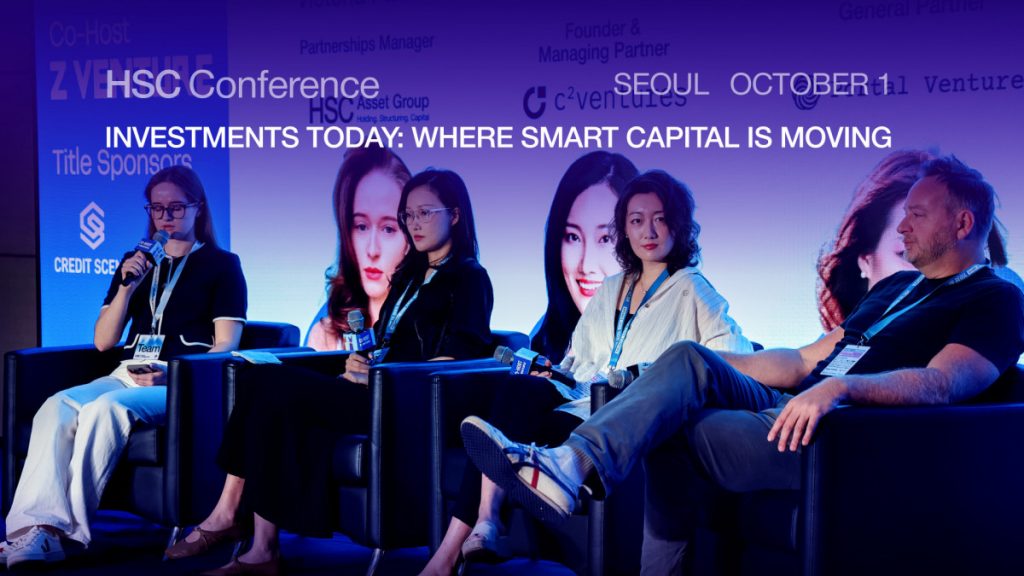
On October 1, the HSC Conference returned to Seoul, bringing together investors, fund managers, and allocators to assess how capital is moving through digital assets in the current market cycle.
Among the sessions was “Investments Today: Where Smart Capital Is Moving”, moderated by Victoria Palchik of HSC Asset Group. The panel featured Ciara Sun of C² Ventures, Catrina Wang of Portal Ventures, and Steven McClurg of Canary Capital, who discussed how leading funds are positioning across the asset class, from early-stage bets to high-conviction plays.
Capital Stays Selective as Liquidity Returns
The panel opened with where capital is actually being deployed. Sun said liquidity has returned compared with last year, but venture investors remain conservative. Larger projects with higher valuations still attract backing, while early-stage teams without a launched product or measurable traction struggle to raise. She added that Bitcoin continues to absorb most trading liquidity.
Wang said the recent rally surprised her, but that as a first-check investor her approach has not changed. McClurg supplied the macro backdrop. High inflation and rising bond yields, he argued, push investors toward crypto, and he expects the next four-year cycle to be led by protocols with strong tokenization projects.
A Contrarian View on AI
The same macro lens shaped McClurg’s answer when the moderator asked why he is not keen on AI as an investment thesis. He said US data center buildout may outpace the compute the world needs, with chips being stockpiled before they can be used. He compared this to Bitcoin mining cycles, where overspending in good times forces selling when prices fall.

Wang and McClurg agreed that AI is ultimately deflationary, with Wang calling it a process innovation rather than a product innovation. The exchange set up the theme that followed: where enthusiasm runs ahead of revenue, these investors are cautious.
What Investors Now Underwrite
The panel agreed that fundamentals matter more than narrative. McClurg said last year’s collapse of digital asset treasury companies showed that adding crypto to a weak company’s balance sheet does not make it viable. For protocols, he said, “what you can’t fake is onchain revenue.”
Sun focused on real user demand, pointing to tokenized equities, FX trading, and distributed computing. She warned that tokens and equity can capture very different value from the same business, so investors must look at how revenue is distributed.
At the earliest stage, Wang said, she underwrites founder and sector, and cited early bets on real-world assets before the category was established. Her emphasis on founders has grown over time. After a portfolio company pivoted entirely outside crypto, she realized she would still back the team, and she now weighs the founder far more heavily than before.
Institutional Versus Merely Interesting
If revenue is the filter, the harder question is what makes a project institutionally investable. Sun said the test is whether users and revenue return after incentives end and the hype fades. Wang drew the line at time horizon. A quick multiple over a few months is a trade, she said, and “more long-term orientation” separates institutional investors from the merely interested.
McClurg said he was not the best person to answer and returned to the macro theme instead. Rising interest rates, he argued, will force investors to be far more selective, because not every company can handle higher borrowing costs. He also named privacy chains as a sector he expects to matter in the next cycle.
Quiet Trends and the Road Ahead
Asked about trends attracting capital without media attention, Wang pointed to foreign exchange and tokenized deposits as banks bring dollars on-chain. Sun named risk management and security, particularly after recent hacks.
Looking ahead, the panel concluded that money will follow revenue-generating businesses and projects whose users stay after the hype. Wang said she looks for old industries without modern technology rails, citing philanthropy and donor-advised funds, and advised founders: “Don’t chase hype.” McClurg ended on a lighter note, saying he would back an HVAC or plumbing company “all day” because AI cannot easily disrupt those businesses.
Disclaimer
In line with the Trust Project guidelines, please note that the information provided on this page is not intended to be and should not be interpreted as legal, tax, investment, financial, or any other form of advice. It is important to only invest what you can afford to lose and to seek independent financial advice if you have any doubts. For further information, we suggest referring to the terms and conditions as well as the help and support pages provided by the issuer or advertiser. MetaversePost is committed to accurate, unbiased reporting, but market conditions are subject to change without notice.
About The Author
Alisa, a dedicated journalist at the MPost, specializes in crypto, AI, investments, and the expansive realm of Web3. With a keen eye for emerging trends and technologies, she delivers comprehensive coverage to inform and engage readers in the ever-evolving landscape of digital finance.
More articles
Alisa, a dedicated journalist at the MPost, specializes in crypto, AI, investments, and the expansive realm of Web3. With a keen eye for emerging trends and technologies, she delivers comprehensive coverage to inform and engage readers in the ever-evolving landscape of digital finance.