How Stablecoins and AI Could Transform Global Payments by 2030



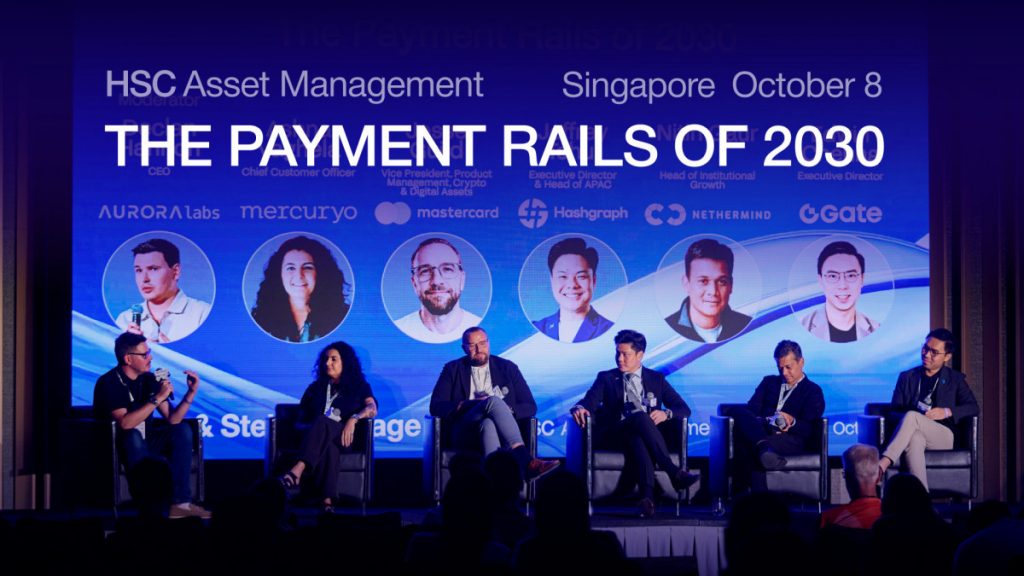
The future of global payments will depend less on creating entirely new financial infrastructure and more on making existing systems work together seamlessly. That was a central theme of “The Payment Rails of 2030,” a panel discussion held at HSC Asset Management in Singapore on October 8, 2026, where industry leaders explored how stablecoins, blockchain infrastructure, regulatory frameworks, and artificial intelligence could reshape the movement of money over the next four years.
Moderated by Declan Hannon of Aurora Labs, the discussion brought together Ashna Vaghela of Mercuryo, Jesse Guild of Mastercard, Jeffrey Tchui of Hashgraph, Nitin Gaur of Nethermind, and Edwin Cheung of Gate.
So, what will payments look like in 2030 when stablecoins move money around the clock, blockchain networks connect across borders, and AI agents begin making transactions on our behalf? Discover the technologies and challenges that could redefine how the world pays.

Simplifying Payments Starts with Identity and User Experience
One of the first issues raised was the repeated need for identity verification. Know‑your‑customer (KYC) procedures remain unnecessarily repetitive across wallets, banking services, and other platforms.
By 2030, it is envisioned that users should be able to verify their identities once and reuse those credentials across multiple services. The current state of KYC has been compared to fax machines: a process that could eventually become an outdated feature of financial services.
The challenge extends beyond identity verification. There is also a fragmented experience of managing fiat currencies, stablecoins, and cryptocurrencies across separate applications. Users may need to switch between a bank account, an exchange, and a crypto wallet simply to understand their financial position or determine how to make a payment.
Efforts are underway to create a more unified experience that brings multicurrency fiat payment accounts and stablecoins together. The longer‑term ambition is to connect traditional payment networks with blockchain‑based systems, allowing users to move money through different channels without having to understand the infrastructure operating behind each transaction.
A practical example from Southeast Asia illustrates the difficulties of settling a dinner bill among people using different payment applications, bank accounts, and digital assets. Even when everyone is willing to pay, completing the transaction often involves multiple applications, identity checks, and security procedures.
The speakers agreed that these obstacles are not necessarily technological limitations. In many cases, they reflect the fragmentation of systems that have developed independently.
Stablecoins Could Extend Payments Beyond Banking Hours
The availability of payment infrastructure around the clock emerged as another important theme. Traditional banking systems often operate according to business hours, settlement schedules, and regional constraints. Blockchain networks, by contrast, can process transactions continuously.
Mastercard envisions a “network of networks” that connects fiat payment infrastructure with blockchain rails. As part of this vision, the company’s cross‑border payment platform, Mastercard Move, integrates stablecoin‑based payment capabilities to expand how money moves globally.
The ability to settle transactions in stablecoins could offer practical benefits for financial institutions. Because blockchain networks operate continuously, issuers and acquirers could settle certain obligations outside conventional banking hours, potentially improving working capital management and reducing delays.
However, the panel emphasized that faster settlement alone will not guarantee widespread adoption. Businesses also need clear compliance processes, predictable conversion costs, reliable transaction speeds, and support when something goes wrong.
These requirements are essential to bringing stablecoin payments into mainstream business operations. Companies need confidence that their transactions meet regulatory requirements, that conversion costs make economic sense, and that someone can resolve problems when they arise.
Adoption will depend on the reliability of the entire payment experience rather than the speed of the underlying technology alone.
The US Dollar Is Likely to Remain Dominant in Stablecoin Payments
Despite growing interest in alternative currencies and blockchain‑based settlement, experts did not expect a rapid shift away from US dollar‑denominated stablecoins by 2030. Regulatory restrictions and differences between national financial systems are likely to continue limiting the expansion of non‑US dollar stablecoin activity. Local currencies and regional payment arrangements could gain traction in specific use cases, but a substantial change in the dominant settlement currency would probably require significant regulatory developments.
Potential opportunities exist in trade finance, commodities, and the movement of tokenized real‑world assets. Shipping offers a relevant example: cargo can represent substantial value, while delays in settling invoices can prevent goods from moving onward. Blockchain‑based settlement could help address these bottlenecks by enabling money to move more continuously alongside commercial transactions.
Regional adoption patterns may differ. Stablecoin activity in markets such as Hong Kong and Singapore does not necessarily translate into widespread everyday use among the general population. Southeast Asian markets, including Thailand and the Philippines, show growth in payment‑related stablecoin activity.
This highlights an important distinction: high transaction volumes do not automatically indicate mass adoption. Regulatory clarity, local payment habits, and practical everyday applications will all influence whether stablecoins become a routine part of consumer and business finance.
Blockchain Infrastructure Is Moving Toward Interoperability
The discussion also examined whether the proliferation of blockchain networks would eventually give way to a more unified financial infrastructure.
It is not necessary for every blockchain to serve the same purpose. Some networks may specialize in transaction processing, while others provide settlement infrastructure. Liquidity and stablecoin activity are already concentrated across a limited number of major networks, alongside Layer 2 systems and emerging institutional blockchains.
Rather than expecting a single blockchain to dominate every use case, the likely outcome is an ecosystem in which several networks coexist and perform different functions.
The more significant challenge is integrating blockchain‑based settlement with the existing financial system. Traditional finance separates payment transmission mechanisms from the banking infrastructure that records and accounts for money movements. Stablecoins and blockchain systems combine some of these functions, creating new opportunities but also introducing technical and operational challenges.
Interoperability must therefore extend beyond connecting blockchains to one another. It must also connect digital asset infrastructure with banks, payment networks, and established financial processes.
For users, the goal is straightforward: payments should work without requiring them to understand which blockchain, wallet, or settlement mechanism is involved. Achieving that outcome will require coordination across networks, liquidity pools, and service providers.
AI Agents Introduce New Questions About Payments and Accountability
As the conversation turned to artificial intelligence, the panel explored how autonomous agents could change the way people and businesses initiate transactions.
AI agents may eventually be able to discover products, compare prices, purchase services, and execute payments on behalf of users. Blockchain infrastructure and stablecoins could support these activities by enabling automated, programmable transactions.
However, autonomous payments introduce a new set of questions around authorization, identity, fraud, and liability. A distinction can be drawn between agentic commerce, agentic payments, and agentic finance. While AI‑driven commerce and payments are already emerging, more complex financial activities involving equities and capital markets face additional challenges. Existing commercial platforms were not necessarily designed for autonomous software agents, and responsibility must be clearly established when an agent makes an incorrect or unauthorized decision.
One initiative aimed at addressing these issues is Agent Pay for Machines (AP4M). One of its components, verifiable intent, is designed to help establish what a user instructed an agent to do and whether the resulting transaction matched that instruction. For example, a user could authorize an agent to make purchases below a specified amount automatically while requiring additional approval for larger transactions. Cryptographically verifiable, onchain receipts could also provide evidence of the original instruction and the resulting action. Such safeguards could help establish accountability as automated payments become more common. Nevertheless, consumers may continue to prefer traditional payment methods for higher‑value or more personal purchases, such as flights and hotel bookings, where established protections and chargeback mechanisms remain important.
Some platforms have already introduced agent wallets and agent trading capabilities, although broader adoption will depend on improvements in infrastructure and product functionality.
Regulation, Privacy and Cybersecurity Remain Critical Challenges
In the panel’s closing discussion, several obstacles that could slow progress toward the payment systems envisioned for 2030 were identified.
Regulatory fragmentation across regions, where different jurisdictions maintain different approaches to payments and digital assets, poses a significant hurdle. Although regulatory frameworks are evolving, their development may not keep pace with technological change.
Privacy is another critical consideration, particularly as companies seek to make identity verification more reusable and payment systems more interconnected.
Cybersecurity is equally important: the increasing automation of financial transactions raises questions about how to monitor activity, prevent attacks, and respond when something goes wrong. Faster settlement can bring efficiency, but it also increases the importance of effective controls and incident response mechanisms.
AI agents operating without adequate safeguards could create serious compliance risks, particularly if they interact with sanctioned entities or conduct prohibited transactions. Without appropriate controls, such incidents could undermine trust and invite regulatory intervention.
Interoperability must improve the overall user experience rather than simply make individual transactions faster. Gasless and bridgeless interactions across blockchains and liquidity pools could help remove friction, but technical connectivity alone will not solve every problem.
From Payment Infrastructure to a Seamless Financial Experience
The panel’s discussion pointed toward a future in which traditional payment networks, stablecoins, blockchain infrastructure, and AI‑powered applications increasingly operate together.
The transition will not be defined by a single technology replacing the existing financial system. Instead, progress will depend on integrating different systems, simplifying identity verification, improving cross‑border settlement, and establishing clear rules for automated transactions.
By 2030, users may expect to move between fiat currencies and digital assets without switching applications or navigating different networks. Businesses may be able to settle payments outside banking hours, while AI agents could handle routine transactions within clearly defined authorization limits.
Achieving that vision will require more than technological innovation. Regulatory coordination, privacy protections, cybersecurity, and reliable customer support will remain essential to building trust.
The central message from the panel was that the future of payments is not simply about moving money faster. It is about making money movement more accessible, interoperable, and intuitive across the increasingly connected global financial system.
Disclaimer
In line with the Trust Project guidelines, please note that the information provided on this page is not intended to be and should not be interpreted as legal, tax, investment, financial, or any other form of advice. It is important to only invest what you can afford to lose and to seek independent financial advice if you have any doubts. For further information, we suggest referring to the terms and conditions as well as the help and support pages provided by the issuer or advertiser. MetaversePost is committed to accurate, unbiased reporting, but market conditions are subject to change without notice.
About The Author
Ana O. is an editor at MPost, where she focuses on reshaping content across a wide spectrum of topics. With an eye for detail and a genuine interest in storytelling, she helps ensure that the content is both accurate and engaging. Her experience spans multiple areas, providing her with the knowledge to offer insightful contributions to various topics highlighted on the platform.
More articles
Ana O. is an editor at MPost, where she focuses on reshaping content across a wide spectrum of topics. With an eye for detail and a genuine interest in storytelling, she helps ensure that the content is both accurate and engaging. Her experience spans multiple areas, providing her with the knowledge to offer insightful contributions to various topics highlighted on the platform.