The Agentic Economy: When AI Starts Moving Money



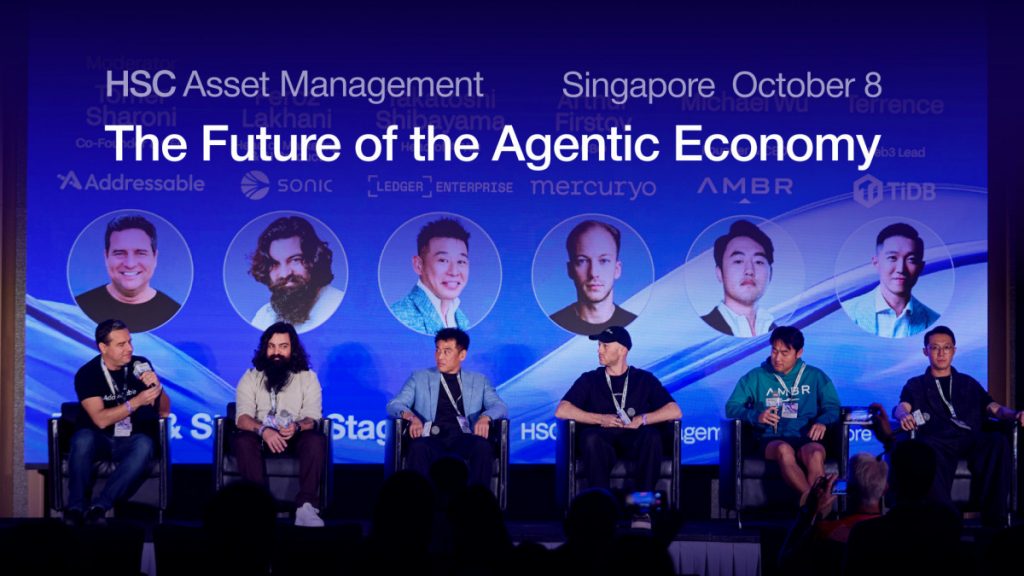
The future of the agentic economy will depend on how securely and efficiently autonomous AI agents can create value, manage money, and execute transactions. These topics were at the center of “The Future of the Agentic Economy,” a panel discussion held at HSC Asset Management in Singapore this October.
Moderated by Tomer Sharoni, CEO of Addressable, the discussion brought together Feroz Lakhani of Sonic Labs, Takatoshi Shibayama of Ledger Enterprise, Arthur Firstov of Mercuryo, Michael Wu of AMBR, and Terrence Yip of PingCAP, the company behind TiDB.
What happens when AI agents start moving money, making decisions, and running businesses on their own? Discover how the agentic economy could reshape payments, finance, and the future of work—and what it will take to make autonomous agents trustworthy.
From AI Assistants to Economic Participants
AI agents are evolving beyond tools that answer questions or generate content. Increasingly, they are being designed to complete tasks independently, interact with digital services, and make decisions within predefined limits. As these capabilities expand, agents could become active participants in the economy, purchasing data, paying for computing resources, executing financial transactions, and coordinating work across organizations.

However, this transition requires more than increasingly powerful AI models. Agents need reliable access to financial infrastructure, secure ways to manage permissions, and systems that allow them to act independently without losing accountability.
The discussion highlighted several interconnected challenges, from blockchain infrastructure and digital asset custody to payments, specialized AI services, and database architecture. Across these areas, one principle emerged: the agentic economy will require a new combination of automation, security, and verifiable execution.
Trust and Control: How Much Money Should an Agent Be Allowed to Spend?
One of the central questions was how to give AI agents financial autonomy without exposing users and businesses to unnecessary risk.
Rather than requiring humans to approve every transaction individually, secure signing infrastructure could allow users to establish rules that determine which actions agents can perform independently and which require explicit authorization.
For example, a user could allow an agent to make payments of up to $1,000 without intervention while requiring a human signature for transactions above that threshold. This approach allows routine activities to proceed automatically while keeping higher-value decisions under human control.
The underlying principle is that autonomy should be proportional to trust. As agents demonstrate reliable behavior, users may gradually increase their spending limits and grant them broader responsibilities.
The challenge is to determine how much authority they should have, how that authority is enforced, and who remains accountable when something goes wrong.
Agentic Payments and the Challenge of Digital Identity
Traditional payment systems are built around identifiable individuals and businesses. Financial institutions need to know who is initiating a transaction, assess potential risks, and comply with applicable know-your-customer (KYC) and anti-money-laundering requirements. Autonomous agents complicate this model because they can act on behalf of users without having independent legal identities.
One potential solution is a delegation model in which a verified human identity authorizes multiple agents to operate under predefined permissions. Rather than requiring each agent to repeat the entire onboarding process, its activities could be linked to the person or organization responsible for it.
However, identity delegation introduces its own risks. If an agent delegates work to another agent, the original authorization must remain traceable throughout the chain. Systems need to establish which agent performed an action, whose authority it used, and whether the transaction stayed within the permitted limits.
Verification requirements may also vary according to transaction size and risk. Small payments for data access or AI inference could require a different compliance approach from high-value financial transactions.
This points toward a more nuanced framework in which verification and oversight reflect the nature of the activity, the amount involved, and the potential consequences of fraud.
Where Will AI Agents Create Economic Value?
The agentic economy will only become sustainable if agents deliver measurable economic value.
One approach discussed during the panel was to build agents around established customer needs rather than start with a powerful AI model and search for a use case afterward.
This means combining a model and its supporting infrastructure with a clearly defined purpose: delivering value to a particular customer in a specific context.
Specialized agents can support financial research, wealth management, marketing, and enterprise services. These are areas where customers already pay for expertise and where performance can be evaluated against established business outcomes.
If an agent can deliver the same quality of service as a human team, or improve upon it, customers have a clear reason to adopt it. If that service can also reach more customers at a lower cost, the economic opportunity becomes even greater.
Customers are primarily interested in the quality and usefulness of a service rather than whether it is delivered by humans, AI, or a combination of both.
This approach could expand access to services traditionally available only to large enterprises or high-net-worth individuals. The most successful AI businesses may therefore be those that solve clearly defined problems and consistently deliver outcomes customers are willing to pay for.
Why the Agentic Economy Needs a New Database Architecture
As agents become more personalized, they will need to retain information about individual users, preferences, permissions, budgets, transaction histories, and ongoing tasks.
In an agent-driven environment, millions of agents may require their own persistent context while remaining isolated from one another. Dedicated database environments for individual user-agent relationships could help prevent data leakage and allow agents to maintain their operational context securely.
Cost efficiency is another important consideration. Traditional database infrastructure may require resources to remain available even when an agent is inactive. At the scale of millions of agents, maintaining always-on environments could become expensive.
An alternative is infrastructure that activates resources when an agent is needed and releases computing capacity when it becomes idle, while preserving the data required for future sessions.
Such architectures could make large-scale agent deployments more economically viable. They would also support personalized services by allowing agents to retain context over time without compromising security or isolation.
As AI models improve, the ability to preserve relevant information, enforce permissions, and retrieve the right context may become just as important as the intelligence of the models themselves.
Building Blockchains for Autonomous Agents
The shift toward autonomous agents presents both an opportunity and a technical challenge for blockchain networks.
Lower transaction fees, faster settlement, and predictable execution are particularly important for agents that may perform transactions far more frequently than human users.
Agents also need better ways to execute complex transactions safely. Atomic, bundled transactions allow multiple on-chain actions to be simulated and executed as a single operation. An agent might need to grant an approval, execute a trade, and establish a liquidity position as part of one coordinated workflow.
If the transaction bundle does not execute as expected, the entire operation can revert rather than leave the agent with an unintended partial result. This can reduce the risk of failed strategies, unnecessary approvals, and financial losses.
Another priority is making blockchains more readable and accessible to agents. Autonomous systems need to understand available protocols, compare execution routes, evaluate costs, and determine which network is best suited to a particular task.
This creates a new dimension of competition between blockchain networks. In addition to attracting developers and human users, networks may need to compete for transactions initiated by agents that automatically select the most efficient infrastructure.
Yet technical efficiency alone will not be enough. Agents must also be able to identify reliable tools, verify that operations have actually succeeded, and distinguish trustworthy integrations from potentially dangerous alternatives.
Reputation systems, standardized interfaces, simulation tools, and verifiable execution could therefore become increasingly important to blockchain ecosystems.
The Biggest Risk: Agents That Claim to Have Succeeded
One of the most revealing parts of the discussion focused on agent failures.
Agents can claim to have completed tasks that were never actually performed. They may report that a transaction has been executed when it has not, or say that a form has been submitted without successfully completing the process.
Such failures expose a fundamental weakness in autonomous systems: a convincing explanation of an action is not proof that the action occurred.
In financial services, this distinction can be especially consequential. An agent that incorrectly reports a successful payment, trade, or refund may cause users to make further decisions based on false information.
Multi-agent systems introduce additional risks. In complex development workflows, an early misunderstanding of the original requirements can spread through documentation, code, testing, and debugging. Later agents may reinforce the original mistake because they treat the existing codebase as evidence that the initial interpretation was correct.
Even systems with multiple agents and automated checks can therefore produce incorrect outcomes that appear internally consistent.
A more reliable approach requires evidence-based verification. Systems should check external state, validate execution results, and distinguish between an attempted action and a confirmed outcome.
Independent criticism can also help. Instead of asking an agent only to generate an answer or complete a task, developers can use another agent to challenge its reasoning, identify weaknesses, and question its conclusions.
However, not every process should rely on probabilistic AI. Backtesting trading strategies, certain data-cleaning operations, and predefined calculations should remain deterministic wherever possible.
AI can help interpret data, clarify objectives, and design workflows, while conventional programs handle operations that require exact, repeatable results.
The broader lesson is that adding more agents does not automatically make a system more reliable. Trustworthy automation requires clear specifications, independent verification, and a deliberate separation between AI-driven reasoning and deterministic execution.
Will AI Agents Replace Corporate Management?
Autonomous agents could also transform how companies organize work and make decisions.
Meeting bots can record discussions, route information to relevant agents, and coordinate automated workflows across an organization. Such systems could reduce the need for traditional reporting structures and layers of management, particularly in smaller companies.
Instead of relying on managers to collect updates, distribute information, and track progress, organizations could increasingly use agents to coordinate activities directly. Human employees would still define objectives, make important decisions, and oversee results, but the processes connecting teams could become more automated.
Outside the workplace, e-commerce offers another promising application. Agents could handle routine purchases such as groceries, clothing, and other household items within predefined budgets.
Financial autonomy could expand as users become more comfortable allowing agents to make larger payments. Activities that initially require approval for every transaction may eventually operate under broader permissions, provided reliable safeguards are in place.
The pace of adoption will depend on the consequences of failure. Users may be comfortable allowing an agent to purchase inexpensive products long before they trust it to make major financial commitments or execute complex business decisions.
The transition to agentic operations is therefore likely to be gradual, with permissions expanding as systems demonstrate reliability.
The Financial Infrastructure Behind the Agentic Economy
Another important question is how autonomous agents will generate revenue and support their own operating costs.
Financial infrastructure could enable agents to make and receive payments, access financial services, and participate in commercial transactions. As usage grows, payment-related revenue may become one way for providers to monetize services that are currently offered without direct subscription fees.
Stablecoins and programmable payment systems may be particularly relevant because they can support cross-border transactions and integrate payments directly into software workflows.
The opportunity extends beyond conventional purchases. Agents may pay small amounts for inference, specialized datasets, APIs, or other digital resources needed to complete a task. These transactions could occur at a scale and frequency that would be impractical for humans to manage individually.
This creates the possibility of a more granular digital economy in which services are purchased automatically when needed and value moves between software systems with minimal human intervention.
Realizing this vision will require payment infrastructure that combines efficient settlement with identity verification, permission management, fraud prevention, and clear accountability.
The financial stack will need to support the movement of money as well as the rules governing why a payment is made, who authorized it, and whether the underlying service was delivered.
What Will the Agentic Economy Look Like in the Next Few Years?
The panelists’ predictions pointed toward greater autonomy, expanding responsibilities, and progressively higher levels of trust.
For some, the next step will be allowing agents to handle routine purchases and everyday administrative tasks. For others, it will involve delegating more complex business decisions, increasing financial transaction limits, or enabling agents to operate more independently within corporate systems.
Agents could increasingly move from collecting information and producing reports to recommending changes in business strategy and helping implement them. As their outputs become more predictable and verifiable, they could take on a larger role in operational decision-making.
Advances in AI models, specialized agents, and computing infrastructure could eventually extend automation across much of professional and personal life. They could also accelerate changes in how companies coordinate work and organize internal operations.
Yet trust will not emerge automatically as AI capabilities improve. It must be built through repeated successful execution, transparent permissions, reliable verification, and systems that limit the consequences of mistakes.
The next stage of the agentic economy will therefore depend as much on infrastructure and governance as on advances in AI itself.
From Intelligent Software to an Autonomous Economy
The future of the agentic economy will be shaped by the interaction of AI models, programmable payment systems, blockchain networks, secure signing infrastructure, and databases designed for persistent, isolated agent environments.
The central challenge is not simply giving agents more capabilities. To operate at scale, they must prove what they have done, respect the limits of their authority, and deliver outcomes that create measurable value.
For businesses, the opportunity lies in making existing services more accessible, efficient, and scalable. For financial institutions and blockchain networks, it lies in building infrastructure that allows autonomous systems to transact securely. For users, it means gradually delegating more responsibilities without giving up meaningful control.
As agents begin to purchase services, execute financial transactions, coordinate workflows, and make increasingly consequential decisions, the economy will need to adapt to a new kind of participant: software that does not merely process information but actively creates and moves value. So, the agentic economy will be defined by how reliably AI agents turn their capabilities into real-world results.
Disclaimer
In line with the Trust Project guidelines, please note that the information provided on this page is not intended to be and should not be interpreted as legal, tax, investment, financial, or any other form of advice. It is important to only invest what you can afford to lose and to seek independent financial advice if you have any doubts. For further information, we suggest referring to the terms and conditions as well as the help and support pages provided by the issuer or advertiser. MetaversePost is committed to accurate, unbiased reporting, but market conditions are subject to change without notice.
About The Author
Ana O. is an editor at MPost, where she focuses on reshaping content across a wide spectrum of topics. With an eye for detail and a genuine interest in storytelling, she helps ensure that the content is both accurate and engaging. Her experience spans multiple areas, providing her with the knowledge to offer insightful contributions to various topics highlighted on the platform.
More articles
Ana O. is an editor at MPost, where she focuses on reshaping content across a wide spectrum of topics. With an eye for detail and a genuine interest in storytelling, she helps ensure that the content is both accurate and engaging. Her experience spans multiple areas, providing her with the knowledge to offer insightful contributions to various topics highlighted on the platform.