Inside Hack Seasons Conference Cannes: The Battle Over Stablecoins As The New Financial Rail Has Already Begun



In Brief
Hack Seasons Cannes panel explores stablecoins as financial infrastructure, covering regulation, adoption, banking roles, and the shift toward tokenized, always-on global payments.
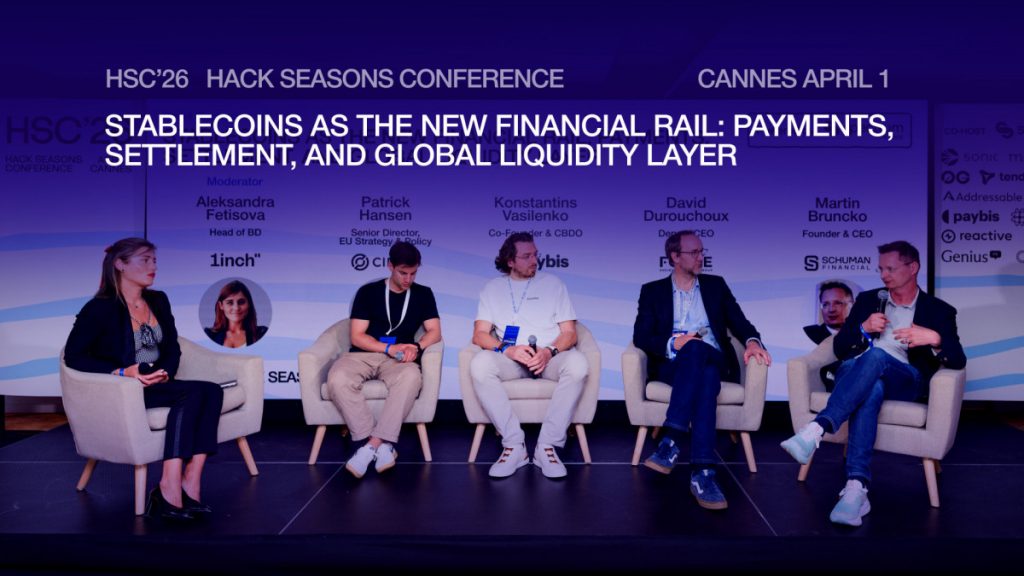
On April 1, the Hack Seasons Conference held its latest edition in Cannes, bringing together senior voices from across crypto, payments, and institutional finance to examine how digital assets are moving into the mainstream.
One of the day’s standout sessions was the panel, “Stablecoins as the New Financial Rail,” moderated by Aleksandra Fetisova, Head of BD at 1inch. The discussion brought together Patrick Hansen of Circle, Konstantins Vasilenko of Paybis, David Durouchoux of SG-Forge, and Martin Bruncko of Schuman Financial to explore how stablecoins are evolving from a niche crypto instrument into a core layer of financial infrastructure.
The panel opened with a clear reminder that stablecoins are no longer an experiment. Each speaker introduced their role in the ecosystem, setting the tone for a discussion that moved fluidly between regulation, consumer adoption, banking infrastructure, and the future of payments. From the outset, the message was that stablecoins are increasingly being used as practical tools, not just trading assets.
Regulation: Progress, But Still Friction
The conversation first turned to regulation, particularly the European framework under MiCA. Patrick Hansen explained that regulatory clarity has helped create a real market for euro-denominated stablecoins in Europe, while also pointing out that the rules still create friction.
In his view, the need for multiple licenses for the same economic activity remains a barrier that slows innovation. He also stressed that the debate between CBDCs and stablecoins is often confused: the two serve different purposes, with stablecoins operating as permissionless blockchain-based money and the digital euro representing a centralized banking feature rather than a replacement for stablecoin rails.

From there, the panel shifted to how stablecoins are actually used today. Konstantins Vasilenko described the consumer side of the market, noting that retail users often come through brokers, wallets, and on-ramp platforms rather than directly to issuers. He pointed to trading, DeFi participation, and yield generation as common retail use cases, but also highlighted a growing role for stablecoins in emerging markets, where they offer access to dollar liquidity and a hedge against local currency volatility. On the business side, he noted that stablecoins are becoming attractive for cross-border settlement, especially as more companies gain confidence in regulated rails.
David Durouchoux then brought in the banking perspective, emphasizing that banks are not standing outside this shift. Instead, they are increasingly acting as bridges between traditional finance and web3. For him, the challenge is not whether stablecoins belong in finance, but how to connect them to existing systems in a safe, compliant, and scalable way. He argued that banks must help build trust by linking innovation with regulation, allowing both CBDC initiatives and stablecoin ecosystems to coexist.
The Next Era: Tokenized Finance And Instant Settlement
Martin Bruncko widened the lens further, arguing that the industry is entering a second era of stablecoins. In his view, the first era was dominated by crypto trading and dollar liquidity, but the next phase will be driven by tokenized financial services, settlement, and 24/7 cross-border payments. He stressed that stablecoins only deliver their full value when users can move between fiat and digital money instantly, without being blocked by banking cutoffs or settlement delays.
Looking ahead, the panel shared a broadly optimistic view. Within five to ten years, they expect stablecoins to underpin much of the financial system, even if most users will not realize it. The most important shift, they agreed, will be one in which stablecoins quietly become part of the everyday machinery of money.
Disclaimer
In line with the Trust Project guidelines, please note that the information provided on this page is not intended to be and should not be interpreted as legal, tax, investment, financial, or any other form of advice. It is important to only invest what you can afford to lose and to seek independent financial advice if you have any doubts. For further information, we suggest referring to the terms and conditions as well as the help and support pages provided by the issuer or advertiser. MetaversePost is committed to accurate, unbiased reporting, but market conditions are subject to change without notice.
About The Author
Alisa, a dedicated journalist at the MPost, specializes in crypto, AI, investments, and the expansive realm of Web3. With a keen eye for emerging trends and technologies, she delivers comprehensive coverage to inform and engage readers in the ever-evolving landscape of digital finance.
More articles
Alisa, a dedicated journalist at the MPost, specializes in crypto, AI, investments, and the expansive realm of Web3. With a keen eye for emerging trends and technologies, she delivers comprehensive coverage to inform and engage readers in the ever-evolving landscape of digital finance.