

From Bitcoin To Black Swans: HSC Asset Management Hong Kong Exposes The New Rules Of Capital Allocation



In Brief
HSC Asset Management Hong Kong panel explores capital flows, AI-driven quant strategies, Bitcoin outlooks, LP risk behavior, RWAs, stablecoins, and black swan risks in digital finance.
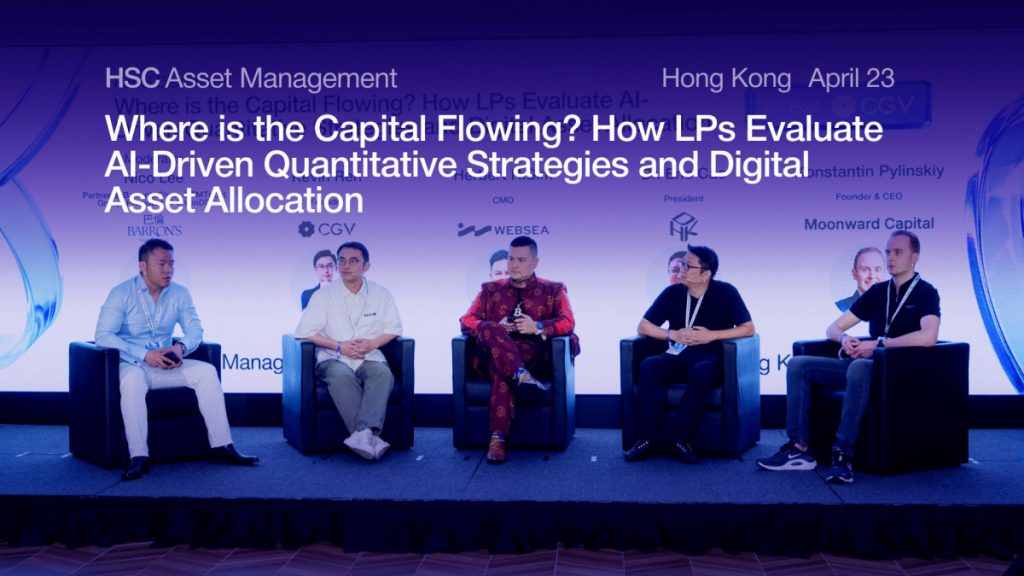
On April 23rd, the HSC Asset Management in Hong Kong brought together industry leaders to examine developments and opportunities in cryptocurrency and institutional finance.
One of the key panel discussions, “Where is the Capital Flowing?”, highlighted how limited partners are evaluating AI-driven quant strategies and digital assets as a distinct allocation category.
Moderated by Nico Lee, Barron’s China, Partner at TMTpost Group and President of ChainDD, the session featured speakers including Kevin Ren, Founder of CGV; Herbert R. Sim, CMO of Websea; Dr. Eric Cao, President of the Hong Kong Digital Asset Research Institute; and Konstantin Pylinskiy, Founder & CEO of Moonward Capital.
The discussion opened with a focus on how capital is moving across digital assets and how quantitative competition is being used to make that movement more visible and measurable. Kevin described the platform’s trading contest as both a live experiment and a public demonstration of how quantitative strategies perform under real conditions. The aim, he explained, is not just to crown winners, but to show the mechanics of trading itself: who gains, who loses, and which systems hold up under pressure. A notable feature of the competition is that it is not limited to cryptocurrencies. It extends into government bonds, precious metals, and tokenized U.S. stocks, signaling a broader shift from crypto-only speculation toward a more global, multi-asset trading environment.
Macro Outlook: Bullish, Bearish, and Unpredictable
The panel quickly split into contrasting macro views. Herbert took the most strongly bullish position, arguing that the U.S. dollar is entering a long decline and that capital should increasingly seek shelter in alternatives such as Bitcoin, gold, or even the Chinese yuan. He tied this view to global geopolitical instability and warned that a major shock could accelerate dollar weakness. In his view, the long-term direction is clear even if the timing is uncertain: the financial system is moving toward a new order in which Bitcoin plays a central hedging role.

Eric offered a more measured and data-driven perspective. Instead of relying on broad macro narratives, he pointed to AI models and on-chain/off-chain data. His view was that Bitcoin could rise around mid-year, followed by an altcoin season later in the year, with a possible peak toward the end of the year. Constantine, by contrast, identified himself as broadly bearish and grounded his expectations in the four-year cycle. He sees the bottom coming in the fourth quarter and stressed that, rather than trying to predict every move, the better strategy is to prepare for multiple scenarios.
How LPs Are Thinking About Risk
A major theme of the panel was the changing behavior of limited partners, especially as fundraising becomes more selective. Kevin observed that LPs across regions are becoming more cautious, but still differ in emphasis. Western LPs, he said, tend to focus more on compliance and stable returns, with a preference for large-cap assets such as Bitcoin and Ethereum, especially when those assets are supported by ETFs or other regulated structures. Eastern LPs, on the other hand, may be more willing to study the strategy itself and evaluate whether it can generate higher returns, even if that means accepting greater risk. Still, he emphasized that safety is now a priority on both sides.
Herbert and Eric reinforced this point from different angles. Herbert argued that traders everywhere are “taking their gloves off,” increasingly using leverage and futures, which makes risk management essential. Eric added that Chinese LPs often want to see historical performance and strategy consistency, while western investors may ask more detailed questions about models and methodology. Constantine echoed the broader trend: market-neutral strategies are becoming more attractive as investors grow less comfortable with direction-only bets.
Sectors Drawing Attention in 2026
When the conversation turned to sector allocation, the panel converged on a handful of themes. Stablecoins emerged as one of the clearest priorities. Kevin described them as the bridge between traditional finance and crypto, while Herbert noted that governments and central banks are racing to launch their own versions. The implication is that stablecoin liquidity could become a major source of capital flow into digital assets more broadly.
Real-world assets, or RWAs, were another major focus. Herbert framed tokenization as a huge opportunity, pointing to the possibility that property, farmland, and other traditional holdings could be brought on-chain. Eric agreed, but broadened the category into both financial assets and physical assets. He also identified AI trading tools and large Web3 projects as areas with strong potential. Constantine highlighted prediction markets as one of the fastest-growing sectors, noting fast volume growth and increasing support from major exchanges and consumer platforms.
AI as a Trading Partner, Not Yet a Replacement
The panel’s discussion of AI was practical rather than theoretical. Several speakers described using AI as an assistant for research, data analysis, and execution support. The consensus was that AI can improve efficiency, surface insights, and accelerate workflows, but major decisions should still remain human-led. Kevin said his team uses AI agents to help read deals and analyze risk, though larger allocations are still handled by people. Eric described AI as increasingly capable when paired with backtesting and computing power, calling it a kind of team member. Constantine went further, arguing that AI can multiply productivity dramatically when used well.
At the same time, the panel showed caution. The speakers did not yet trust AI to manage large sums autonomously because the market remains too unpredictable. Herbert, however, pushed the vision further into the future, suggesting that brain-computer interfaces could eventually make trading even faster and more integrated with human intent.
Black Swans and the Need for Caution
The closing topic centered on black swan risk. The answers varied, but the mood was clearly wary. The panel mentioned war, geopolitical shocks, unstable markets, and the possibility that technology or regulation could outpace security. Herbert raised the possibility of severe global disruption, while others pointed to conflict or sudden market breakdowns. The shared conclusion was simple: this is a year to stay defensive, diversify, and keep a close eye on the risks.
Disclaimer
In line with the Trust Project guidelines, please note that the information provided on this page is not intended to be and should not be interpreted as legal, tax, investment, financial, or any other form of advice. It is important to only invest what you can afford to lose and to seek independent financial advice if you have any doubts. For further information, we suggest referring to the terms and conditions as well as the help and support pages provided by the issuer or advertiser. MetaversePost is committed to accurate, unbiased reporting, but market conditions are subject to change without notice.
About The Author
Alisa, a dedicated journalist at the MPost, specializes in crypto, AI, investments, and the expansive realm of Web3. With a keen eye for emerging trends and technologies, she delivers comprehensive coverage to inform and engage readers in the ever-evolving landscape of digital finance.
More articles
Alisa, a dedicated journalist at the MPost, specializes in crypto, AI, investments, and the expansive realm of Web3. With a keen eye for emerging trends and technologies, she delivers comprehensive coverage to inform and engage readers in the ever-evolving landscape of digital finance.