


Why Enterprise AI Agents Fail—And What They Need To Work




In Brief
Most enterprise AI deployments fail not because of the model, but because of poor integrations, scattered knowledge, and undefined autonomy. Here’s why.

When an enterprise deployment goes right, I know it within the first two weeks.
People aren’t just logging in. They’re logging in, closing support tickets handled overnight by their AI agents, confirming follow-ups sent to sales leads while they slept, discovering new use cases and setting up more agents on their own. You start getting questions from the team like “can it do this too?” instead of “why isn’t it doing that?” That’s the magic moment where you know your customer loves the product and is relying on it already, like how they use WhatsApp every day.
The value delivered is substantial, manifesting in significant time and cost savings, alongside marked improvements in CSAT scores and overall operational efficiency. The business impact is just too big to not notice.
But when it goes wrong, the signal is just as clear.
They sign the contract, put out the press release about their big AI transformation, and then… people log in and don’t really do anything. The agent is handling a fraction of what it was supposed to. Most of the team still does things the manual way. They don’t complete the integrations with the CRM, the ERP, or the ticketing system. They log in once a day, then once a week, then stop. You don’t need a crystal ball to know that next year they’ll say something like “this just doesn’t fit how we work” and that the contract isn’t renewing.

The difference between these two outcomes almost never comes down to the technology.
The technology works. The AI agent is ready. But the enterprise isn’t.
Here’s why. Most companies think deploying an AI agent means connecting ChatGPT to their systems and boom, it’s magic, it runs on its own. It doesn’t work like that. Every single integration between the AI and your CRM, your ERP, your ticketing system, your communication channels and so on is a hard engineering problem on its own. There’s no magic where an AI automatically hooks into 200 internal systems.
People also tend to think the AI model is the hard part. It isn’t anymore. AI models are increasingly a commodity. You can switch from ChatGPT to Claude to Gemini or any other models in seconds, and today’s open source models run at roughly 1~2.5% of the cost of frontier labs while performing at about 90~96% of the quality, sometimes even over 100% in specific niche domains. There’s no moat in models. The moat is in the integrations, and every single integration is a step forward that takes real work to build.
The moat is also in the knowledge that powers them.
Your knowledge has to first be usable
Even if you get all the integrations with AI right, the agent’s output is only as good as the quality of the knowledge you feed it. Data is king, data quality is goldmine. Companies like Mercor have built businesses hiring domain experts at high rates specifically to produce high-quality data for AI to learn from. Most normal companies don’t have millions of dollars lying around to invest in that, but they do have something just as valuable: years of accumulated knowledge about how their business actually works. The only problem is that knowledge is almost never where it needs to be.
Think about how knowledge actually moves through a company. An employee spends days researching a complex customer problem, finally solves it, and replies over WhatsApp. The next time the same problem comes up for a different employee, a different customer, they start from scratch and spend another few days getting there. What a waste of time.
Also everything the company knows is usually scattered everywhere in the form of natural languages: in emails, PDFs, documents on someone’s local drive, files on the company cloud full of duplicates and conflicting versions… In phone calls that happened once and were never recorded. In the heads of ex-employees and their deleted data, the knowledge transfer never occurred.
Now, all this knowledge can be recorded, organized, managed, used, and applied by AI.
Getting this right means treating knowledge like infrastructure. Every document the agent draws from needs to be uploaded to the knowledge base, kept up-to-date, and access controlled. Customer-facing agents see what customers should see, internal agents see the full picture.
Think of it like onboarding a new hire. Instead of throwing them a bunch of Google Drive files and forwarding them email threads hoping they absorb the right information over a month, you decide exactly what they know from day one.
The knowledge base also needs to handle whatever the enterprise throws at it, whether it’s PDFs, spreadsheets, voice notes, images, documents across multiple languages. When something changes, the knowledge should be updatable without rebuilding from scratch. It should be as simple as giving it to your agent and letting it replace the old knowledge automatically and everywhere.
One of the largest real estate groups in Asia managing hundreds of residential and commercial properties had exactly this problem. It had compliance documentation, tenant contracts, building-specific maintenance procedures, vendor escalation rules, data all scattered across different systems in different languages. For years no one’s created a consistent structure and a clear boundary between the knowledge that can be shared externally and should stay internal.
They used to take hours to get back on a tenant inquiry. Once they deployed agentic AI, any piece of information became retrievable in under 30 seconds. First response time dropped from 12 hours to under 60 seconds, and tenant satisfaction almost doubled within 90 days of deployment.
I once heard an employee of that group saying, even after 20 years he still isn’t able to memorize 50% of the SOP because it’s constantly changing, while AI is able to memorize everything and answer everything correctly within 2 seconds of digestion.
Same information. Finally usable.
Sales is 99% follow-up, so is the agent
Getting the knowledge right is the internal problem. The external problem is connecting every conversation the agent has to the systems your business actually runs on.
I’ll tell you something about sales that most people won’t put on LinkedIn: sales is 99% about follow-ups. Before I created Jurin AI, every year I collected about 800 to 1200 business cards. I followed up with less than 2%. It’s not that I didn’t want to do the other 98%, but the process is just painful. You have to find enough time to manually enter someone’s details, recall where you met and what you actually talked about, then draft a personal message. By the time you get to it, the moment’s already gone.
Now imagine the agent handles it. You meet someone, the system already knows who they are, what they posted last week, what connects to what you’re building. The follow-up goes out the same day, personalized, while the conversation is still fresh. Every single lead. Not just the ones you remembered.
That’s not a 10% improvement. Done right, that’s 50x revenue, or 200x profits in some industries, sitting in a pile of business cards nobody got to. This is where AI becomes the “game changer”.
When you can recall every past conversation and pick up right where you left off… that’s the very heart of the Meta mission statement to “bring the world closer together”.
The same logic applies inside the enterprise. When a prospect asks about pricing, the conversation may be simple, but the workflow underneath isn’t: Is it an existing account or new? Has anyone spoken to them before? Which region owns the relationship? Open opportunity in the pipeline? Does this discount need approval? Previous support tickets? Is someone already handling this? The more human layers there are, the more the inefficiencies compound – exponentially; but AI just scales linearly without sweat.
An AI agent can navigate all of that, but only if it’s connected to the systems that have those answers. Salesforce, HubSpot, SAP, Oracle, your ticketing system, your ERP, whichever combination your enterprise runs on needs to be integrated before the agent can do any of this. Once those integrations are in place, the agent checks the CRM, pulls real history, routes to the right owner, logs the interaction, and schedules the follow-up. The conversation happens, and the AI catches all the workflows that come before, during, and after.
All your interactions need to be in one place
But catching the workflows only works if you can see the full picture. And most enterprises can’t because the conversation is happening in different places owned by different people, and these people don’t know what each other has said.
For example the account manager has the WhatsApp history. Sales sees the CRM. Support sees the ticket. Finance sees the invoice. The customer assumes any one of you in the company knows everything they’ve ever told any of you.
If an enterprise deploys an agent into that fragmentation and expects it to perform, it won’t.
Every channel the customer touches, whether it’s email, WhatsApp, Slack, phone, CRM, ticketing system, needs to be integrated into the same system. When that’s done, the agent has the full picture: what was promised last week, what’s still open, who spoke to the customer this morning and what they said. It picks up the conversation with full context, regardless of which channel it started on.
That real estate group I mentioned earlier had different LINE, WhatsApp, WeChat accounts and email inboxes running separately for each property. Once every channel was unified and connected, the agent knew the building, the tenant, the history, the outstanding issues. It finally got the full picture.
Give the agent the right level of autonomy for each workflow
You don’t give a new employee the company credit card on their first day. But you also don’t make them ask permission to reply to an email. Agents work the same way.
Some workflows you want the agent to just handle end-to-end, like replying to the customer, updating the record, closing the ticket, rescheduling the delivery. Others you want a human to review before anything goes out. The agent would do the groundwork like pulling the data, drafting the response and flagging the exceptions, while a person makes the final call.
The key is deciding how much autonomy you give each agent before your enterprise AI deployment goes live.
An e-commerce business processing 3,000 orders a day may give their agents full autonomy over subscription edits, delivery changes, and cancellation approvals. But refunds above a certain amount still go to a human. It takes less than a day to define all these rules and permissions. But set it up right and you’ll have zero unhandled requests after hours and save yourself seven figures (and a lot of headaches) annually.
This is what enterprise AI agents actually need
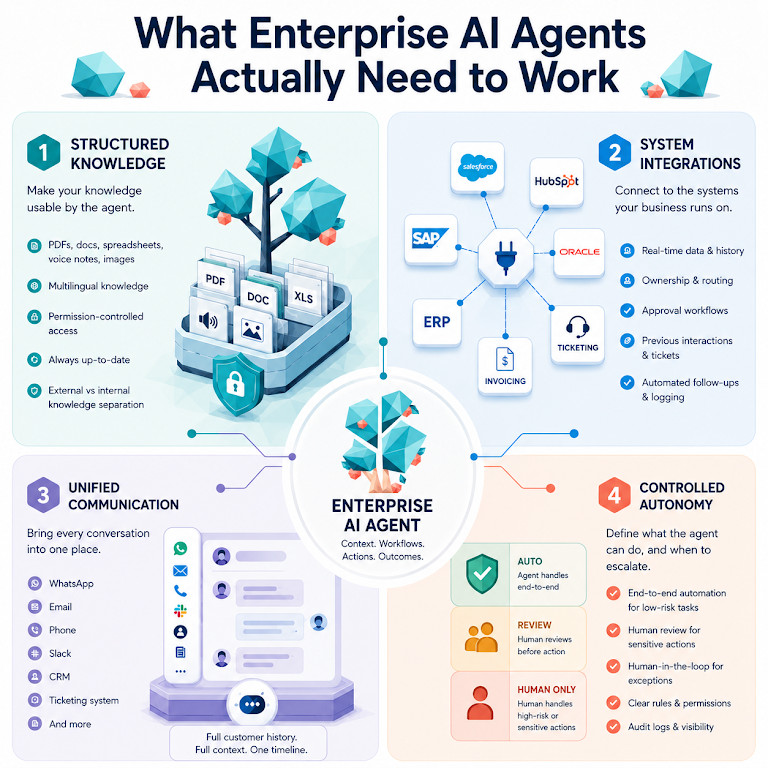
The magic moment I described at the start, people logging in to find the work already done, asking “can it do this too?”, that doesn’t happen by accident. It happens when the knowledge is structured and usable, when the agent is connected to the systems the business actually runs on, when every channel integrates into one system, and when someone made the deliberate decision about what the agent is allowed to do before it ever went live.
None of that is technically hard if you’re on the right platform. But all of it requires the enterprise to make decisions it’s been avoiding.
The enterprises that do this work don’t just end up with a working agent. They end up with a clearer picture of how their business actually operates than they had before: documented workflows, clean knowledge, and integrated systems.
Turns out the prerequisites for a good enterprise AI deployment and the prerequisites for a well-run company are exactly the same thing.
Disclaimer
In line with the Trust Project guidelines, please note that the information provided on this page is not intended to be and should not be interpreted as legal, tax, investment, financial, or any other form of advice. It is important to only invest what you can afford to lose and to seek independent financial advice if you have any doubts. For further information, we suggest referring to the terms and conditions as well as the help and support pages provided by the issuer or advertiser. MetaversePost is committed to accurate, unbiased reporting, but market conditions are subject to change without notice.
About The Author
Rise Ooi is a three-time tech founder, engineer, and investor known for identifying billion-dollar opportunities early. He helped scale Applied Intuition into a multi-billion-dollar unicorn by building its Asian presence from the ground up and now leads Jurin AI, where he’s assembling a world-class team to reshape workplace productivity across Asia-Pacific. A former AI scientist at Japan’s national labs, Rise brings deep technical and global expertise to everything he builds.
More articles
Rise Ooi is a three-time tech founder, engineer, and investor known for identifying billion-dollar opportunities early. He helped scale Applied Intuition into a multi-billion-dollar unicorn by building its Asian presence from the ground up and now leads Jurin AI, where he’s assembling a world-class team to reshape workplace productivity across Asia-Pacific. A former AI scientist at Japan’s national labs, Rise brings deep technical and global expertise to everything he builds.