Web3 in Blue Suits: What I Saw at MERGE Madrid 2026



Crypto conferences are getting smaller, their audiences are growing more institutional, and conversations about blockchain are starting to sound a lot like discussions at banking summits. A firsthand look at MERGE Madrid, where tokenization, stablecoins, regulation, and business fundamentals took center stage.
At one point during MERGE Madrid, I was standing with a colleague, talking about how much the audience at Web3 events has changed.
Just then, someone walked past us wearing a particularly flamboyant outfit — the kind of look that wouldn’t have raised an eyebrow at a crypto conference a few years ago.
What struck me was how much he stood out.
Most of the people around us were middle-aged men in business suits. Bankers, investment professionals, payment executives, compliance specialists. The familiar atmosphere of early crypto conferences, with their colorful influencers and endless conversations about the next big thing, seemed to have faded into the background.

That was probably one of my strongest impressions of MERGE Madrid 2026.
Web3 is becoming increasingly institutional. And you can see it not just in the company names on stage, but in the people walking around the exhibition floor.
Madrid, 20 Degrees, and a Conference in the Heart of the City
MERGE Madrid took place on October 27–29. The event opened with an Institutional Summit at the Madrid Stock Exchange, followed by the main conference at Palacio de Cibeles on October 28–29. I attended the main conference.
I hadn’t arrived in Madrid with particularly high expectations for the city itself. But it turned out to be a pleasant surprise.
I stayed in the city center, so my walk to the venue took me through some of Madrid’s beautiful historic streets. Monumental architecture, wide squares, impressive façades — the city made an impression before the business program had even started.
And the late-October weather was almost perfect: around 20°C.
Palacio de Cibeles deserves a mention of its own. The historic building, which now houses Madrid’s City Hall, sits right in the heart of the city. As far as locations go, the organizers couldn’t have chosen much better.
The conference itself was relatively intimate.
By my rough estimate, there were around 20 to 30 exhibition booths. One main exhibition hall, a separate auditorium for panel discussions, and a second stage located directly in the exhibition area.
Everything felt quite cozy and manageable. There was none of that overwhelming expo experience where you spend half your day walking between enormous halls.
Of course, that compact setup also had a downside.
The second stage was positioned close to the exhibition booths, which meant that background noise sometimes made it difficult to follow the speakers. For an event where industry discussions are such an important part of the experience, that wasn’t the most comfortable arrangement.
On the positive side, audience engagement was noticeably strong.
At many conferences, panel rooms are half-empty. People wander in to take a break, catch up on messages, or kill time before their next meeting.
MERGE felt different.
During the sessions I attended, I’d estimate that around 80% of the seats were occupied. Even the smaller stage in the exhibition area attracted a substantial audience, despite the noise.
Smaller Events Don’t Necessarily Mean Less Business
Having attended several Web3 conferences throughout 2026, I’ve noticed a broader trend: many events seem smaller than they were in previous years.
More compact exhibition areas. Fewer elaborate booths. Less of the sheer scale that used to characterize major crypto gatherings.
MERGE Madrid felt like a relatively small event, too. To be fair, I hadn’t attended its previous editions, so I can’t compare it directly with earlier years.
But there’s an important distinction here.
The size of a conference and its actual business value are two very different things.
You can bring thousands of people together, build an impressive exhibition floor, and still walk away with very little in terms of meaningful business connections.
Or you can organize a smaller gathering where the right people meet, discuss real problems, and continue those conversations long after the event is over.
From that perspective, MERGE worked well.
I caught up with partners, spoke with representatives from different parts of the industry, and exchanged impressions with other attendees who seemed generally satisfied with the business opportunities.
Interestingly, the shift isn’t limited to the way conferences are organized. It also reflects a change in how Web3 companies themselves are being evaluated.
Angela Alaverdova, Co-Founder of AUREMONT Advising, believes institutionalization is changing the way Web3 businesses approach growth and management.
“The institutionalization of Web3 is not just about banks and large investment firms entering the market. It also means a fundamental shift in how businesses are managed. At a certain point, showing growth in users, transactions, or capital raised is no longer enough. Investors want to understand whether that growth is profitable, how much capital it requires, and whether a company can scale without a proportional increase in costs and operational complexity.”
I think this captures something important about where the industry is heading.
At some point, size stops being the most meaningful indicator of success. That applies to Web3 companies just as much as it does to the conferences where they meet.
The focus is gradually shifting from demonstrating scale to delivering tangible business results.
RWA, AML, and Compliance: The New Web3 Agenda
The mix of companies at MERGE Madrid was revealing.
There was a noticeable concentration of businesses working on real-world asset tokenization, AML/KYT analytics, and compliance infrastructure.
I also came across payment providers offering solutions for specific regions and jurisdictions, regulatory consultants, and companies helping traditional financial institutions enter the digital asset space.
These are increasingly becoming some of the industry’s most important areas of activity.
A few years ago, crypto conferences revolved heavily around new blockchains, tokens, and user acquisition.
Today, a growing share of the conversation is about infrastructure.
How do you integrate digital assets into existing financial systems? How do you manage security and regulatory obligations? And how do you make these products commercially viable for businesses?
Institutional adoption, however, doesn’t mean that regulation has suddenly become consistent worldwide.
Dmitry Machikhin, CEO of BitOK, a company specializing in AML/KYT and blockchain analytics, points to the gap between the direction of international regulation and the reality of implementing it.
“International regulation of digital assets is gradually moving toward common principles, but it is still too early to speak of a unified global AML and KYT standard. Different jurisdictions are at different stages of implementing requirements, and enforcement practices can vary significantly. For companies operating across multiple markets, this means building flexible compliance systems that account not only for local legislation but also for the actual risks associated with transactions.”
This helps explain why compliance infrastructure continues to attract so much attention.
As banks, investment firms, and payment providers become more involved in Web3, questions around the source of funds, transaction monitoring, and jurisdiction-specific risks become increasingly important.
And compliance is no longer simply a box to check before launching a product.
For companies operating internationally, it is becoming part of the product’s underlying architecture.
Tokenizing a Bad Product Still Gives You a Bad Product
One of the more substantive topics at MERGE Madrid was the tokenization of financial assets.
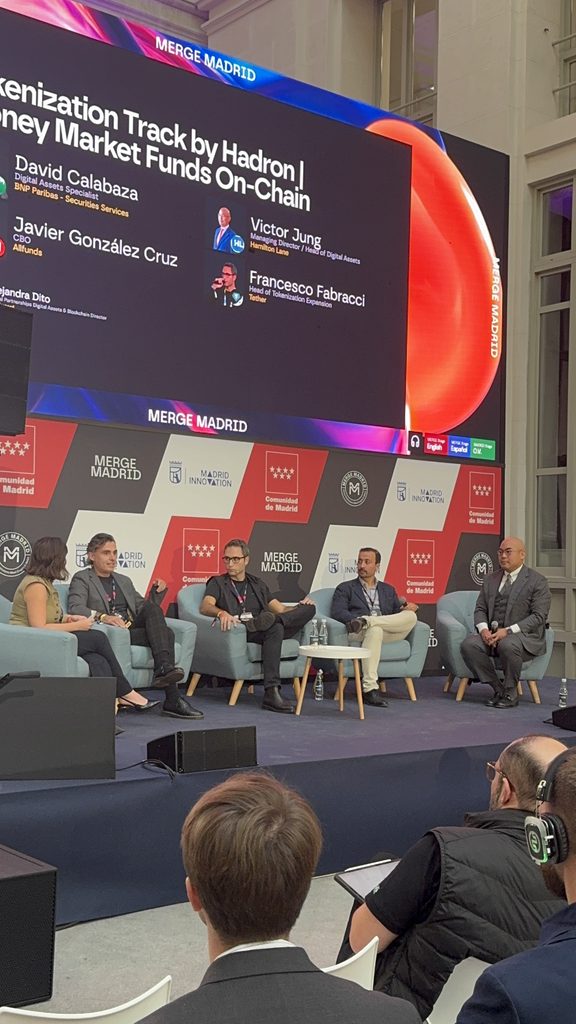
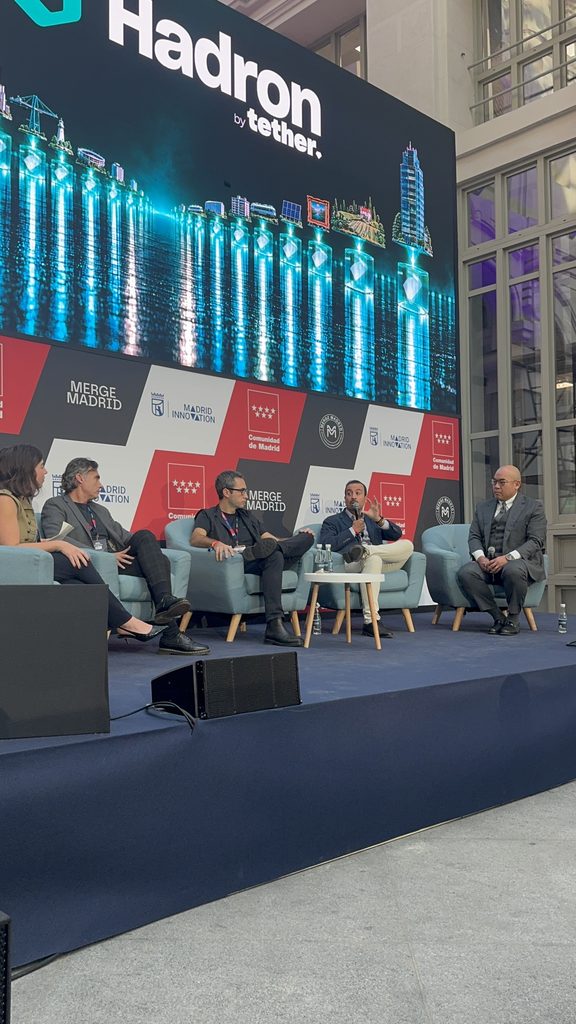
On October 29, representatives of Allfunds, BNP Paribas Securities Services, Tether, and Hamilton Lane joined the Money Market Funds On-Chain panel, moderated by Alejandra Dito, Global Partnerships Digital Assets & Blockchain Director at Mastercard.
The discussion focused on tokenized money market funds, the infrastructure required to distribute them, and the actual benefits blockchain can offer investors.
Javier González Cruz, Chief Business Officer at Allfunds, delivered one of the panel’s most straightforward observations.
“If your product is shit, you are tokenizing shit. If your product is good, you are tokenizing a good product.”
Blunt? Absolutely.
But behind the colorful language was a fairly simple point: tokenization doesn’t automatically make an investment product more valuable.
If a financial product isn’t attractive to investors in the first place, putting it on a blockchain is unlikely to solve that problem.
What tokenization can change, however, is the way investors access that product.
Javier illustrated this by describing the expectations of participants operating within the Web3 ecosystem.
“I don’t want to use Swift to be invested in this product. I don’t want to wait the end of day cut-off. I want to use a stablecoin.”
For a traditional investor, the defining characteristics of a fund are its returns, liquidity, and risk profile.
For businesses operating with digital assets, the infrastructure matters too: the ability to use stablecoins, avoid certain banking cut-off times, and interact with investment products through blockchain-based systems.
Yet behind that apparent simplicity lies an enormous amount of technical and regulatory work.
Javier had another memorable way of describing the role of infrastructure providers.
“We are the plumbers of the industry. We are the dark side of the industry, but we are taking care.”
It’s a surprisingly fitting metaphor for what is happening across financial technology.
While the industry talks about innovative products and new investment opportunities, someone still has to make everything work behind the scenes: settlement, legal procedures, compliance, and communication between different financial systems.
David Calabaza, Digital Assets Specialist at BNP Paribas Securities Services, expanded on this idea.
He described how traditional financial infrastructure providers are evolving beyond their established roles.
“What we see is that their role is changing from connector and to simplifier also.”
In other words, traditional financial institutions aren’t necessarily being pushed out of the picture by blockchain.
Instead, they can become the bridge between existing banking infrastructure and emerging digital networks.
But bringing these two worlds together also introduces new technological risks.
Nurtilek Taalaibekov of CertiK argues that institutional digital asset security needs to be evaluated far beyond the level of individual smart contracts.
“The tokenization of financial assets creates new opportunities, but it also expands the technological attack surface. For institutional investors, knowing that a smart contract has passed an audit is not enough. What matters is how secure the entire infrastructure is — from key management and access controls to the interaction between blockchain and traditional financial systems. Without that level of security, scaling RWA products will become significantly more difficult.”
It’s an important addition to the tokenization debate.
When digital assets begin serving major financial institutions, proving that the technology works is only the starting point.
The entire system needs to be reliable, from the blockchain and key management to its integration with conventional banking infrastructure.
Stablecoins Are Becoming Payment Infrastructure
The perspective from Tether was somewhat different.
Francesco Fabracci, Head of Tokenization Expansion, highlighted a category of investors for whom tokenization is already becoming a practical way to manage capital.
He pointed to large corporations handling hundreds of millions, or even billions, in daily transaction volumes.
“They need to have access to this tokenized product.”
His argument was that companies already holding substantial amounts of stablecoins face additional friction when they have to convert those assets into fiat currency before investing in traditional financial products.
Tokenized funds could potentially remove some of those intermediate steps.
But the trend extends well beyond investment products.
As stablecoins become more deeply integrated into financial infrastructure, their role in payments is becoming increasingly important.
Vladislav Kuznetsov, CTO of BananaTech, a company developing payment card issuance and management infrastructure, describes the transition this way:
“We are gradually moving away from a model in which cryptocurrency is perceived exclusively as an investment asset toward one where digital assets become part of everyday payment infrastructure. But between a stablecoin sitting in a wallet and the ability to spend it at a regular store lies an entire technological chain: issuers, processing, compliance, conversion, and card networks. This is where one of the industry’s most important transformations is taking place today.”
Essentially, we’re watching two previously distinct financial worlds move closer together.
On one side is the crypto industry, with its digital assets, blockchains, and stablecoins.
On the other are traditional banks, card networks, payment providers, and established financial institutions.
An increasing number of businesses now operate directly at the intersection of these two systems.
What stood out at MERGE Madrid was that the conversation around stablecoins was no longer limited to whether they had a future or whether they made sense as investment instruments.
The more interesting questions were practical ones.
How can digital assets be used in financial transactions? How should settlement work? And who is responsible for making the entire infrastructure function reliably?
The Next Frontier: Private Markets
Money market funds, however, represent only one part of the tokenization opportunity.
During the same panel, Victor Jung, Managing Director and Head of Digital Assets at Hamilton Lane, shifted the discussion toward private markets and investment opportunities beyond traditional stock exchanges.
“So you think everything in the listed markets or in the exchanges are the only opportunities? No.”
His argument was that investors are increasingly looking beyond publicly traded assets toward private companies and investment opportunities that have historically been difficult for the broader market to access.
He mentioned companies such as SpaceX and Tether as examples.
And one of those examples was sitting right there on stage.
Turning to the Tether representative, Victor asked:
“Tether. You’re a private company, right? Who here wouldn’t like to own a piece of Tether? Can they today? No.”
That exchange captured an important direction in the broader discussion.
The industry is no longer talking only about putting existing financial products on a blockchain.
It is also exploring whether tokenization can expand access to investment opportunities that have traditionally been available to a relatively limited group of investors.
Of course, tokenization alone doesn’t eliminate securities laws, investor eligibility requirements, or the need for sufficient market liquidity.
But the nature of the conversation is changing.
Instead of promising an abstract revolution in finance, industry participants are increasingly discussing specific assets, distribution models, and the infrastructure required to make these products work.
Web3 Is Growing Up. And You Can Feel It.
I left MERGE Madrid with the impression that Web3 is continuing to change its identity.
Crypto conferences used to be associated with colorful personalities, bold promises, experimental projects, and ambitious ideas about completely reinventing the financial system.
Today, you’re increasingly likely to run into bankers, investment professionals, payment executives, and regulatory consultants.
On stage, the conversation revolves around integrating with existing infrastructure, managing compliance, securing digital assets, expanding access to investment products, and making new financial services economically sustainable.
Against that backdrop, the flamboyantly dressed crypto personality I spotted earlier almost felt like a reminder of another era.
I don’t think one generation of industry participants is completely replacing another.
Web3 is simply becoming broader, and its institutional side is becoming much more visible.
Interestingly, that doesn’t necessarily mean the conferences themselves are getting bigger. Based on what I’ve seen throughout 2026, quite the opposite may be happening.
But perhaps the size of an exhibition floor isn’t the right way to measure the industry’s progress anymore.
What matters more to me is who shows up, what people talk about, and whether those conversations can turn into real business.
By that measure, MERGE Madrid left a positive impression.
It was a compact, business-focused event with a strong institutional presence, an engaged audience, and several genuinely interesting discussions about where digital finance is heading.
And Madrid itself turned out to be a wonderful bonus.
After the conference, I managed to catch a flamenco performance, which became one of the most memorable experiences of the entire trip.
In the end, MERGE Madrid wasn’t an event I’ll remember for its scale.
I’ll remember the atmosphere: a beautiful European city, an intimate industry gathering, and a rather clear indication that Web3 is becoming part of the traditional financial world.
It seems the age of blue suits has arrived.
Disclaimer
In line with the Trust Project guidelines, please note that the information provided on this page is not intended to be and should not be interpreted as legal, tax, investment, financial, or any other form of advice. It is important to only invest what you can afford to lose and to seek independent financial advice if you have any doubts. For further information, we suggest referring to the terms and conditions as well as the help and support pages provided by the issuer or advertiser. MetaversePost is committed to accurate, unbiased reporting, but market conditions are subject to change without notice.
About The Author
Anatoliy is a Web3 and fintech professional with a background in marketing, business development, and strategic partnerships. As a former CMO and media contributor, he focuses on blockchain, digital finance, and emerging technologies, covering major industry events and sharing insights from the global Web3 ecosystem.
More articles
Anatoliy is a Web3 and fintech professional with a background in marketing, business development, and strategic partnerships. As a former CMO and media contributor, he focuses on blockchain, digital finance, and emerging technologies, covering major industry events and sharing insights from the global Web3 ecosystem.