World First: CertiK Brings Mathematical Proofs to AI Infrastructure With New TensorLean Framework



As AI developers push GPU hardware to its limits, researchers from CertiK and Columbia University are exploring a way to mathematically verify that the software running these systems produces correct results.
Their new framework, TensorLean, announced November 20, applies formal verification to production GPU kernels, using machine-checkable proofs developed in Lean. The researchers say the approach marks the first formal verification of production AI kernels and could help address a persistent challenge in AI infrastructure: ensuring that performance optimizations do not introduce computational errors.
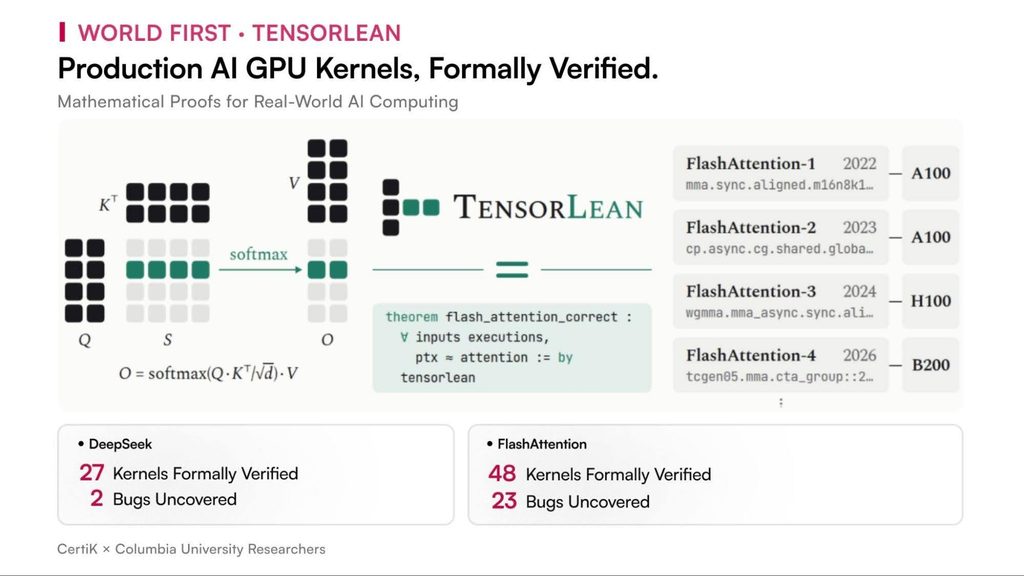
The team tested TensorLean on more than 100 production GPU kernels across multiple generations of GPU architectures, including code from DeepSeek and the FlashAttention library. The research uncovered 25 bugs, comprising two in DeepSeek kernels and 23 in FlashAttention.
Why AI Kernels Need Mathematical Verification
GPU kernels perform the low-level mathematical operations that underpin AI model training and inference. As developers optimize these programs to improve performance and reduce computing costs, their implementations become increasingly complex.
Conventional testing can identify problems in specific examples, but it cannot establish that a program meets its requirements across all inputs and execution conditions within its intended scope. Formal verification addresses this limitation by using mathematical proofs to establish that code satisfies defined specifications.

For production GPU kernels, this is complicated by the need to account for real-world execution behavior. Programs may overlap data transfers with computation, change execution configurations depending on workload size, and rely on lower-precision arithmetic to improve efficiency.
TensorLean incorporates these conditions into its verification process. It examines PTX code directly, allowing researchers to verify the computations generated through NVIDIA’s GPU compilation pipeline rather than relying solely on higher-level program representations.
The proofs are developed in Lean, which checks the mathematical logic and produces machine-checkable evidence that the verified computations meet their requirements within defined numerical tolerances.
Keeping Verification Up to Date With AI Development
One of the framework’s intended applications is helping developers maintain correctness as they continue optimizing their GPU code. Each time an implementation changes, teams can rerun verification to determine whether the updated version still meets its requirements.
The approach also allows researchers to reuse existing specifications for related mathematical operations, potentially reducing the effort involved in extending verification to additional kernels.
Ronghui Gu, co-founder of CertiK and a computer science professor at Columbia University, said the goal is to ensure that performance improvements are accompanied by reliable evidence of correctness, reducing the possibility of errors reaching large-scale AI training and deployment.
The financial implications can be significant. The researchers offered a hypothetical example in which a $100 million training run requires 1% of its computation to be repeated because of a kernel error, resulting in an additional $1 million in computing costs.
TensorLean also arrives amid broader interest in applying mathematical proofs to software reliability. In October, Anthropic published research on using Claude to construct mathematical proofs for open-source software. While that work focused on general software, TensorLean applies formal verification to the underlying computational infrastructure used by AI models.
The researchers’ findings suggest that formal verification could become an important part of AI infrastructure development, particularly as increasingly sophisticated optimization techniques make it harder to establish the correctness of production code through conventional testing alone.
Disclaimer
In line with the Trust Project guidelines, please note that the information provided on this page is not intended to be and should not be interpreted as legal, tax, investment, financial, or any other form of advice. It is important to only invest what you can afford to lose and to seek independent financial advice if you have any doubts. For further information, we suggest referring to the terms and conditions as well as the help and support pages provided by the issuer or advertiser. MetaversePost is committed to accurate, unbiased reporting, but market conditions are subject to change without notice.
About The Author
Anastasiia O. is an editor at MPost, where she focuses on reshaping content across a wide spectrum of topics. With an eye for detail and a genuine interest in storytelling, she helps ensure that the content is both accurate and engaging. Her experience spans multiple areas, providing her with the knowledge to offer insightful contributions to various topics highlighted on the platform.
More articles
Anastasiia O. is an editor at MPost, where she focuses on reshaping content across a wide spectrum of topics. With an eye for detail and a genuine interest in storytelling, she helps ensure that the content is both accurate and engaging. Her experience spans multiple areas, providing her with the knowledge to offer insightful contributions to various topics highlighted on the platform.