


The 14 Best AI Crypto Trading Bots In 2026: A Category-By-Category Guide



An AI crypto trading bot is software that automatically buys and sells cryptocurrencies on your behalf using a defined strategy. The strategy can be a fixed rule like DCA, grid, or arbitrage; a single language model making the decisions; or a multi-LLM system where several AI models cross-check one another before each trade. Which bot suits you depends on what you want automated: a fixed strategy you can backtest against historical data, an adaptive model that reads market context, or a system that publishes its trades and reasoning in the open. This guide covers fourteen platforms that real traders use in 2026, grouped by what they actually do under the hood.

How we selected these bots
The fourteen entries below were chosen across six dimensions: active user base or trading volume (a real-usage signal), supported exchanges and assets, AI architecture (rule-based, single-LLM, or multi-LLM), custody model (custodial vs. self-custody/API-only), pricing tiers and transparency, and verifiable third-party trust signals (exchange partnerships, regulatory status, dated public track record). We included entries across the full architecture range instead of ranking by a single feature, because the question buyers ask first is which kind of bot fits my use case, not which bot within that kind.
PRO-TIPS |
|---|
| 1. In the present day, more and more people are looking for ways to invest their money and ensure that it grows. However, traditional methods of investment, such as stock market trading, are no longer as profitable as they used to be. Many people have turned to cryptocurrency as an alternative investment, and among the various ways to trade cryptocurrency, many people have found crypto trading bots to be the most effective. |
| 2. Nowadays, a growing number of people are looking for ways to invest their money and make it grow. Traditional financial strategies, including stock market trading, aren’t as lucrative as they once were. As an alternative investment, many people have turned to cryptocurrencies, and among the many ways to trade cryptocurrencies, many individuals have discovered that crypto trading bots are the most efficient. |
At-a-glance comparison
| # | Bot | Category | Best for | Custody | Starting price | Notable signal |
| 1 | Arcanum Pulse | Rule-based futures automation | Bybit futures with high-diversification, low-margin risk management | API-key (non-custodial, no withdrawal) | 30% of profit | 97–98% trade success rate; independent track record on tradermake.money since Aug 2024 |
| 2 | 3Commas | Rule-based + marketplace | Multi-exchange portfolio automation | API-key (non-custodial) | Free / $22 mo | 220,000+ users, 16 exchanges |
| 3 | ArbitrageScanner | Arbitrage scanner | Cross-DEX/CEX arbitrage | Manual (no funds access) | $69 | 70 exchanges, 20 blockchains |
| 4 | SMARD | Hands-off automation | Set-and-forget portfolio management | API-key, no withdrawal | 10% of profit | Profit-share pricing only |
| 5 | CoinRule | Visual rule builder | Beginners building rules without code | API-key | Free / $29 mo | 250+ rule templates |
| 6 | TradeSanta | Rule-based, spot + futures | Spot and futures automation | API-key | Free / $13 mo | Demo bot included |
| 7 | CryptoHopper | Rules + signals + AI tier | Strategy marketplace and external signals | API-key | Free / $16 mo | 190+ countries, 75+ assets |
| 8 | Zignaly | Free copy-trading | Copying experienced traders | API-key | Free | 440K users, $5.6B volume |
| 9 | Pionex | Exchange-native bots | Built-in bots with low fees | Custodial (on-platform) | 0.05% per trade | 16 built-in bots, $5B/mo volume |
| 10 | eToro | Social multi-asset | Multi-asset social trading | Custodial | Free | 140+ countries, 20+ cryptos |
| 11 | NAGA | Regulated social broker | Regulated CFD + crypto | Custodial, CySEC-regulated | Spread-based | Publicly traded parent |
| 12 | Kryll | Visual AI builder | Visual strategy design | API-key | Pay-per-use | 280+ rentable strategies |
| 13 | GunBotShop | High-frequency scripting | Technical users doing HFT | API-key | 0.028 BTC | HaasScript + visual editor |
| 14 | GT Protocol | Multi-LLM consensus | AI-architecture transparency | Self-custody framing | Free + $GTAI staking | 5-LLM AI Hedge Fund, public ledger |
1. Arcanum Pulse

Arcanum Pulse is a rule-based crypto futures trading bot developed by the Arcanum Foundation, engineered around low-margin and break-even algorithms and built exclusively for the Bybit futures exchange. Rather than picking individual winners, the bot runs a high-diversification “shotgun” strategy: it holds 30–70 simultaneous positions per cycle across assets ranging from large-caps such as BTC and ETH to mid-cap infrastructure tokens such as SUI, GMX, and GRT, spreading risk across the full market heatmap instead of concentrating it. The interface is Telegram-native — no VPS, no local Python installation — which allows monitoring and adjustments from a mobile device. Connection to Bybit is via a read-and-trade-only API key; withdrawal permissions are disabled at setup, making it technically impossible for the bot to move funds off the exchange. Pricing is success-based: a 30% commission charged only on closed profitable trades, with nothing owed on break-even or losing trades. Performance statistics have been independently published on tradermake.money since August 2024.
Best for: Bybit futures automation with a wide-net diversification strategy and capital-preservation focus.
Benefits

- Rule-based futures automation on Bybit, delivered through a Telegram interface with no VPS or technical installation required
- Diversification across 30–70 assets per cycle; integrated Telegram Heatmap shows live position distribution across active tokens
- Non-custodial architecture — API key is configured without withdrawal permissions, so funds cannot be transferred off the exchange
- 30% commission on net profits only; no subscription fee, no charge on losing or break-even trades
- Extra Earning Mode generates passive income on idle capital at 0.1–0.35% per annum (10% platform fee applies to staking returns)
- Eight-level “Max Entries” strategy systematically lowers average entry prices during drawdowns, enabling simultaneous take-profit hits across dozens of positions on minor recoveries
- Performance independently tracked on tradermake.money since August 2024; no client capital losses recorded during the October 2024 $19B market liquidation event
Rating: 10/10
2. 3Commas

3Commas is a rule-based crypto trading automation platform with more than 220,000 active users and integrations with 16 leading exchanges. It offers DCA bots, grid bots, full TradingView integration, and a marketplace of pre-built strategies, with a complete free tier and paid plans up to $74/month for advanced automation. Trading is non-custodial via API connection; funds stay on the connected exchange.
Best for: Multi-exchange portfolio automation with TradingView integration.
Benefits
- Operate and manage portfolios across 16 exchanges from a single dashboard
- DCA, grid, and TradingView-integrated automated strategies
- Free plan plus a 3-day PRO trial; paid plans at $22 (Starter), $37 (Advanced), $74 (Pro)
- Paper trading and a community marketplace of more than 100,000 traders sharing strategies
- Mobile app and intuitive web interface
Rating: 9.5/10
3. ArbitrageScanner

ArbitrageScanner.io is a cryptocurrency arbitrage scanner covering 70 exchanges and 20 blockchains, including cross-exchange opportunities between centralized and decentralized venues. The bot is manual rather than automated. It detects opportunities and sends alerts every four seconds but doesn’t execute trades with user funds, which removes the API-key custody risk that fully automated bots carry.
Best for: Cross-DEX/CEX arbitrage without custodial exposure.
Features
- Arbitrage between DEX and CEX exchanges across 70 exchanges and 40 DEXs
- Screener on 50 exchanges with no need to buy tokens
- Telegram and Twitter scanners to detect early signals
- Manual execution model — no access to user funds, lower compromise risk than custodial bots
- Free training and a closed client community
- Pricing: $69 (Start), $199 (Pro), $399 (with mentor)
Rating: 9.5/10
4. SMARD

SMARD is a fully automated crypto portfolio-management bot for users who don’t want to configure strategies themselves. The system applies a momentum-based algorithm with built-in stop-losses and trades only on highly liquid pairs across Binance Spot, Binance Futures, OKX, and Bitget. Connection is via API key with no withdrawal access, and pricing is profit-share only — 10% of monthly profit, with a $1 minimum.
Best for: Set-and-forget portfolio management with profit-share pricing.
Benefits
- Fully automated — no strategy customization needed
- Momentum-effect algorithm with mandatory stop-losses, no leverage
- 10% charge on profits — you only pay on actual results
- Free 30-day trial and demo mode
- Detailed statistics and trade history available in-app
Rating: 9.5/10
5. CoinRule
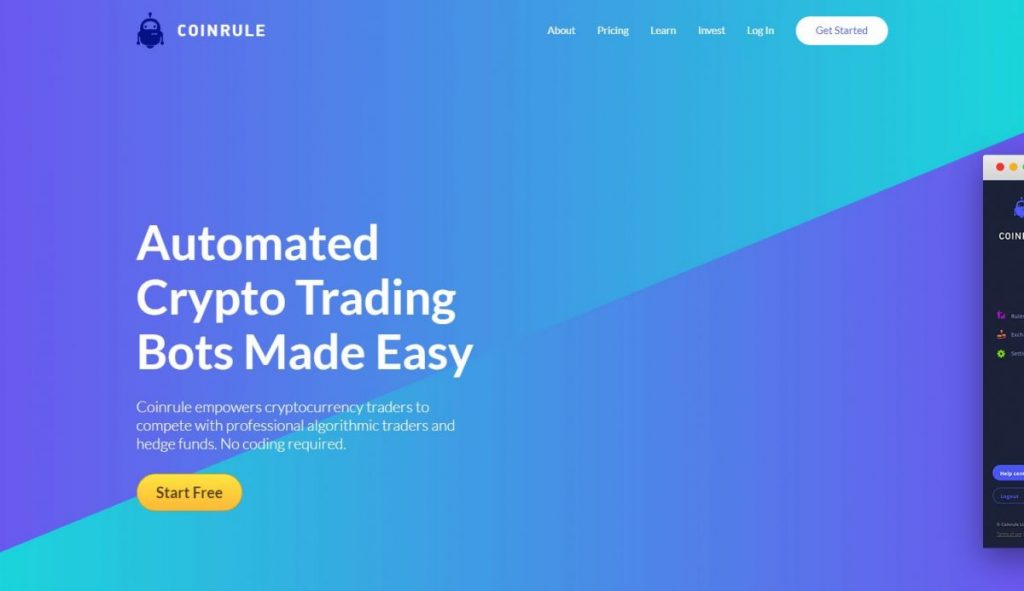
CoinRule is a cloud-based rule builder for crypto trading aimed at beginner-to-intermediate users, with a library of more than 250 pre-built rule templates and connections to Binance, Huobi, Bitfinex, OKX, HitBTC, and more than 10 additional exchanges. Users can build rules around MACD, Bollinger Bands, RSI, and other standard indicators without writing code. Trading is non-custodial via API.
Best for: Beginners building automated rules without coding.
Features
- More than 250 rule templates plus a custom rule builder
- 15+ supported exchanges
- Standard technical indicators built in: MACD, Bollinger Bands, RSI
- TradingView integration for shared strategies
- Live Telegram support, webinars, and email
- Pricing: Free (Starter), $29 (Hobbyist), $59 (Trader), $449 (Pro)
Rating: 9.5/10
6. TradeSanta

TradeSanta is a cloud-based crypto trading bot that supports spot and futures markets on Binance, Huobi, and other major exchanges. The platform was built around a 24/7 automated execution model with built-in risk management, a demo bot for testing strategies, and native Android and iOS apps. Trading is non-custodial via API.
Best for: Spot and futures automation with built-in risk management.
Features
- Support for spot and futures bots
- Demo bot for strategy testing
- Built-in risk-management controls
- Native Android and iOS mobile apps
- 5-day trial on paid plans
- Pricing: Free, $13 (Basic), $23 (Advanced), $35 (Maximum)
Rating: 9/10
7. CryptoHopper
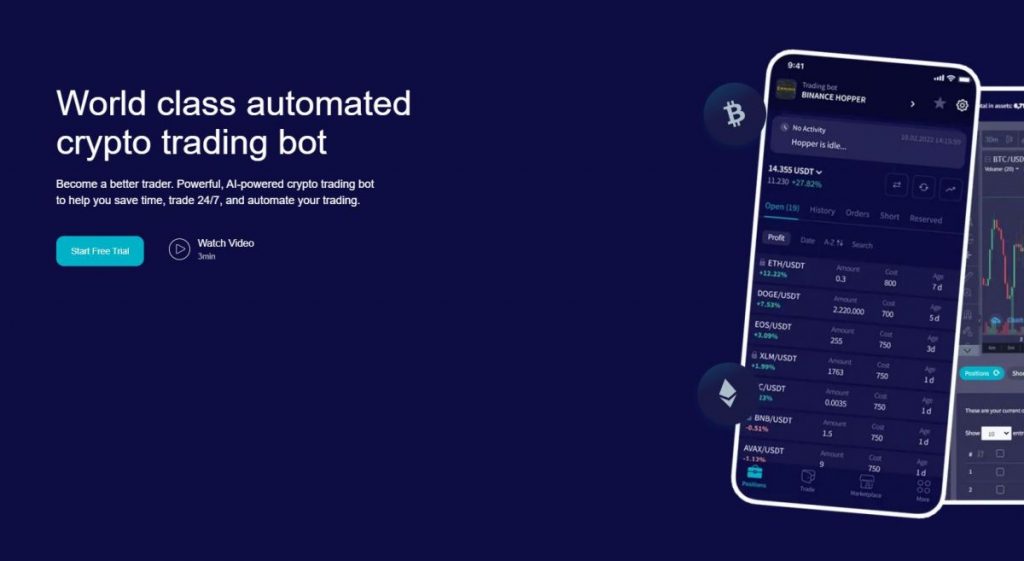
CryptoHopper is a cloud-based crypto trading platform that combines rule-based automation, external signals from third-party providers, and a “Trading A.I.” top-tier feature reserved for its highest plan. Headquartered in Amsterdam and available in more than 190 countries, the platform supports 75 cryptocurrencies, more than 30 technical indicators, and more than 90 candle patterns, plus full backtesting, configurable templates, and trailing stops. Trading is non-custodial via API.
Best for: Strategy marketplace and external-signal integration.
Features
- Algorithmic trading plus integration with paid and free signals
- Copy-trading and a public strategy marketplace
- Backtesting, configurable templates, trailing stops
- Works closely with exchanges and regulators on compliance
- Native Android and iOS apps
- Pricing: Free (Explorer), $16, $41 (Adventurer), $83 (Hero — includes Trading A.I.)
Rating: 9/10
8. Zignaly

Zignaly is a free crypto trading and copy-trading platform with 440,000 users, $120M in assets under management, and $5.6B in total trading volume. The free plan (no retention on profits) and the copy-trading feature aimed at beginners are the platform’s main differentiators. It connects to Binance, KuCoin, and eight other exchanges, supports unlimited pairs, and offers DCA rebuys plus TradingView integration.
Best for: Free copy-trading from experienced traders.
Benefits
- Free to use — no retention on profits
- Copy trades from experienced traders, or sell your own signals
- DCA rebuy strategies and TradingView integration
- Native iOS, iPad, and Android apps
- Connects with Binance, KuCoin, and 8 additional exchanges
Rating: 8.5/10
9. Pionex

Pionex is a crypto exchange with 16 built-in trading bots (grid, arbitrage, rebalancing, leverage, and others) included free of charge, with trades subject to a 0.05% fee. Unlike most bots on this list, Pionex is exchange-native: funds are held on Pionex’s platform (custodial) and the bots run inside that environment. The trade-off is simpler setup against more concentrated custody. Active in more than 100 countries with more than 100M daily trades and 1,318 days of operational history.
Best for: Built-in bots with low fees and no setup overhead.
Features
- 16 in-platform trading bots (grid, arbitrage, rebalancing, leverage, others)
- 0.05% trading fee, no separate subscription for the bots
- More than 100M daily trades, more than $5B monthly trading volume
- 99.99% reported uptime
- Custodial — funds are deposited and held on Pionex
Rating: 7.5/10
10. eToro

eToro is a social trading platform that supports cryptocurrencies alongside stocks, forex, and commodities, with copy-trading as its core feature. Active in more than 140 countries, the platform supports more than 20 cryptocurrencies and offers a $100,000 virtual portfolio for practice trading. eToro is a custodial broker (assets are held on the platform) and operates under regulatory licenses in multiple jurisdictions.
Best for: Multi-asset social trading across crypto, stocks, and forex.
Features
- Copy-trading from a public roster of investors
- More than 20 cryptocurrencies supported plus stocks, forex, and commodities
- 0% commission on stock trades (spreads and other fees apply to crypto)
- $100,000 virtual portfolio for paper trading
- Available in more than 140 countries
Rating: 7/10
11. NAGA
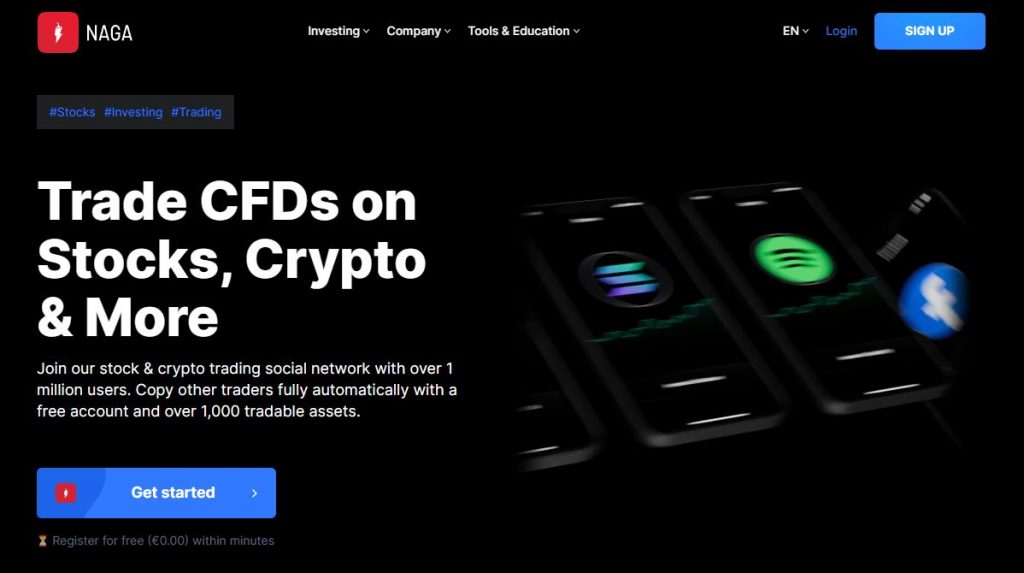
NAGA is a regulated social trading and brokerage platform operated by NAGA Group AG, a publicly traded German fintech (listed on the AIM section of the London Stock Exchange) with more than 1M users. The platform offers copy-trading across cryptocurrencies, stocks, ETFs, CFDs, and more than 90 financial products, with leverage up to 1000× available on supported instruments. Regulated by the Cyprus Securities Exchange Commission (CySEC); not available in the US or Australia.
Best for: Regulated CFD and crypto social trading.
Features
- Regulated by CySEC, with a publicly traded parent company (NAGA Group AG)
- More than 1,000 tradable assets in crypto, stocks, ETFs, and CFDs
- Free account with copy-trading enabled at $250 minimum deposit
- Deposit options including bank, card, Skrill, Neteller, Bitcoin, Ethereum, Litecoin, Dash
- Web and Android apps
- Pricing: spreads from 0.1 pip; inactivity fee applies after 3 months; standard CFD broker fee structure
Rating: 6.5/10
12. Kryll

Kryll is an AI-augmented crypto trading bot built around a visual drag-and-drop strategy editor that lets users create automated strategies without writing code. The platform’s Marketplace hosts more than 280 strategies shared by experienced traders, available for rent on a pay-per-use model. Trading is non-custodial via API; nine exchanges are supported.
Best for: Visual drag-and-drop strategy design.
Features
- Drag-and-drop strategy editor — no programming required
- Marketplace with more than 280 rentable strategies including performance history
- Trading terminal with configuration for multiple take-profits and stop-losses
- Pay-per-use, no subscription needed
- 9 supported exchanges
Rating: 6/10
13. GunBotShop
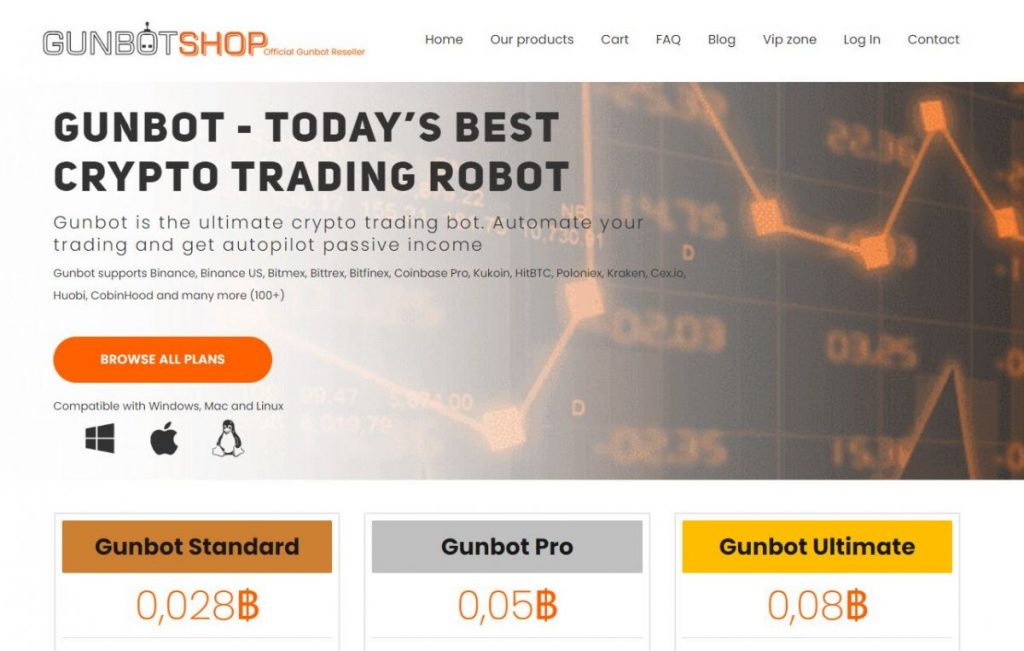
GunBotShop is a high-frequency crypto trading platform built around HaasScript — a scripting language with more than 600 commands — and a visual editor for users who prefer a graphical interface. The platform focuses on power users developing, backtesting, and deploying custom strategies across multiple exchanges, with both historical and real-time backtesting modes.
Best for: Technical users scripting high-frequency strategies.
Features
- HaasScript with more than 600 trading commands
- Visual editor for graphical strategy building
- Historical and real-time backtesting
- Multi-exchange deployment from a single setup
- Aimed at technical users comfortable with scripting
- Pricing: 0.028 BTC (Standard), 0.05 BTC (Pro), 0.08 BTC (Ultimate)
Rating: 6/10
14. GT Protocol

GT Protocol is an AI-powered crypto trading ecosystem and AI infrastructure for crypto trading. Founded in 2021, the platform enables users to build, backtest, optimize, and launch fully automated AI-driven trading strategies across centralized and decentralized crypto markets.
The ecosystem includes GT APP, AI Backtesting, AI Trading Agents, and the public AI Hedge Fund experiment. GT APP supports non-custodial trading through integrations with Binance and Hyperliquid, while AI Backtesting allows traders to generate, test, and optimize strategies using historical market data.
GT Protocol serves more than 100,000 registered users and is powered by the native $GTAI token.
Best for: Traders who want AI architecture transparency and a published track record.
Benefits
- AI-powered strategy creation, optimization, backtesting, and automated execution through GT APP trading infrastructure with Binance and Hyperliquid integrations
- AI Backtesting is a smart environment for testing, refining, optimizing, and validating crypto trading strategies on real historical data
- Multi-LLM consensus — five frontier models in specialized roles (analyst, quant, risk officer, portfolio manager, devil’s advocate) cross-check one another before each trade
- Non-custodial architecture — users retain control of their assets through connected exchange accounts
- Native $GTAI token powering memberships, staking programs, and ecosystem utilities
Rating: 9.5/10
How the top picks compare
A few comparisons readers ask about most often, summarized in one place so you don’t have to read every entry to know which one to choose.
3Commas vs. CryptoHopper. Both are mature rule-based platforms, with strategy marketplaces and TradingView integration. 3Commas has a larger active user base (220,000+) and a wider free plan; CryptoHopper covers more cryptocurrencies (75+), operates in more countries (190+), and offers a single-model “Trading A.I.” feature reserved for its top Hero plan at $83/month. If you want breadth and community, 3Commas wins. For signal-marketplace depth or an AI tier, the answer is CryptoHopper.
Pionex vs. CoinRule. Pionex is exchange-native: 16 built-in bots, a 0.05% fee, funds custodied on the platform. CoinRule is a non-custodial rule builder that connects to your existing exchange and lets you build strategies from more than 250 templates without programming. Pionex suits whoever wants bots they don’t have to configure. CoinRule suits whoever wants to own the rules and keep funds on a separate exchange.
Arcanum Pulse vs. SMARD. Both platforms skip strategy-building and charge only on profits. SMARD takes 10% across four exchanges using a momentum algorithm on liquid pairs. Arcanum Pulse takes 30% but runs on Bybit futures only, holding 30–70 simultaneous positions with an eight-level drawdown entry system, and publishes its track record on an independent third-party platform. SMARD wins on exchange breadth and commission rate; Arcanum Pulse wins on diversification depth and verifiable performance history.
Zignaly vs. eToro. Both offer copy-trading at no subscription cost. Zignaly is crypto-only, non-custodial via API, with 440,000 users and a free signal marketplace. eToro is a custodial multi-asset broker (crypto, stocks, forex, commodities) with regulated status in more than 140 countries. Zignaly is the cleaner pick if you want crypto-only and self-custody. For copy-trading across multiple asset classes, eToro is the broader platform.
GT Protocol vs. CryptoHopper. Both are described as AI-driven, but their architectures are different. CryptoHopper’s “Trading A.I.” is a single-model feature reserved for its $83/month tier, sitting on top of a rule-based platform. GT Protocol is built from the start around multi-LLM consensus, with five frontier models that cross-check one another and a public AI Hedge Fund that publishes every decision. CryptoHopper makes more sense if you want breadth of rule-based functionality with AI signals as an option. GT Protocol makes more sense if what matters to you is transparency in the AI architecture and a dated public track record.
Arcanum Pulse vs. GT Protocol. Both emphasise transparency, but differently. GT Protocol publishes AI reasoning — every decision from its five-model consensus system is dated and openly accessible. Arcanum Pulse publishes outcomes — aggregate trade statistics tracked independently on tradermake.money since August 2024. For AI decision-layer visibility, GT Protocol is the pick. For a verified historical performance record with a profit-share structure and no subscription, Arcanum Pulse is the closer fit.
Conclusion
The fourteen bots above cover the functional range of what “AI crypto trading bot” means in 2026. Most of the category (3Commas, CryptoHopper, TradeSanta, Pionex, GunBotShop) is rule-based automation with optional AI signals on top, and that remains a reasonable starting point for traders who want a strategy they can reason about and backtest. The social and copy-trading tier (Zignaly, eToro, NAGA) suits traders who prefer to follow other people’s calls. Kryll’s drag-and-drop and CoinRule’s rule library lower the bar for people who don’t program, and SMARD skips the build step entirely with a profit-share model. Arcanum Pulse shares that profit-share model but applies it to Bybit futures specifically, with a wide-asset diversification strategy and a third-party-verified track record. GT Protocol is the multi-LLM bet — a public research ledger in place of templates. The right choice depends on which part of the work you want to hand off: execution, the strategy itself, or the AI’s reasoning.
Frequently asked questions
What are AI crypto trading bots?
AI crypto trading bots are software programs that automatically buy and sell cryptocurrencies on exchanges using a defined strategy. They range from rule-based bots that execute predefined logic (DCA, grid, arbitrage), through single-LLM agents where a single language model reads market data and decides, to multi-LLM consensus systems where several models cross-check one another in specialized roles before each trade.
How do AI crypto trading bots work?
An AI crypto trading bot connects to the user’s exchange account or wallet — typically via API key — and executes trades on the user’s behalf according to a defined strategy. Rule-based bots follow fixed logic and can be tested against historical data. AI-driven bots use a language model to interpret market data and make adaptive decisions, which means their reasoning matters more than their historical backtest results.
What is multi-LLM crypto trading?
Multi-LLM crypto trading uses several frontier AI models in specialized collaborative roles (typically analyst, quant, risk officer, portfolio manager, and devil’s advocate) that cross-check one another before each trade, instead of letting a single model decide on its own. The setup mirrors the way institutional trading desks split work across roles — which is how desks avoid the blind spots a lone analyst tends to miss.
What is an AI hedge fund in crypto?
An AI hedge fund in crypto is a system that lets AI models manage trading capital in the open and publishes the resulting decisions, instead of a human fund quietly using AI tools behind closed doors. GT Protocol’s AI Hedge Fund is one current example: five frontier LLMs each run a separate paper-trading account, and a sixth “Committee” account trades on their structured consensus, with every decision dated and published.
What is the difference between a single-LLM bot and a multi-LLM bot?
A single-LLM trading bot has one language model making every decision, which carries the usual lone-trader failure modes: overconfidence, momentum chasing, no one in the loop to argue the other side. A multi-LLM trading bot splits the decision across several models in specialized roles that check one another, which is closer to how real trading desks actually work.
Are AI crypto trading bots safe?
Three things, in order. Custody: non-custodial bots that connect via API key without withdrawal permission are safer than custodial bots that hold user funds. Risk limits: leverage caps, stop-losses, and drawdown circuit breakers should be stated and enforced, not aspirational. Transparency: a bot whose decisions get published is more trustworthy than one whose AI is merely asserted. “Our AI analyzes the market” with no public track record is a marketing claim, not a safety signal.
Can AI crypto trading bots really make money?
AI crypto trading bots can generate profits, but there is no guarantee. The most public test of frontier-LLM trading to date — the Alpha Arena experiment run by Nof1.ai, where six frontier language models each traded $10,000 in crypto — showed mixed-to-negative results overall, with most models losing money when running on their own. Performance varies significantly with the architecture, the market regime, and risk discipline; profitability is still unproven as a category.
How do I choose an AI crypto trading bot?
It depends on what you want automated. If you want a mechanical strategy you can backtest, a rule-based bot is the right tool — 3Commas, CryptoHopper, TradeSanta, and Pionex are the established options. Copy-trading from experienced users belongs on a social platform such as Zignaly, eToro, or NAGA. Visual rule-building without code is what CoinRule and Kryll do. Dated, published AI decision-making is GT Protocol’s niche. Either way, check the custody model, supported exchanges, and stated risk limits before connecting any funds.
How do I spot an AI crypto trading bot scam?
Genuine AI crypto trading bots tend to share a few traits: non-custodial connection via API (no withdrawal permission), a stated risk-limit framework, and either a dated track record or fees that only kick in on profits. The red flags go the other way. Bots that demand deposits into their own accounts, promise guaranteed returns, or refuse to explain how they get paid are the highest-risk profile. Verifiable third-party signals (regulatory licenses, exchange partnerships, public trading ledgers) are how to separate legitimate platforms from scams.
Disclaimer
In line with the Trust Project guidelines, please note that the information provided on this page is not intended to be and should not be interpreted as legal, tax, investment, financial, or any other form of advice. It is important to only invest what you can afford to lose and to seek independent financial advice if you have any doubts. For further information, we suggest referring to the terms and conditions as well as the help and support pages provided by the issuer or advertiser. MetaversePost is committed to accurate, unbiased reporting, but market conditions are subject to change without notice.
About The Author
Damir is the team leader, product manager, and editor at Metaverse Post, covering topics such as AI/ML, AGI, LLMs, Metaverse, and Web3-related fields. His articles attract a massive audience of over a million users every month. He appears to be an expert with 10 years of experience in SEO and digital marketing. Damir has been mentioned in Mashable, Wired, Cointelegraph, The New Yorker, Inside.com, Entrepreneur, BeInCrypto, and other publications. He travels between the UAE, Turkey, Russia, and the CIS as a digital nomad. Damir earned a bachelor's degree in physics, which he believes has given him the critical thinking skills needed to be successful in the ever-changing landscape of the internet.
More articles
Damir is the team leader, product manager, and editor at Metaverse Post, covering topics such as AI/ML, AGI, LLMs, Metaverse, and Web3-related fields. His articles attract a massive audience of over a million users every month. He appears to be an expert with 10 years of experience in SEO and digital marketing. Damir has been mentioned in Mashable, Wired, Cointelegraph, The New Yorker, Inside.com, Entrepreneur, BeInCrypto, and other publications. He travels between the UAE, Turkey, Russia, and the CIS as a digital nomad. Damir earned a bachelor's degree in physics, which he believes has given him the critical thinking skills needed to be successful in the ever-changing landscape of the internet.