Picking The Winner In Every Crypto Category: Inside Canary Capital’s Strategy For XRP, Solana, HBAR And Beyond



In Brief
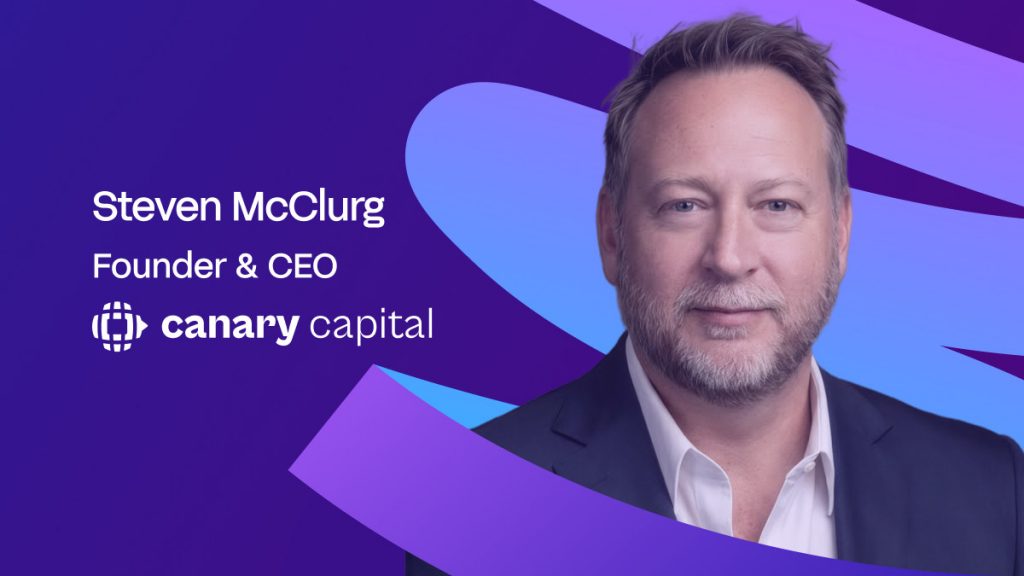
Canary Capital CEO Steven McClurg on altcoin ETFs, staking rewards, custody choices, and which blockchain networks could reshape crypto next.
The U.S. crypto ETF market is entering a new phase, with the industry expanding well beyond Bitcoin and Ethereum as asset managers seek to bring a broader range of digital assets into regulated investment products. Bloomberg estimates that crypto ETFs now represent roughly $153 billion in assets across around 130 active products, while more than 100 additional filings are under review.
This trend is paving the way for more specialized products, including ETFs offering exposure to assets such as XRP, Solana, SUI, Dogecoin, and Avalanche. Alongside Bitwise, Grayscale, Franklin Templeton, and 21Shares, Canary Capital is among the firms contributing to this evolving market, with a growing lineup of crypto ETFs available through major U.S. brokerages.
Against this backdrop, we spoke with Steven McClurg, Founder and CEO of Canary Capital Group, about the evolution of the crypto ETF market, the advantages of accessing digital assets through ETFs rather than buying tokens directly, how issuers approach custody, security, and product selection, and which blockchain networks and crypto sectors could have the greatest potential to reshape the industry over the next one to two years.
Who is buying digital assets today? What draws investors to digital assets and why to altcoin ETFs specifically?
It’s a combination of different types of investors. We’re seeing it across the whole spectrum. On the short-term side, one of the biggest trades in crypto is the basis trade. When volatility creates a nice spread between the derivative and the underlying, it makes for a very nice basis trade. For the longest time, Bitcoin ETFs had large inflows because of it. Then the basis trade broke down, which created many of the outflows from Bitcoin ETFs a year ago. Many basis investors have since moved to XRP, Solana, HBAR and SUI, probably the four biggest we’re seeing right now. I consider them short-term, because they move in when the basis is good and out when it breaks down, following the best basis.

Most of the investors we see, though, are long-term. Often it’s their first time in these cryptocurrencies, and they don’t necessarily have exchange accounts, so they use ETFs because they’re easier to access. Some have financial advisors who are more comfortable with ETFs, and others are individuals with brokerage accounts.
Another long-term category is investors who held the token in a cold wallet, a hardware wallet or on an exchange, and feel safer owning an ETF because someone else manages the custody, storage and trading risk. That has been a big segment, particularly after events like the Trezor hack and other hardware wallet bugs, which pushed many investors and tokens into ETFs.
What risks and costs does a crypto ETF remove compared with buying tokens directly?
It reduces a lot of the risk. When you trade on an exchange or on-chain, you can enter the wrong wallet address or lose your private keys. An ETF solves those issues. Exchanges and other services are also expensive. Because of economies of scale across many clients, an ETF costs less to own and less to trade than trading on an exchange.
How should an investor choose between altcoin ETFs?
There are many types of blockchains. Some are direct competitors, but many focus on different areas. When we launch ETFs, we try to pick the winner in each category.
Solana and ETH are direct competitors, both leading open-source blockchains that can be used for almost anything. We think Solana will be the category winner, even though ETH is currently larger, which is why we launched a Solana ETF. In pure financial services, a few blockchains do a great job, but we think XRP is the category winner, so we launched XRP. Enterprise solutions are often closed and data-focused, and HBAR has been the clear winner there. Outside of protocols, Bitcoin is clearly the leader in cryptocurrency as money.
Privacy will be a really interesting area, and we think Litecoin has a real shot at leading privacy coins. Bitcoin is not a privacy coin. That’s how we decide what to launch. Investors might then ask which category interests them, and it may be several.
One more worth mentioning is Tron, a direct competitor to ETH and Solana. It is the largest blockchain in Asia and emerging markets, and it processes more stablecoin transactions than any other open-source protocol, because stablecoins are heavily used by unbanked populations in emerging markets and across Asia, an early adopter of cryptocurrencies. So we like Tron as our Asia and emerging-markets play.
Do you plan to expand into, for example, Zcash?
We think Zcash is pretty good, though we like Litecoin slightly better. Several Zcash products already exist from competitors, and with that competition it didn’t make sense to launch another. It’s the same logic for Ethereum.
Some of Canary’s funds stake and others do not. How does staking work inside an ETF?
Bitcoin is proof-of-work, and several other protocols are proof-of-stake. We stake any asset that can be staked. If you own the tokens, you can stake them back to the network, often to super nodes or masternodes, which process transactions much as data centers do for Bitcoin. When those transactions occur, you receive tokens as a reward. Staking is also a voting mechanism. Network participation is important, and we want to take part in the growth and strength of the network. We often distribute the rewards to ETF holders, so it’s a form of yield.
How much do staking rewards influence investors’ decisions?
Between two similar ETFs, one with staking rewards and one without, I think the preference is for the one that stakes. Solana is a good example. There are many Solana ETFs, and we distribute 100% of the staking rewards, so ours has the highest staking reward of any of them. Some issuers use staking providers and take a cut of the rewards. Most do. We distribute the entire amount, and total return is often higher for the funds that distribute the most.
Why did you choose your custody arrangements? What protections do investors have in cases of forks, hacks or protocol changes?
In the US there are about five good custody arrangements that most issuers use. We evaluated all of them on many factors. Security is the biggest, along with high insurance coverage and recovery, then trading, ease of use and the platform’s user experience.
We chose BitGo because we felt it had the best security. Everything has positives and negatives, and we can work around the other issues that fall on us, but security is the most important thing. Some platforms may offer easier trading and better spreads, but BitGo lets us trade with other OTC agents and shop for the best price while still offering the best security. We felt we really won by going with them.
What comes next for Canary? Are you planning more single-token funds, or other structures too?
We have about six more single-token ETFs filed, and we’re going back and forth with US regulators on comments before we can launch them. Regulators also require certain things, one of which is a US futures market, so some funds are waiting for futures to become available. Those are the two things we’re waiting on before we can launch the remaining six.
Beyond that, I don’t know that we’ll do many more single-token ETFs. We might look at an index or two, and on the ETF side we might do products that are not crypto at all. More to come on that.
What share of an investor’s portfolio should go to crypto ETFs, compared with equities, bonds or gold? Within that share, how would you split exposure between Bitcoin, Ether and altcoin ETFs?
I generally think 3-10% belongs in crypto. Within crypto, I’d put Bitcoin at 10-20%, because it’s the bellwether. I’d put another 10% or so in privacy tokens, where we prefer Litecoin. The rest goes to the protocols you think will win, meaning the areas that will use protocols the most. Financial services? We believe so. Open source? We think there’s a big opportunity there. We also like to go out on the risk curve and find newer technology, because technology gets better with every iteration. Ethereum, a good technology ten years ago, can be replaced by something faster and more secure, and we’re constantly looking for technologies that can beat the legacy players.
Looking one or two years ahead, what has the most potential to change the industry?
Today, the two I find most interesting are XRP Ledger, because many financial services companies are moving into tokenization and it’s well set up for that, and HBAR, which is the winner in enterprise data, where there’s a strong need. Looking further out, I see potential disruptors in Injective and SUI. Privacy coins will also become extremely important, as people will want more private transactions, and I believe Litecoin will be interesting there too.
Where are we in the cycle? What could generate new liquidity?
We’re at the bottom of the next cycle. What will generate liquidity from here is that rates are going up very quickly in the US and globally, because inflation remains a concern. High inflation and high rates will likely cause some financial calamity, which will lead central banks to print money again and try to lower rates. That will bring a massive increase in the M2 money supply, which will push cryptocurrencies and other risk assets up. I think that’s more near-term, and risk assets usually start rising in anticipation of such events.
Global M2 is already rising about 7% a year, which is very high, and that is already pushing crypto up. It’s why we saw big moves up in August and September, and we should see bigger moves in the new year.
Disclaimer
In line with the Trust Project guidelines, please note that the information provided on this page is not intended to be and should not be interpreted as legal, tax, investment, financial, or any other form of advice. It is important to only invest what you can afford to lose and to seek independent financial advice if you have any doubts. For further information, we suggest referring to the terms and conditions as well as the help and support pages provided by the issuer or advertiser. MetaversePost is committed to accurate, unbiased reporting, but market conditions are subject to change without notice.
About The Author
Alisa, a dedicated journalist at the MPost, specializes in crypto, AI, investments, and the expansive realm of Web3. With a keen eye for emerging trends and technologies, she delivers comprehensive coverage to inform and engage readers in the ever-evolving landscape of digital finance.
More articles
Alisa, a dedicated journalist at the MPost, specializes in crypto, AI, investments, and the expansive realm of Web3. With a keen eye for emerging trends and technologies, she delivers comprehensive coverage to inform and engage readers in the ever-evolving landscape of digital finance.