Inside HSC Hong Kong’s Tokenization Debate: When Everything Becomes Liquid — Promise, Illusion, Or The Future Of Global Markets?



In Brief
HSC Asset Management Hong Kong panel “When Everything Becomes Liquid” explores tokenization, institutional adoption, liquidity vs access, and how regulation and infrastructure are reshaping global private and digital markets.
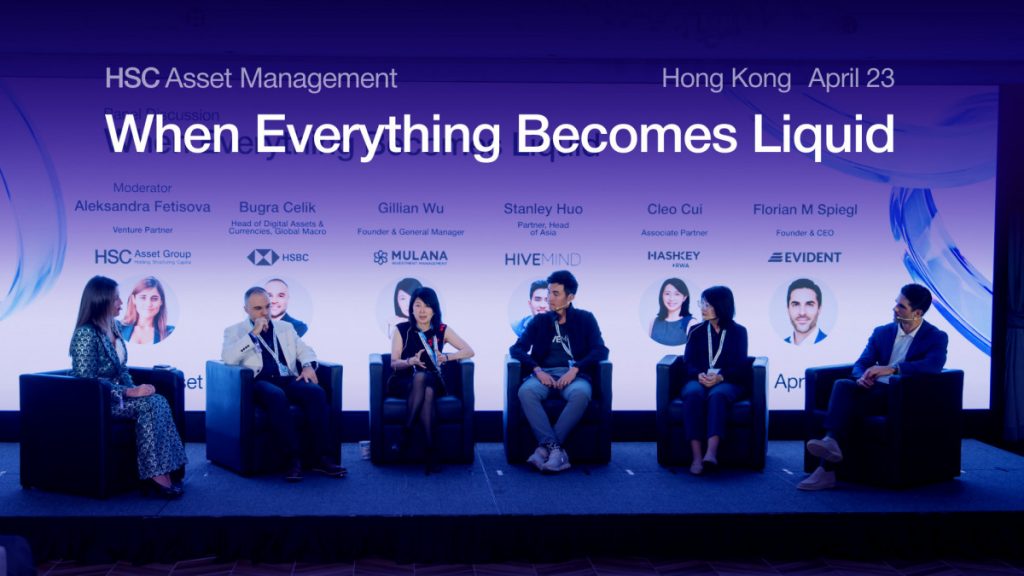
On April 23rd, HSC Asset Management in Hong Kong brought together leading voices from across traditional finance and digital assets to explore the evolving intersection of cryptocurrency, tokenization, and institutional markets.
One of the key panel discussions, “When Everything Becomes Liquid,” examined how tokenization is reshaping financial infrastructure by dissolving the traditional boundaries between asset classes and unlocking liquidity in markets that were once structurally illiquid.
Moderated by Aleksandra Fetisova, Venture Partner at HSC Asset Group, the panel featured Bugra Celik, Head of Digital Assets and Currencies at HSBC; Gillian Wu, Founder and General Manager of Mulana Investment Management; Stanley Huo, Partner and Head of Asia at Hivemind Capital; Cleo Cui, Associate Partner at HashKey RWA; and Florian M. Spiegl, Founder and CEO of Evident Capital.
What “Liquidity” Really Means in Tokenization
The panel began by challenging a common assumption in digital assets: that tokenization automatically creates liquidity. Speakers agreed that tokenization can dramatically improve access, speed, and settlement, but they were careful to distinguish between technical tradability and true market liquidity. A tokenized gold product at HSBC was held up as a strong example of real utility: it is available to retail clients in Hong Kong, trades around the clock, and gives instant visibility and settlement. The scale of that product, with billions in trading volume and hundreds of thousands of trades, was used to show that tokenization can succeed when it wraps an asset that already has natural demand.
Still, the panel warned that tokenization does not magically transform every asset into an active market. As one speaker put it, an illiquid asset remains illiquid if demand is weak. Tokenization can lower friction, improve administration, and broaden access, but the underlying economics of the asset still matter. That point became a recurring thread throughout the discussion: technology helps, but it does not replace fundamentals.

Access, Not Just Trading
Another major theme was that the real value of tokenization is often access rather than speculative trading. In the case of private markets, the speakers noted that many investors already want exposure to assets like private equity, infrastructure, private credit, and even private shares of major companies. Tokenization helps open those opportunities to more investors, including high-net-worth individuals, family offices, and accredited clients who previously had limited routes into these markets.
The panel emphasized that private-market investors typically do not need crypto-style instant liquidity. Instead, they often want the ability to rebalance positions or exit more quickly than the traditional multi-year lockup cycle allows. That distinction was important: liquidity in tokenized private assets does not mean nonstop trading, but rather a more flexible exit window, which can be enough to materially improve the investment experience.
Why the Shift Is Happening Now
The discussion then moved to why tokenization is accelerating at this moment. The consensus was that several forces are converging at once. Regulation has become clearer in multiple jurisdictions, especially in Hong Kong, the United States, Europe, and Singapore. At the same time, institutions are increasingly comfortable treating tokenized assets as a legitimate financial category rather than an experiment on the margins.
Hong Kong was described as especially significant because of its early and relatively strict regulatory approach. That rigor, according to the panel, has helped firms gain credibility with banks, asset managers, and compliance-heavy counterparties. Licensing, once seen as a hurdle, is now increasingly viewed as a commercial advantage. The broader takeaway was that tokenization is no longer being discussed as a future concept; it is moving into mainstream market infrastructure, even if the transition is gradual.
Infrastructure, Distribution, and the Role of Institutions
Several speakers argued that the success of tokenization depends on more than code. It also requires robust sourcing, risk management, distribution, and trusted intermediaries. Pure technology startups, they suggested, often cannot solve the entire problem on their own. The strongest platforms are those that combine technical capabilities with existing financial expertise and strong institutional relationships.
This was especially true in the discussion of distribution. The panel noted that major banks, insurers, and traditional asset managers are already involved in tokenization projects, from private credit to private equity to digital settlement systems. That institutional involvement was seen as critical to scaling the market. In other words, the next phase of tokenization will not be driven by technology alone, but by trusted institutions bringing high-quality assets on chain.
A Future of Interoperability and On-Chain Capital Bridges
In the final part of the conversation, the panel looked ahead to what the market could become if tokenization continues to scale. One speaker highlighted the importance of interoperability across blockchains, arguing that the ecosystem will only reach full potential if different networks can work together seamlessly. Another predicted that in the next few years, more equities, private shares, and private credit opportunities will be issued natively on chain through regulated platforms.
The most optimistic vision was one of “capital bridges” between fragmented markets. Today, private-market investing is often local, manual, and relationship-driven. Tokenization could change that by connecting liquidity pools across regions and enabling global access in a digital environment. The panel was clear, however, that the infrastructure must remain disciplined: strong underwriting, good process, and clear regulation will determine whether the sector matures or overreaches.
The Bottom Line
The discussion ultimately framed tokenization as a structural upgrade to financial markets, not a shortcut to liquidity. Its promise lies in access, efficiency, and better distribution, especially in private markets and regulated digital products. But the panel also made clear that the old rules still apply: quality of asset, quality of counterparties, and quality of process will determine success. Tokenization may change the rails, but it does not eliminate the need for sound investing.
Disclaimer
In line with the Trust Project guidelines, please note that the information provided on this page is not intended to be and should not be interpreted as legal, tax, investment, financial, or any other form of advice. It is important to only invest what you can afford to lose and to seek independent financial advice if you have any doubts. For further information, we suggest referring to the terms and conditions as well as the help and support pages provided by the issuer or advertiser. MetaversePost is committed to accurate, unbiased reporting, but market conditions are subject to change without notice.
About The Author
Alisa, a dedicated journalist at the MPost, specializes in crypto, AI, investments, and the expansive realm of Web3. With a keen eye for emerging trends and technologies, she delivers comprehensive coverage to inform and engage readers in the ever-evolving landscape of digital finance.
More articles
Alisa, a dedicated journalist at the MPost, specializes in crypto, AI, investments, and the expansive realm of Web3. With a keen eye for emerging trends and technologies, she delivers comprehensive coverage to inform and engage readers in the ever-evolving landscape of digital finance.