


How Reactive Smart Contracts Could Turn Trustlessness Into A Real Design Principle


In Brief
For years, crypto has used the word “trustless” as both a slogan and a promise. It has been shorthand for a world where users no longer need banks, brokers, custodians, or other intermediaries to move value and interact financially.
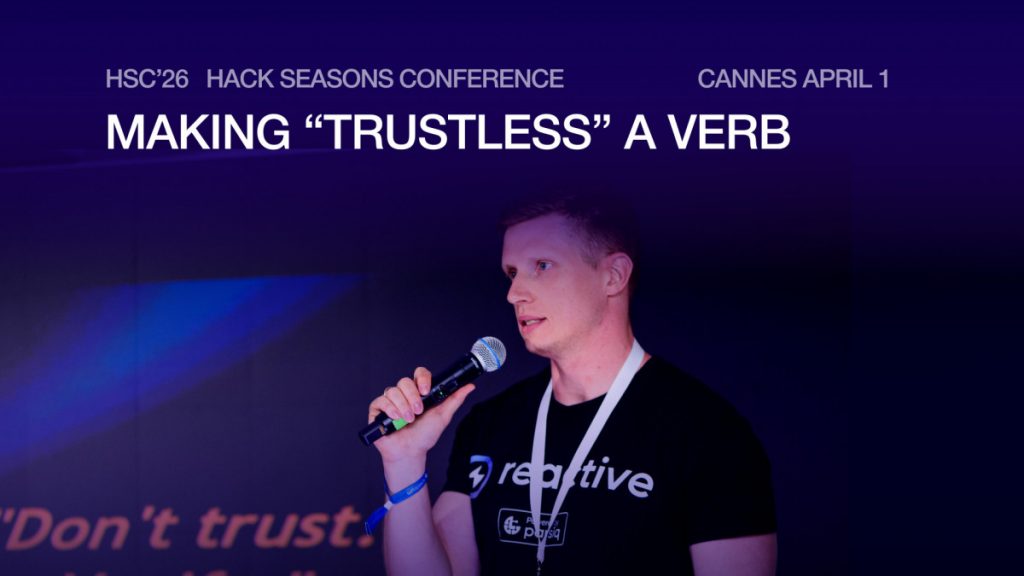
For years, crypto has used the word “trustless” as both a slogan and a promise. It has been shorthand for a world where users no longer need banks, brokers, custodians, or other intermediaries to move value and interact financially. But at HSC Cannes, Emilijus of Reactive Network argued that the industry now faces a harder challenge: turning trustless from a concept into a practical design principle.
His keynote, “Making ‘Trustless’ a Verb,” was less about celebrating what crypto has already achieved and more about exposing the pattern that keeps repeating across the industry. Whenever blockchain manages to solve one level of trust, it is likely to replicate another layer of complexity that is delegated to new intermediaries. That is to say, crypto tends to remove trust to a single place only to quietly reinstate it to another place.
That critique gave the talk its edge. Emilijus was not claiming the industry had failed. He was arguing that it has matured enough to spot its own contradictions and build the next layer more deliberately.
Bitcoin Removed Trust From Payments, but Only at One Level
Emilijus began by going back to first principles. Bitcoin, in his framing, was the breakthrough that removed the need for a middleman in peer-to-peer money transfers. It gave users a way to transact without needing a central bank or payment intermediary to authorize, block, or reverse the exchange.
That was the original leap. Bitcoin proved that money could move without trusted institutions standing between two parties. But its functionality was narrow. It could transfer value, but it could not express more complex logic beyond that.

That limitation set the stage for Ethereum, which Emilijus described as doing for agreements what Bitcoin did for money. Smart contracts took the idea of trust minimization and extended it into programmable arrangements. Code could now enforce lending, exchanges, collateral, and settlement without relying on a central operator to supervise every step.
For a while, that looked like the natural next phase of trustlessness. But then demand exposed a different problem.
DeFi Proved the Model, Then Exposed the Cost of Scale
The 2020 DeFi summer became a turning point in the keynote’s historical arc. Emilijus treated it as proof that a large part of financial infrastructure could run directly on code. Lending markets, decentralized exchanges, stablecoins, and liquidity incentives showed that the onchain model was not just theoretical. It worked.
But success came with strain. Although Ethereum is the most trusted programmable blockchain, it was not designed to handle every burst of activity at low cost. Traffic jammed, charges soared and users were being charged very high prices only to move money or even to interact with protocols.
That is when the industry shifted into scaling mode. Layer 2s appeared as the obvious answer. They were supposed to preserve Ethereum’s security while giving users faster and cheaper execution. In practice, they did help solve the throughput problem. But Emilijus argued that they also complicated the trust model.
Not every Layer 2 was fully decentralized. Others were dependent on centralized sequencers or other trust assumptions which, however, were still far short of the ideal many in crypto were purportedly supporting. This meant that even as the ecosystem began to scale to the point where it made blockchain interesting in the first place, it eroded some of the trustless traits that had made blockchain fascinating in the first place.
That, to Emilijus, is the same old story about crypto infrastructure: a solved problem has a tendency to create a second one.
Cross-Chain Infrastructure Reintroduced Middlemen in a New Form
Fragmentation was the next big challenge as he put it up. As assets and applications became decentralized across a variety of chains and Layer 2s, crypto started to resemble a fractured internet, where systems could not communicate in their natural form. Moving value between networks became awkward, slow, and often risky.
Bridges and messaging protocols emerged to solve that. But here again, trustlessness often gave way to convenience. Early bridge designs were dangerously simple, sometimes relying on a single key or a small multisig. Even as the technology improved, the industry saw repeated exploits and massive losses. The result was an uncomfortable reality: the moment users needed automation or cross-chain interaction, they were often back to trusting external infrastructure.
Emilijus’s point was not that bridging was unnecessary. It was that crypto has repeatedly tolerated new trust assumptions whenever the next technical bottleneck appears. That makes trustlessness less of a fixed property and more of an unfinished process. This is where Reactive Network places its bet.
Reactive Contracts Aim to Make Automation Native and On-chain
The essence of the keynote was what Emilijus believes to be the next missing puzzle: trustless automation.
Most crypto automation remains today based on external bots, off-chain keepers, and semi-centralized services that monitor events and consequently run logic. It is to say that there are several applications that seem to be decentralized at the level of smart contracts, but still have to use external infrastructure to operate in real time.
The solution of the Reactive Network is what Emilijus referred to as reactive contracts. These can be used like standard Solidity contracts, except they are not invoked by explicit calls made by a user. When the event being subscribed to takes place, the reactive contract is able to execute logic and, in the event that it is required, make things happen either on the same chain as the event or on a different chain altogether.
That is the architectural leap he wants developers to pay attention to. In his view, it allows automation itself to become part of the blockchain environment rather than something coordinated by an external actor.
He framed this as an “on-chain if-this-then-that” system. If a condition happens on Ethereum, logic can fire automatically. If a threshold is reached, another action can follow. If a protocol wants to build stop orders, liquidation protection, automated leverage management, or multi-step workflows across chains, it can do so without moving that logic off-chain.
That is the verb form of trustless he was trying to define. Not just a secure settlement. Not just deterministic contracts. But active infrastructure that responds to events and enforces outcomes without a separate trusted operator sitting in the middle.
Trustless Infrastructure Becomes More Meaningful When It Is Verifiable
One of Emilijus’s stronger points was that reactive automation is not only about convenience. It is also about accountability.
If an action is triggered by an on-chain event and executed through on-chain logic, then users can inspect the full trail. They can see what event fired, what logic was executed, and what consequence followed on the destination chain. That creates a more transparent record of automated behavior than the off-chain bot model many protocols still use.
In the case of liquidations, rebalancing, cross-chain workflows, or event-driven strategies, such a degree of traceability is important. It implies that the users do not need to ask themselves whether a keeper acted fairly or whether an external operator made a discretionary decision. The action can be tied back directly to code and on-chain conditions.
That does not make the entire industry instantly trustless. But it does push one more function into a verifiable, programmable environment.
The Next Phase of Crypto May Be About Removing Hidden Trust
What made the keynote work was that it did not pretend trustlessness had already been achieved. It argued that the industry is still in the middle of defining it properly.
Bitcoin reduced trust in payments. Ethereum reduced trust in agreements. DeFi proved that financial primitives could run on code. Layer 2s fixed cost and speed bottlenecks, but often at the expense of simplicity in the trust model. Bridges expanded interoperability, but introduced new vulnerabilities and external dependencies.
Now the next challenge is automation. If crypto wants to remove hidden intermediaries rather than just replacing obvious ones, then event-driven logic and cross-chain coordination also need to become native, transparent, and verifiable.
That is the future Emilijus was pointing toward at HSC Cannes. In his version of the industry’s next step, trustless is no longer just an adjective used to describe blockchain in theory. It becomes something applications actively do.
Disclaimer
In line with the Trust Project guidelines, please note that the information provided on this page is not intended to be and should not be interpreted as legal, tax, investment, financial, or any other form of advice. It is important to only invest what you can afford to lose and to seek independent financial advice if you have any doubts. For further information, we suggest referring to the terms and conditions as well as the help and support pages provided by the issuer or advertiser. MetaversePost is committed to accurate, unbiased reporting, but market conditions are subject to change without notice.
About The Author
Alisa, a dedicated journalist at the MPost, specializes in crypto, AI, investments, and the expansive realm of Web3. With a keen eye for emerging trends and technologies, she delivers comprehensive coverage to inform and engage readers in the ever-evolving landscape of digital finance.
More articles
Alisa, a dedicated journalist at the MPost, specializes in crypto, AI, investments, and the expansive realm of Web3. With a keen eye for emerging trends and technologies, she delivers comprehensive coverage to inform and engage readers in the ever-evolving landscape of digital finance.