How Privacy-Preserving Tokens Could Unlock The Next Phase Of Institutional DeFi


In Brief
Institutional DeFi has spent years trying to convince traditional capital that public blockchains can offer better settlement, wider access, and new forms of programmable finance.
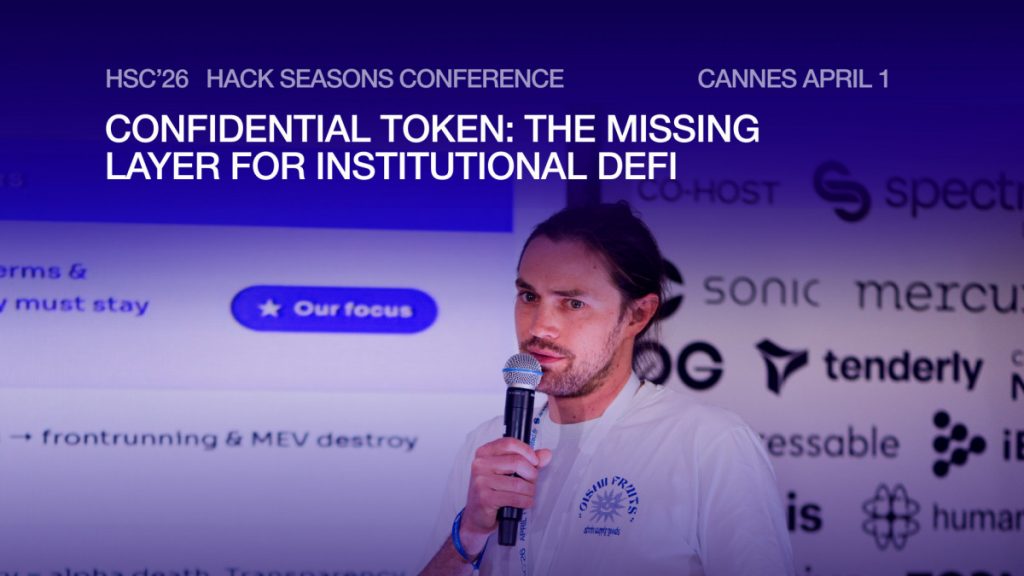
Institutional DeFi has spent years trying to convince traditional capital that public blockchains can offer better settlement, wider access, and new forms of programmable finance. The pitch has always been compelling on paper. The notion of markets that run 24 hours, facilitate settlement effectively in real time, lower the cost of coordination, and support composable infrastructure all sound like natural extensions of traditional finance. But to the majority of institutional players, there has been one fundamental issue that has not been resolved, and that is confidentiality.
That was the central argument in a keynote at HSC Cannes, where iExec product marketing manager Matthieu Jung laid out why privacy-preserving token infrastructure could be the missing piece that finally makes institutional DeFi viable at scale. His case was simple. Institutions are not avoiding on-chain finance because they do not see the opportunity. They are holding back because today’s public DeFi environment still exposes too much information.
DeFi’s biggest users are not all facing the same privacy problem
Jung framed his keynote around the discovery process that led iExec to build its confidential token product. That process began with a broad market analysis of major blockchain ecosystems, including Ethereum, Arbitrum, Base, Solana, and Hyperliquid. The team mapped DeFi activity by category and found a familiar structure: lending, liquid staking, DEXs, yield, derivatives, and real-world assets.
What stood out to them was that the real-world asset segment remained relatively small compared to more mature DeFi sectors. That mattered because in categories like lending or liquid staking, one or two dominant protocols already capture much of the market. In those segments, competition is tighter, and user behavior is more established. By contrast, tokenized real-world assets remain early, fragmented, and structurally open.
But the more important insight came from user interviews. According to Jung, iExec spoke with more than 100 people across the ecosystem and found that confidentiality problems looked very different depending on who was being asked.

Privacy concerns already are a friction point to crypto-native traders, the users of DAOs, and derivatives. They are concerned about front-running, alpha leakage, sandwich attacks, and exposure to MEV. But those users have, to some extent, learned to live with those conditions. They are used to operating in public markets and understand the trade-offs.
Institutions are different. For them, confidentiality is not just a friction point. It is often a legal and operational blocker.
Institutions want the rails, but not the exposure
One of the keynote’s clearest messages was that institutions are already attracted to what blockchains can do. They want instant settlement. They want 24/7 markets. They want access to new forms of liquidity and more efficient financial infrastructure. In other words, they are not rejecting the benefits of DeFi.
What they do reject is the idea that moving capital on-chain should require them to reveal position sizes, investor allocations, or transaction details to the entire market.
That is where the public nature of today’s DeFi becomes a problem. If an institution wants to move a large amount of capital into a strategy, a tokenized fund, or an on-chain asset, that activity can become visible in real time. According to Jung, this creates obvious issues around execution, allocation, privacy, and compliance-sensitive data.
From the perspective of a traditional institutional allocator, this is not a minor inconvenience. It cuts directly against how professional capital normally operates. Asset managers, treasuries, and fund structures are built around the controlled disclosure of sensitive information, not full public exposure by default.
That gap helps explain why so much institutional blockchain activity has remained cautious, permissioned, or limited in scope. It is possible that the technology stack already has on-chain settlement and tokenization. However, in the absence of privacy-preserving infrastructure, it remains usable by many institutions in ways that they cannot afford to do. It is possible that the technology stack already has on-chain settlement and tokenization. However, in the absence of privacy-preserving infrastructure, it remains usable by many institutions in ways that they cannot afford to do.
Real-world assets are growing, but the gap is still enormous
Jung supported that argument by pointing to the rapid growth of tokenized real-world assets over the last few years. He said the market had grown from roughly $3 billion three years ago to about $26 billion by March 2026, with expectations of exceeding $100 billion in the near future.
Even so, he stressed that the current market remains tiny relative to the full addressable opportunity. The broader real-world asset universe that could eventually be tokenized is measured in the tens of trillions, while just the global fund industry alone is expected to reach around $30 trillion in assets under management in the coming years.
The implication is hard to miss. Even after recent growth, on-chain real-world assets still represent only a tiny fraction of what could move onto public blockchain rails.
That is why confidentiality matters so much. If tokenization is going to scale beyond a narrow early-adopter set, infrastructure has to support the actual operating constraints of institutional finance. For iExec, that means building privacy directly into token behavior rather than treating it as a secondary feature.
The confidential token is designed to hide what institutions cannot expose
The product Jung presented is meant to do exactly that. The confidential token acts as a wrapper around existing ERC-20 assets, allowing users to move from a public token state into a private one when needed. Inside what he described as a confidential zone, balances and transaction amounts are hidden, while the system still aims to preserve composability and selective auditability.
That last part is especially important. Institutions do not just need privacy. They also need the ability to disclose information when regulators, auditors, or internal stakeholders require it. Total opacity would not solve the institutional problem either. What matters is controlled visibility.
Jung’s pitch, then, is not for a fully hidden financial system. It is for a more flexible infrastructure layer where institutions can protect sensitive information by default while still meeting regulatory obligations when necessary.
He argued that this is the kind of architecture institutional DeFi has been missing. If a manager wants to move $15 million on-chain, they should not have to choose between public exposure and staying out of DeFi entirely. Privacy-preserving wrappers could allow that capital to interact with on-chain markets more safely and more realistically.
Privacy may be the next unlock for institutional DeFi
What made the keynote notable was that it did not treat confidentiality as a side feature for edge cases. Jung presented it as a foundational requirement for DeFi’s next stage of growth.
That argument feels timely. Tokenization has advanced. Stablecoins have become mainstream financial rails. Institutional interest in on-chain assets is no longer in doubt. But large-scale participation still runs into structural issues that retail users and crypto-native traders often underestimate.
Confidentiality is one of those issues. Public blockchains are excellent at transparency, but institutional markets do not function on radical transparency alone. They function on controlled disclosure, selective reporting, and the ability to manage information without broadcasting every move.
At HSC Cannes, Jung’s message was that institutional DeFi may not need a completely different financial system to grow. It may just need a missing layer that makes public rails usable for private capital. In that sense, confidential tokens are not being pitched as a niche upgrade. They are being positioned as the bridge between DeFi’s open architecture and the realities of institutional finance.
Disclaimer
In line with the Trust Project guidelines, please note that the information provided on this page is not intended to be and should not be interpreted as legal, tax, investment, financial, or any other form of advice. It is important to only invest what you can afford to lose and to seek independent financial advice if you have any doubts. For further information, we suggest referring to the terms and conditions as well as the help and support pages provided by the issuer or advertiser. MetaversePost is committed to accurate, unbiased reporting, but market conditions are subject to change without notice.
About The Author
Alisa, a dedicated journalist at the MPost, specializes in crypto, AI, investments, and the expansive realm of Web3. With a keen eye for emerging trends and technologies, she delivers comprehensive coverage to inform and engage readers in the ever-evolving landscape of digital finance.
More articles
Alisa, a dedicated journalist at the MPost, specializes in crypto, AI, investments, and the expansive realm of Web3. With a keen eye for emerging trends and technologies, she delivers comprehensive coverage to inform and engage readers in the ever-evolving landscape of digital finance.