Hack Seasons Cannes: Institutional Adoption Has Arrived—But Is It Killing Crypto’s Original Vision Or Scaling It?



In Brief
Hack Seasons Cannes panel explores institutional crypto adoption driven by ETFs and tokenization, highlighting regulation, infrastructure gaps, stablecoins, and the convergence of TradFi and DeFi in global markets.
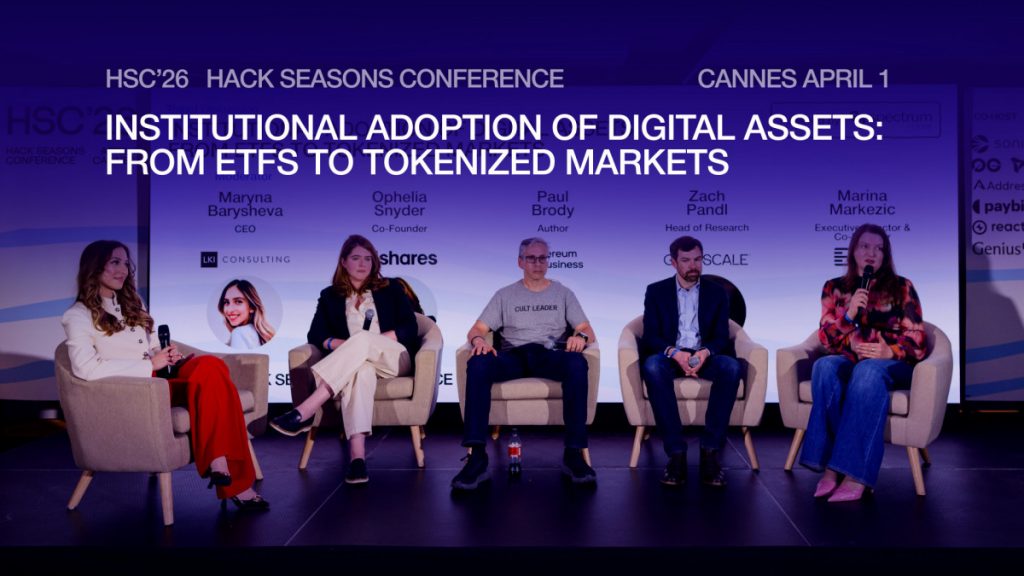
On April 1st, the Hack Seasons Conference in Cannes brought together industry leaders to explore the latest developments and opportunities in institutional digital assets.
One of the key panel discussions, “Institutional Adoption of Digital Assets,” examined the pathways institutions are taking to enter digital asset markets. Moderated by Maryna Barysheva, CEO of LKI Consulting, the session featured Ophelia Snyder, Co-Founder of 21Shares; Paul Brody, Author of Ethereum for Business; Zach Pandl, Head of Research at Grayscale Investments; and Marina Markezic, Executive Director & Co-Founder of EUCI. The panel focused on regulatory clarity, product innovation, and the key requirements needed to bridge traditional finance and decentralized finance at scale.
The panel opened with a clear framing: institutional adoption is no longer a future narrative, but a present-day shift driven by ETFs, real-world assets (RWAs), and the gradual integration of traditional finance into blockchain infrastructure. After brief introductions from speakers the conversation quickly moved to the central question: what trend best defines the current market?
The speakers agreed that institutional adoption is accelerating, with ETFs surpassing $150 billion and RWA markets reaching $30 billion. However, they immediately diverged on what is driving this shift.
One of the first themes to emerge was the idea that history is repeating itself. Some panelists argued that institutions experimenting with permissioned blockchains are mirroring earlier cycles in banking, where early private systems eventually migrated toward open networks like Ethereum. Others emphasized a regulatory tailwind, particularly in Europe, where policymakers are increasingly enthusiastic about tokenization, even if skepticism around crypto assets remains.

The discussion then broadened to a key inflection point: the industry is shifting from questioning whether crypto is investable to asking how blockchain rails can improve traditional financial infrastructure. This transition, speakers agreed, is forcing both regulators and firms to confront a deeper challenge—how to operationalize crypto at scale within existing financial market norms.
From Market Cycles To Institutional Infrastructure Bottlenecks
The panel then switched focus from macro trends to market structure and adoption barriers. While optimism around entry points and macro signals was discussed, the conversation quickly returned to infrastructure readiness.
Speakers highlighted that large financial institutions are not merely waiting for legal permission, but for clear regulatory roadmaps and fully mature infrastructure capable of handling trillions in transaction volume with near-zero tolerance for failure. This led to a broader realization: the scale and complexity of traditional finance are still widely underestimated within crypto-native discourse.
Another unexpected friction point emerged—internal resistance within financial institutions themselves. Even when strategy supports blockchain adoption, organizational silos and “infrastructure turf wars” are slowing integration efforts.
Stablecoins, Regulation, And Europe’s Fragmented Path Forward
The conversation then moved into regulation, particularly in Europe. Speakers noted that while frameworks like MiCA have formalized crypto oversight, adoption remains uneven, with licensing bottlenecks and liquidity fragmentation—especially in non-USD stablecoin markets.
Debate intensified around whether Europe can compete with more agile jurisdictions such as Singapore or Hong Kong. While some emphasized regulatory rigor and long-term stability, others argued that Europe risks falling behind without faster execution and clearer policy alignment.
Stablecoins became a focal point, with panelists discussing multi-issuance debates, ECB concerns over financial stability, and emerging ideas such as digital euro and tokenized central bank money. The consensus: monetary design itself is now part of the crypto adoption cycle.
The Institutional Era And The Future Of Crypto’s Identity
As the panel neared its conclusion, the discussion widened into a philosophical divide: will crypto become “plumbing” for traditional finance, or remain a distinct parallel system?
Some argued that crypto’s long-term value lies in infrastructure efficiency and integration with TradFi, enabling yield optimization and improved financial plumbing. Others pushed back, emphasizing the enduring importance of crypto’s original ethos—self-custody, censorship resistance, and permissionless innovation.
The final takeaway was a nuanced convergence: institutional adoption is accelerating, but it is also reshaping crypto itself. The next cycle will not be defined by retail speculation alone, but by sovereign funds, pension capital, regulatory clarity, and the gradual merging of financial systems.
Disclaimer
In line with the Trust Project guidelines, please note that the information provided on this page is not intended to be and should not be interpreted as legal, tax, investment, financial, or any other form of advice. It is important to only invest what you can afford to lose and to seek independent financial advice if you have any doubts. For further information, we suggest referring to the terms and conditions as well as the help and support pages provided by the issuer or advertiser. MetaversePost is committed to accurate, unbiased reporting, but market conditions are subject to change without notice.
About The Author
Alisa, a dedicated journalist at the MPost, specializes in crypto, AI, investments, and the expansive realm of Web3. With a keen eye for emerging trends and technologies, she delivers comprehensive coverage to inform and engage readers in the ever-evolving landscape of digital finance.
More articles
Alisa, a dedicated journalist at the MPost, specializes in crypto, AI, investments, and the expansive realm of Web3. With a keen eye for emerging trends and technologies, she delivers comprehensive coverage to inform and engage readers in the ever-evolving landscape of digital finance.