


Figma’s 2026 AI Report: As Role Boundaries Blur, Design Emerges As The New Competitive Edge



In Brief
Figma’s 2026 AI report reveals how AI is dissolving role boundaries, boosting team collaboration, and making design more valuable than ever.

Digital design and prototyping platform Figma released a new report, highlighting that AI’s influence on product development has moved well beyond individual productivity gains and is now fundamentally reshaping how entire teams collaborate.
Based on 8,403 survey responses collected across three years and 639 qualitative interviews with designers, developers, and product managers across ten markets, the 2026 AI Report identifies a defining shift: the boundaries between professional roles are dissolving, and the design canvas has emerged as the central space where cross-functional work converges.
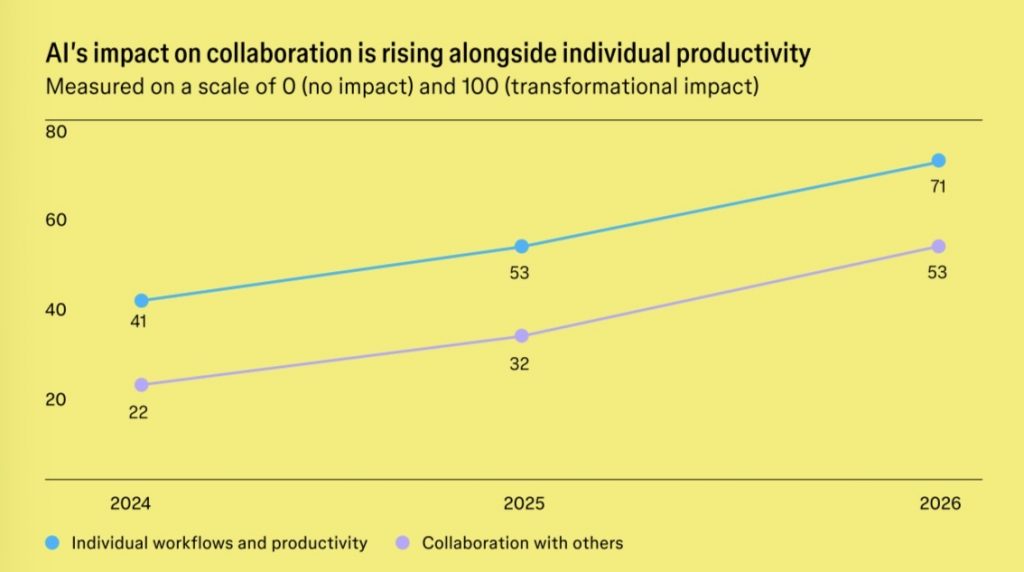
The headline figures are impressive. The share of developers participating in design work jumped from 44% to 60% in a single year, while designers engaging in development work nearly doubled, rising from 21% to 41%. 70% of product builders report using AI to accomplish tasks that were previously outside their skillset, and over half say they have abandoned linear handoffs entirely. Meanwhile, 41% of respondents say AI has changed how their team works together — six times the number who said the same two years ago.
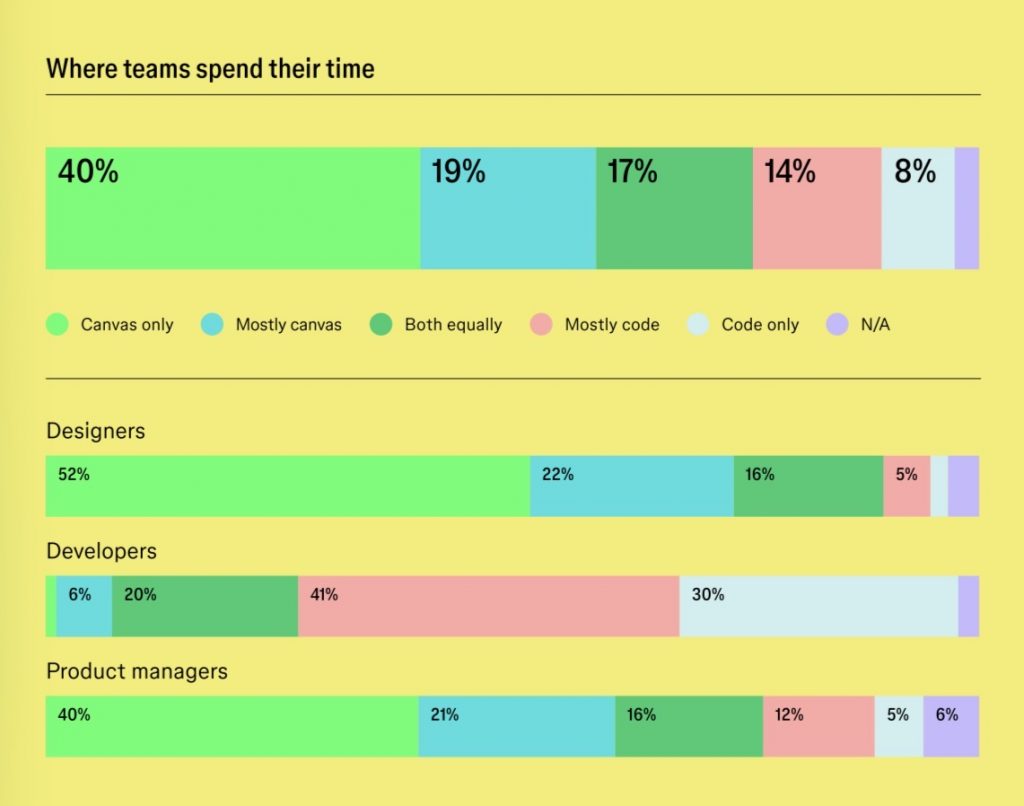
These numbers reflect a structural change rather than a productivity trend: AI has lowered the technical barriers between disciplines, enabling a more fluid loop in which work moves continuously between code and canvas. Notably, 76% of product builders say at least half their work now happens on the canvas — making it not just a designer’s tool, but the shared workspace of the modern product team.
In 2026 Design’s Value Is Rising, Not Declining
A core finding of the report concerns design’s perceived importance in an AI-accelerated environment. Counterintuitively, as code generation becomes more accessible, design expertise is growing more valuable, not less. 90% of respondents building AI-powered products say design is at least as important as it was before AI, and 57% say it is more important — a figure that climbs to 65% among developers. Respondents with the deepest AI integration in their workflows are 25% more likely to say design’s importance is increasing, suggesting that exposure to AI’s limitations drives appreciation for human judgment in shaping user experience.

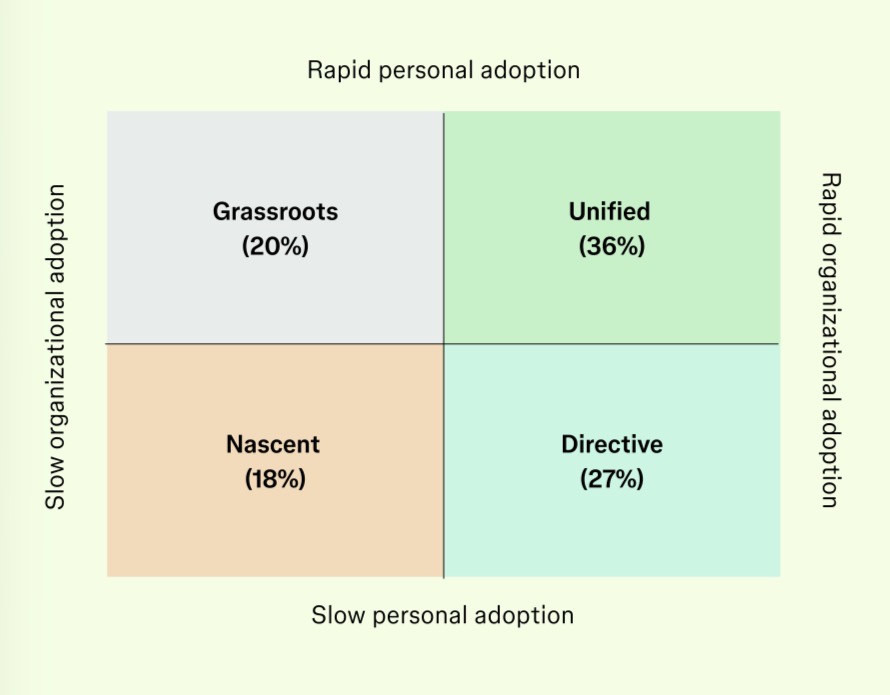
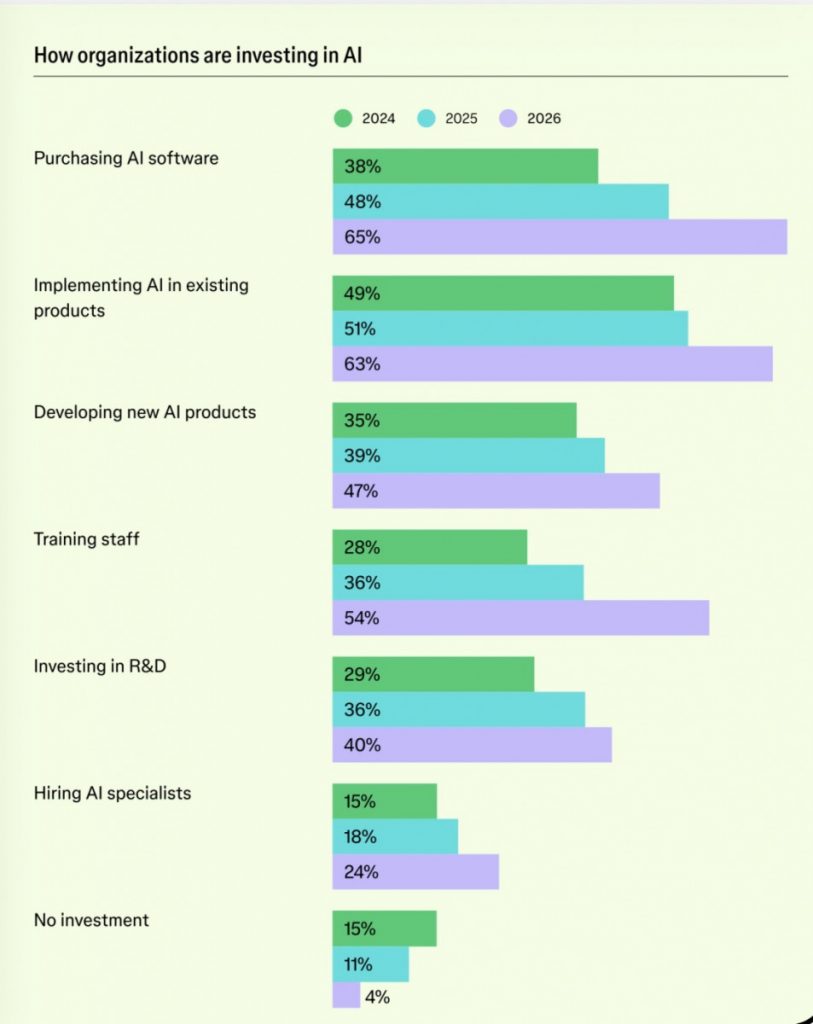
The report also maps four distinct patterns of organizational AI adoption — Unified, Grassroots, Directive, and Nascent — finding that the deepest impact is achieved when individual adoption and organizational enablement advance in parallel. Companies in the “Unified” category, representing 36% of respondents, report the highest scores across all six impact dimensions, with productivity outcomes exceeding prior-year expectations for the first time. By contrast, “Grassroots” adopters — where individuals outpace their organizations — face a 35-point expectation gap, revealing that personal enthusiasm cannot substitute for institutional investment. The proportion of companies training staff in AI use has nearly doubled, from 28% to 54%, signaling a broader shift from ad-hoc experimentation to structured enablement.
Figma’s findings position 2026 as an inflection point: AI’s promise of faster, more fluid product development is materializing not through the rise of the individual power user, but through teams learning to work together in genuinely new ways.
Disclaimer
In line with the Trust Project guidelines, please note that the information provided on this page is not intended to be and should not be interpreted as legal, tax, investment, financial, or any other form of advice. It is important to only invest what you can afford to lose and to seek independent financial advice if you have any doubts. For further information, we suggest referring to the terms and conditions as well as the help and support pages provided by the issuer or advertiser. MetaversePost is committed to accurate, unbiased reporting, but market conditions are subject to change without notice.
About The Author
Alisa, a dedicated journalist at the MPost, specializes in crypto, AI, investments, and the expansive realm of Web3. With a keen eye for emerging trends and technologies, she delivers comprehensive coverage to inform and engage readers in the ever-evolving landscape of digital finance.
More articles
Alisa, a dedicated journalist at the MPost, specializes in crypto, AI, investments, and the expansive realm of Web3. With a keen eye for emerging trends and technologies, she delivers comprehensive coverage to inform and engage readers in the ever-evolving landscape of digital finance.