


BlackRock, HSBC, And Standard Chartered Signal A New Financial Era At HSC Asset Management’s Hong Kong Panel



In Brief
At HSC Hong Kong, leaders from BlackRock, HSBC, and Standard Chartered explored how tokenization, regulation, and infrastructure are reshaping finance and accelerating the shift to on-chain markets.
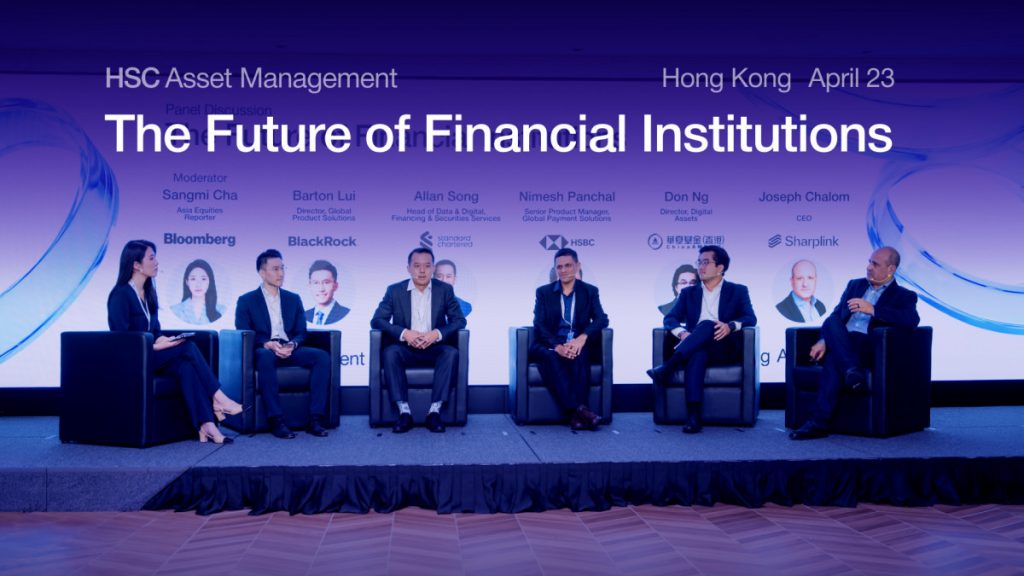
On April 23, HSC Asset Management in Hong Kong brought together industry leaders to examine the evolving landscape of cryptocurrency and institutional finance.
One of the key panel discussions, titled “The Future of Financial Institutions,” explored how traditional financial players are adapting their business models and infrastructure to compete in an increasingly on-chain world.
Moderated by Sangmi Cha, Asia Equities Reporter at Bloomberg, the panel featured Barton Lui, Director of Global Product Solutions at BlackRock; Allan Song, Head of Data & Digital for Financing & Securities Services at Standard Chartered Bank; Joseph Chalom, CEO of Sharplink; Don Ng, Director of Digital Assets at China Asset Management; and Nimesh Panchal, Senior Product Manager for Global Payment Solutions at HSBC, who shared insights on how institutions are navigating this transition.
Capital Reallocation and the End of Old Market Frictions
The panel opened with a clear sense that a major financial shift is already underway. Across traditional markets and digital assets, speakers agreed that capital is being pushed to reconsider where it sits, how fast it moves, and which infrastructure can support it. Geopolitical tension, regulatory change, and the limits of old settlement systems were all cited as forces accelerating this reallocation. What once moved only through intermediaries, during limited market hours and with lengthy settlement cycles, is now being reimagined in a world of 24/7 markets, stablecoins, and tokenized assets.
The panel’s strongest shared belief was that this is not just a crypto story. It is a broader restructuring of financial rails. The discussion repeatedly returned to one point: the old assumptions around trading hours, settlement delays, and market access no longer fit the pace of modern capital.

From Experimentation to Implementation
A major theme was the industry’s transition from experimentation to execution. Several speakers described the last few years as a period when institutions were still testing tokenization through pilots, fractionalization, and small-scale digital asset initiatives. That phase, they argued, was important but incomplete. Today, the conversation has shifted from “should we do this?” to “how should we do this properly?”
That change in attitude reflects a more mature market. Institutions are no longer treating digital assets as a side project or speculative novelty. Instead, they are asking how tokenization can fit into real product design, client service, and regulated operations. Hong Kong’s regulatory progress, especially recent developments around secondary trading and stablecoins, was seen as an important signal that the market is moving closer to practical adoption.
Why TradFi and DeFi Bring Different Strengths
The panel also explored the growing convergence between decentralized finance and traditional finance. Rather than framing the two as enemies, speakers described them as having different value propositions. DeFi brings speed, experimentation, and fresh ideas. Traditional institutions bring scale, trust, compliance, and client protection.
That distinction mattered. Large institutions were described as moving more carefully not because they are slower by nature, but because they carry responsibilities that DeFi-native players often do not. Protecting clients, complying with regulation, and maintaining reputational trust were presented as non-negotiable. At the same time, the speakers acknowledged that DeFi’s innovations are influencing how banks and asset managers think about product design and user experience. The future, they suggested, will be less about two separate worlds and more about convergence into a shared ecosystem.
What Will Tokenize First
When the conversation turned to which asset classes are most likely to move on chain first, cash-like instruments came out clearly ahead. Stablecoins, money market funds, and tokenized deposits were described as the obvious starting point because they already resemble the core logic of tokenization: speed, transparency, and efficient movement of value. One speaker noted that tokenized money market funds are especially useful as yield-bearing collateral, a use case already familiar in DeFi.
Bonds were identified as another likely frontier, though with more complexity. Unlike cash, bonds are often buy-and-hold instruments, so the promised liquidity benefits may be less dramatic. Still, tokenized bonds were framed as part of the broader shift toward more efficient market infrastructure. The panel was united in the view that tokenization succeeds best when it improves something the market already wants, rather than forcing a completely new behavior.
Liquidity, Not Technology, as the Real Bottleneck
One of the most pointed disagreements centered on the biggest barrier to tokenizing everything. For some speakers, the answer was liquidity. Tokenization can make any asset technically tradable, but that does not mean there will be buyers, market makers, or meaningful volume. Liquidity, they argued, will likely need to come first from traditional assets and institutions before tokenized markets can scale on their own.
Others added a related but slightly different concern: cash leg readiness. The asset side may already be prepared, they argued, but if the payment side remains trapped in legacy rails, the full promise of tokenization cannot be realized. This was especially relevant in Hong Kong, where recent moves toward regulated stablecoins were seen as critical because they could finally make the cash side of the transaction fully on chain.
Regulation, Coexistence, and the Geopolitical Race
The panel repeatedly returned to regulation as the essential enabler. Clarity on securities status, settlement, custody, and cross-border rules was seen as the foundation for institutional adoption. But regulation was also discussed in geopolitical terms. Speakers warned that stablecoins, especially dollar-denominated ones, are reshaping global finance and creating anxiety in jurisdictions that do not want to lose monetary influence. This made the rise of local-currency stablecoins and digital hubs in Asia part of a much larger strategic race.
Despite those concerns, the panel did not see digital assets replacing traditional finance. Instead, they described a future of coexistence. Existing systems such as banks, payment rails, and custodians will not vanish. Rather, tokenization and digital assets will gradually sit beside them, then merge into them, until the technology becomes invisible to most users.
AI, Risk, and the Next Inflection Point
The final theme centered on AI’s growing role in the digital asset ecosystem. Speakers saw clear upside in using AI for anomaly detection, screening, and code analysis, especially in systems that must operate in real time. But they also warned that AI introduces a new kind of systemic concern: legacy code and fragile infrastructure may now be exposed faster than institutions can fix them. One speaker called this the most worrying near-term risk, arguing that AI is already capable of finding bugs and vulnerabilities in critical financial systems.
The closing message of the panel was that the next major inflection point will not come from a single invention, but from the combination of regulation, liquidity, interoperability, and better infrastructure. The tools are becoming available. The challenge now is making the entire system work together.
Disclaimer
In line with the Trust Project guidelines, please note that the information provided on this page is not intended to be and should not be interpreted as legal, tax, investment, financial, or any other form of advice. It is important to only invest what you can afford to lose and to seek independent financial advice if you have any doubts. For further information, we suggest referring to the terms and conditions as well as the help and support pages provided by the issuer or advertiser. MetaversePost is committed to accurate, unbiased reporting, but market conditions are subject to change without notice.
About The Author
Alisa, a dedicated journalist at the MPost, specializes in crypto, AI, investments, and the expansive realm of Web3. With a keen eye for emerging trends and technologies, she delivers comprehensive coverage to inform and engage readers in the ever-evolving landscape of digital finance.
More articles
Alisa, a dedicated journalist at the MPost, specializes in crypto, AI, investments, and the expansive realm of Web3. With a keen eye for emerging trends and technologies, she delivers comprehensive coverage to inform and engage readers in the ever-evolving landscape of digital finance.