At HSC Conference Seoul, The ‘Financial Infrastructure In The Digital Economy’ Panel Mapped How AI Agents And Tokenization Will Reshape Global Finance



In Brief
At HSC Conference in Seoul, the Financial Infrastructure in the Digital Economy panel debated AI agents, crypto regulation, tokenization, and the future of on-chain finance.
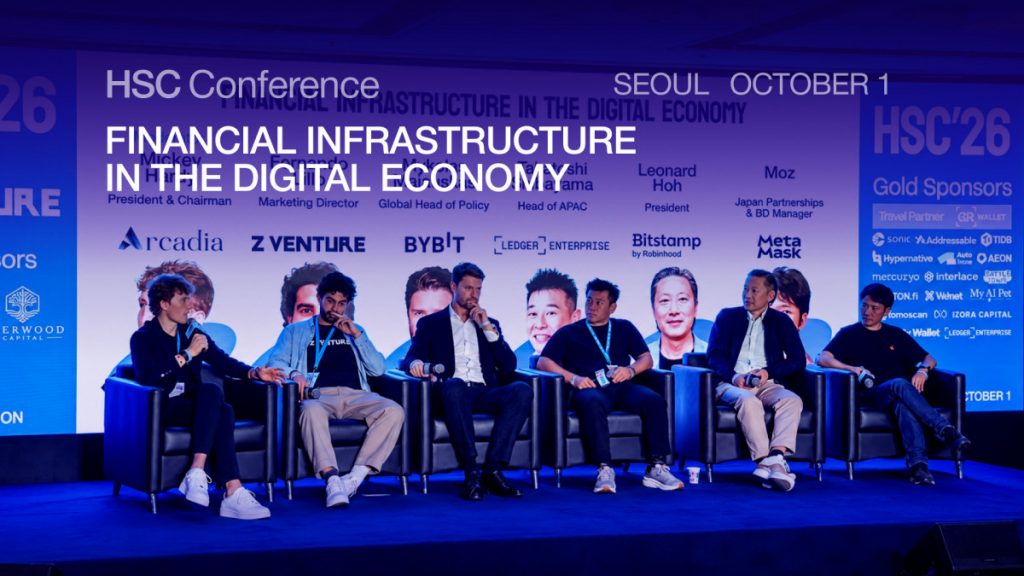
On October 1, 2026, the HSC Conference returned to Seoul, gathering senior voices from financial institutions, crypto investment funds, and technology companies to debate the future of digital finance.
Among the event’s most anticipated discussions was “Financial Infrastructure in the Digital Economy,” a deep dive into the rails, platforms, and institutions reshaping how value moves in a digital-first financial system. Moderator: Mickey Hardy, Founder & Chairman, Arcadia. Panelists: Fernando Lillo, Marketing Director, Z Venture; Mykolas Majauskas, Global Head of Policy, Bybit; Takatoshi Shibayama, Head of APAC, Ledger Enterprise; Leonard Hoh, President, Bitstamp by Robinhood; Moz, Japan Partnerships & BD Manager, MetaMask.
The Agentic Economy Comes On Chain
The panel opened with moderator Mickey Hardy posing a question that would not have been conceivable two or three years ago: how will AI agents transact on financial infrastructure? As he noted, agents could soon be executing millions of transactions a day, arguably more than humans.
Mykolas Majauskas, Global Head of Policy at Bybit, framed the shift in stark terms, drawing on his firm’s experience running roughly $20 billion in daily trading volume, with AI already informing a large share of financial decisions. “We’re getting into the stage where we’ve been focusing on knowing your customer to understanding that the customer is not necessarily a human but a software,” he said, predicting a future of “know your AI” alongside traditional KYC. Agents, he added, “don’t care about the banking app colors design. What they care is: is it readable, is it programmable, can you access it 24/7.”
Takatoshi Shibayama, Head of APAC at Ledger Enterprise, outlined a roadmap in which devices encode rules and policies for agents, ensuring that humans remain in the loop for significant transactions. For instance, agents might operate freely up to a $1,000 threshold before requiring human approval. Leonard Hoh, President of Bitstamp by Robinhood, pointed to Robinhood’s launch of agentic trading, while Moz of MetaMask described an open-source agentic wallet, arguing that “the beauty of open source” means the ecosystem must build the agentic future together.

Regulation: Fragmented but Competitive
Having surveyed the technological horizon, the conversation turned to policy, and the panel agreed that regulation remains the industry’s defining tension. Majauskas argued that “crypto touches everything that government wants to control,” making increased government oversight inevitable, but stressed that competition between jurisdictions, from the EU’s MiCA to the US GENIUS and CLARITY acts, creates opportunities. Fernando Lillo of Z Venture warned that intensive regulation can “kill innovation,” calling for standard frameworks that reduce friction across markets, while Moz noted that regulation is only beginning to converge globally.
What Comes On Chain, and What Stays Off
The discussion then shifted from rules to roadmaps: asked what will move on chain in the next three to five years, the panel diverged productively. Lillo pointed to stablecoins and real-world asset tokenization as the next liquidity wave. Hoh pushed back as a self-described contrarian, warning that tokenizing everything ignores the question of demand: “Blockchain is not the answer to every problem. If it were easier to use pigeons, we would use pigeons again.” Shibayama added that tokenization only matters when paired with automation, such as connecting assets to government registries, rather than simply replicating traditional securitization.
The panel agreed that personal data, complex legal structures, and heavy computation will remain off chain.
The Path to the Mainstream
On the question of when the masses arrive, the panel agreed that infrastructure should eventually become invisible. “The success of the blockchain industry is when it actually becomes invisible,” one panelist remarked, likening it to how users no longer think about internet protocols. Lillo stressed the need to balance simplicity for newcomers with transparency for professionals, while Moz identified UX as a critical remaining barrier, the reason MetaMask is building a one-stop wallet spanning cards, prediction markets, and agentic tools.
Hot Takes to Close
The panel concluded with contrarian predictions: Hoh cautioned against expecting a rapid transition from fiat to crypto rails, predicting a five to ten year period where both coexist; Majauskas expressed skepticism that sovereign wealth funds will allocate to Bitcoin at scale. After forty minutes of debate, one sentiment united the stage: the rails are being built, but pragmatism, trust, and human oversight will determine which of them survive.
Disclaimer
In line with the Trust Project guidelines, please note that the information provided on this page is not intended to be and should not be interpreted as legal, tax, investment, financial, or any other form of advice. It is important to only invest what you can afford to lose and to seek independent financial advice if you have any doubts. For further information, we suggest referring to the terms and conditions as well as the help and support pages provided by the issuer or advertiser. MetaversePost is committed to accurate, unbiased reporting, but market conditions are subject to change without notice.
About The Author
Alisa, a dedicated journalist at the MPost, specializes in crypto, AI, investments, and the expansive realm of Web3. With a keen eye for emerging trends and technologies, she delivers comprehensive coverage to inform and engage readers in the ever-evolving landscape of digital finance.
More articles
Alisa, a dedicated journalist at the MPost, specializes in crypto, AI, investments, and the expansive realm of Web3. With a keen eye for emerging trends and technologies, she delivers comprehensive coverage to inform and engage readers in the ever-evolving landscape of digital finance.