10 Enterprise Workflow Automation Platforms to Watch in 2026



RPA, business process automation, and iPaaS used to be three genuinely separate shopping categories, each with its own vendors and its own sales pitch.
That’s blurring fast. Bots that used to just click through legacy screens now sit next to AI agents making judgment calls, and workflow tools that used to just move data between apps now orchestrate entire approval chains with a reasoning layer on top.
Some platforms below are RPA vendors stretching upward into process orchestration; others started as workflow tools and are stretching downward into what used to be RPA territory. Here are ten actually running inside company operations right now.
Automation Anywhere

Automation Anywhere built its reputation as one of the more cloud-native, AI-first names in enterprise RPA, positioning itself specifically against older, more rigid on-premises bot platforms that struggled to keep up once workloads moved to the cloud.
Its Automation Success Platform pairs traditional bot execution with a reasoning layer meant to handle exceptions and unstructured decisions rather than breaking every time a process deviates slightly from script.

The bigger story this year is structural. Reports surfaced in April 2026 that Automation Anywhere and C3 AI were in advanced talks around a combination, which would be a genuinely significant consolidation move pairing RPA execution with C3’s domain-specific AI models, assuming it actually closes.
Blue Prism (SS&C)

Blue Prism is one of the older names in this category, and it’s stayed relevant specifically by leaning into the audit-heavy, security-conscious end of the market rather than chasing the flashiest AI features.
It shows up constantly in banking, healthcare, and government deployments where every bot action needs a clean audit trail and access controls that satisfy a compliance officer, not just an IT admin.
It’s not the lightest or fastest-moving platform in this list, and it doesn’t try to be. Its whole pitch is being the boring, defensible choice for an organization that genuinely cannot afford an automation failure nobody can explain to a regulator afterward.
Microsoft Power Automate
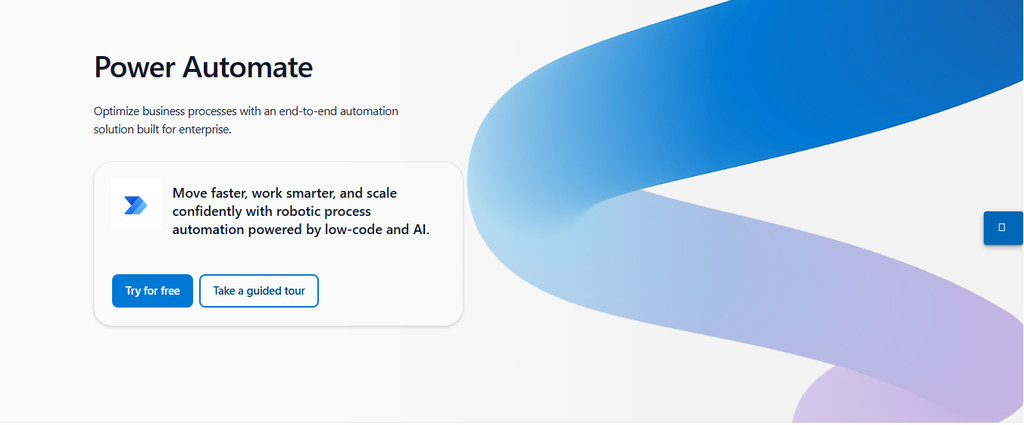
Power Automate’s advantage is the same one that shows up everywhere in the Microsoft world: deep native ties to Microsoft 365, Dynamics, Teams, and Azure, which makes it the practical default for organizations already committed to that ecosystem rather than a standalone RPA purchase decision made in isolation.
It spans desktop RPA, cloud workflow automation, and AI-assisted flow building, and it’s increasingly bundled into licensing many enterprises already pay for, which makes the economics genuinely hard for a dedicated RPA vendor to compete against on a pure cost basis.
The trade-off is familiar by now: excellent if Microsoft is already the center of gravity, considerably less compelling for an organization running a genuinely mixed, non-Microsoft stack.
Workato

Workato sits in an interesting spot between integration and automation.
It’s basically an enterprise iPaaS, pulling SaaS apps together with recipes and low-code workflows. But it can cover a lot of what a dedicated RPA tool does, especially for teams that care more about moving data smoothly across systems than clicking through old desktop apps.
The recipe library and connectors are approachable for non-engineers, not just developers. And it’s pushing into genAI-native orchestration, letting automations make sense of unstructured inputs, not just react to rigid triggers.
For a company whose main issue is “our SaaS tools don’t talk to each other,” Workato tends to solve that more directly than a bot-first RPA platform would.
Appian

Appian isn’t positioned as an RPA first tool. It’s a low‑code platform that brings together process automation, case management, and app building in one place, with RPA as just one piece of a broader orchestration puzzle, not the headline feature.
The big win is the built‑in process mining. It actually looks at how work flows in a real organization and shows where automation will move the dial before anyone even sketches a single workflow.
That kind of process‑driven insight makes it a natural fit for government, insurance, and healthcare teams dealing with genuinely complex, multi‑system approval chains.
Of course, all that comes with a higher price tag than lighter mid‑market tools. The payoff tends to show up when it’s deployed across several processes at once, not just a single isolated use case.
Pega (Pegasystems)

Pega combines RPA, CRM, case management, and AI-driven decisioning into what it treats as a single unified platform rather than a standalone automation tool bolted onto existing systems.
It shows up constantly in insurance, banking, and telecom specifically, automating claims processing, customer onboarding, and servicing workflows where decisions genuinely need to be made, not just tasks executed mechanically.
Pricing is often case-based rather than seat-based, which tracks with how Pega frames itself.
Less “buy our bot” and more “consolidate your CRM, case management, and decisioning under one roof,” a pitch that resonates with enterprises tired of stitching together three separate vendor relationships to cover what feels like one connected problem.
Nintex

Nintex has built its name specifically around workflow automation paired with document generation (contracts, forms, approval workflows), which matters a lot for industries like legal, real estate, and professional services where a huge share of daily work is genuinely document-centric rather than data-centric.
Its process-mapping tools let non-technical staff visualize and adjust a workflow without deep developer involvement, which is a meaningful part of its appeal for organizations that don’t have a dedicated automation engineering team on staff.
It’s a narrower, more specialized bet than something like Appian or Pega, but for the specific job of automating document-heavy business processes, that narrowness tends to work in its favor rather than against it.
Make (formerly Integromat)

Make occupies roughly the same territory as Zapier: visual, no-code automation connecting everyday SaaS tools.
But, it has built a real following as the more budget-conscious, more visually flexible alternative, with a canvas-style workflow builder that gives users more granular control over branching logic than a simpler linear automation would allow.
It tends to attract smaller companies and individual power users who want more customization than Zapier’s simpler flows provide, without paying enterprise iPaaS prices for something like Workato.
It’s less focused on deep enterprise governance and more focused on being genuinely pleasant and flexible to build in, which is exactly the audience it’s continued to win over.
Camunda

Camunda takes a developer‑first stance in this space. It’s an open‑source process orchestration engine built on BPMN, the formal business process modeling notation, not just a drag‑and‑drop tool for business users.
That makes it a solid fit for engineering teams that want precise, versioned control over how a complex process actually runs across people, bots, and AI services at the same time.
It treats orchestration like real software, not just a configured workflow.
It’s a bigger lift to adopt than something like Make or Nintex, but for organizations that need to formally model and audit every step, that rigor isn’t a hassle, it’s the whole point.
monday.com (Work OS)

monday.com didn’t start as an automation platform at all. It began as project and work management software.
But, it’s layered genuine automation capability across projects, CRM, and dev workflows to the point where a lot of smaller and mid-sized teams now use it as their de facto operations automation tool without ever evaluating a dedicated RPA or BPA vendor separately.
Its no-code automation recipes handle routine status updates, notifications, and cross-board triggers, which covers a surprising share of what a smaller company actually needs without the implementation weight of something like Appian or Pega.
It’s not trying to compete with the heavyweight enterprise names on this list on complex, regulated process orchestration.
Its real strength is that teams already living inside it for daily work get automation almost as a byproduct rather than a separate purchase decision.
Disclaimer
In line with the Trust Project guidelines, please note that the information provided on this page is not intended to be and should not be interpreted as legal, tax, investment, financial, or any other form of advice. It is important to only invest what you can afford to lose and to seek independent financial advice if you have any doubts. For further information, we suggest referring to the terms and conditions as well as the help and support pages provided by the issuer or advertiser. MetaversePost is committed to accurate, unbiased reporting, but market conditions are subject to change without notice.
About The Author
Anastasiia O. is an editor at MPost, where she focuses on reshaping content across a wide spectrum of topics. With an eye for detail and a genuine interest in storytelling, she helps ensure that the content is both accurate and engaging. Her experience spans multiple areas, providing her with the knowledge to offer insightful contributions to various topics highlighted on the platform.
More articles
Anastasiia O. is an editor at MPost, where she focuses on reshaping content across a wide spectrum of topics. With an eye for detail and a genuine interest in storytelling, she helps ensure that the content is both accurate and engaging. Her experience spans multiple areas, providing her with the knowledge to offer insightful contributions to various topics highlighted on the platform.