Why AI-Native Blockchains Are Emerging As The Next Big Web3 Battleground



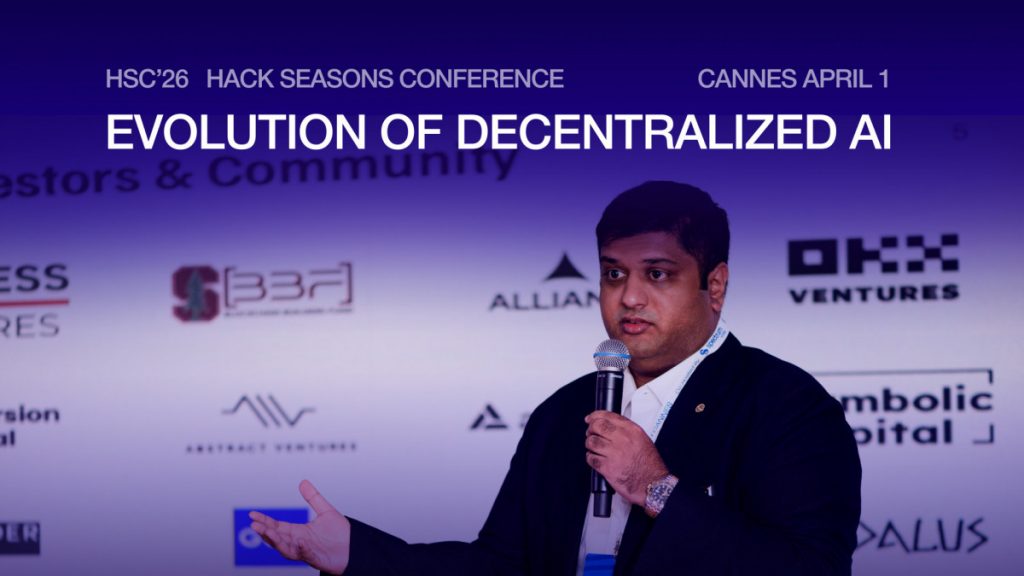
For years, decentralized AI has largely lived on the edge of both crypto and artificial intelligence. It has often been treated as a speculative niche, full of agent tokens, infrastructure promises, and big rhetoric about open systems. But at HSC Cannes, George V of 0G.ai laid out a more ambitious case. According to George, decentralized AI is no longer just a crypto narrative. It is starting to look like an infrastructure race.
George discussed the evolution of decentralized AI in his keynote and argued that the next big change in AI would not be only about better models. It will be who owns the infrastructure on which those models operate, who owns the data that trains those models, and whether that value created by AI will remain concentrated in the hands of a few centralized companies or will be more widely distributed across networks and users.
That is the larger vision behind 0G.ai, which George described as the largest EVM-compatible AI-focused Layer 1. The pitch is not just that blockchain can support AI in theory, but that purpose-built on-chain infrastructure can make decentralized AI practical, scalable, and economically meaningful for developers.
The Real Target is the Centralized AI’s Control Model
The most important part of the keynote was the criticism of the present-day AI environment. George positioned centralized AI platforms as systems that request users to surrender colossal amounts of data in exchange, and do so with little control or transparency. In his retelling, people use major AI tools daily, and they have no real idea what model version they are dealing with, what data they are collecting, how they are shaping their outputs, or how their inputs may eventually be monetized.
This criticism is not wholly new, but the case became more tangible as he associated it with infrastructure. For George, decentralized AI is not just about ideology or ownership slogans. It is about building a full operating system for AI that includes decentralized storage, decentralized compute, and data availability, all tightly integrated rather than stitched together from external providers.

That is the point where 0G.ai wants to differentiate itself. Instead of a patchwork of third-party services, George said the aim is to provide developers with AI-native infrastructure on day one. Practically, that implies that builders do not have to search among the various chains and vendors to create the tools that are required in AI applications. The chain itself is designed around those needs.
Model Training is Becoming More Expensive, and That Changes the Game
One of the most interesting parts of the keynote was George’s emphasis on the economics of AI model development. He argued that training frontier models is getting dramatically more expensive with every new generation, while inference costs are coming down. That divergence, in his view, creates a major opening for decentralized networks.
The logic is straightforward. If only a few giant companies can afford the next wave of model training, then control over AI becomes more centralized, not less. But if decentralized infrastructure can make large-scale training cheaper and more distributed, then the economics start to shift.
George pointed to what he called the largest decentralized model training run in the space so far, a 107-billion-parameter model, as proof that the category is starting to move beyond theory. He said that 0G.ai’s system achieved that at significantly lower cost than centralized alternatives. The broader message was clear: decentralized AI will only be taken seriously if it can compete with centralized players on performance and economics, not just on ideals.
That may be the keynote’s most important point. The decentralized AI thesis is no longer just about resisting centralization. It is about proving that distributed systems can actually deliver.
Crypto’s next AI phase may be less about meme agents and more about ownership
George also offered a historical framing that tried to explain how the current moment emerged. In his view, crypto infrastructure tends to create a wave of applications, which then feeds back into the next infrastructure cycle.
He linked Ethereum’s ICO era to tokenized capital formation, Nvidia’s AI hardware leap to the rise of decentralized compute networks, and the recent boom in large language models to the explosion of on-chain AI agents and memecoin-style speculation around them. That sequence matters because it suggests decentralized AI is now entering a more serious stage.
The first visible phase was cultural. AI agents, token launches, speculative trading, and viral projects. The next phase, at least according to George, is about ownership rights, user-controlled data, and decentralized participation in the economics of model training and inference.
That is where his “AI as a public good” framing becomes more than marketing. The real promise is not just that AI becomes open-source or distributed. It is that people who contribute data, compute power, or model participation can share in the economic upside rather than just feeding the revenue growth of a few giant firms.
The Strongest Near-term Opportunities are Becoming Clearer
Toward the end of the keynote, George became more explicit about where he sees actual demand emerging. That section was arguably the most useful part of the talk because it moved away from infrastructure theory and into categories builders are already pursuing.
He contended that among the largest priorities is to make AI products friendlier to Web2 audiences. That involves such things as wallet abstraction, less complex onboarding, and less complex interfaces. That is, if decentralized AI is to have a real adoption, it cannot remain a crypto-native pastime activity.
He further identified autonomous agents, privacy-preserving inference, prediction markets, AI-driven DeFi tools, decentralized data marketplaces, healthcare AI, and robotics as some of the areas where most of the energy is flowing. The list is very broad, yet the pattern is relatively consistent. The most compelling categories are the ones where decentralization improves either trust, ownership, privacy, or monetization.
Healthcare stood out in particular because George repeatedly returned to privacy as one of decentralized AI’s biggest advantages. If users can get AI-powered health tools or personalized systems without giving up full control of their data to centralized providers, that becomes a much stronger consumer proposition than just another chatbot alternative.
Robotics was another striking area. George described a future in which robots can train models locally and learn from real-world interactions in more distributed ways. That may still sound early, but it fits the broader theme of his keynote. AI infrastructure is widening far beyond chat interfaces and into systems that operate in the physical world.
The Real Test is Whether Builders Show Up
For all the scale of the vision, the success of 0G.ai will likely come down to whether developers actually build durable products on top of it. George spent meaningful time talking about the company’s ecosystem support programs, including its accelerator and broader guild structure, and made it clear that a large part of the strategy is to use both capital and technical support to attract builders early.
That is probably wise. Decentralized AI will not become meaningful because it has a compelling narrative. It will become meaningful if developers can use its infrastructure to launch products that are faster to build, cheaper to run, safer for users, and economically superior to centralized alternatives.
At HSC Cannes, George’s broader argument was that the decentralized AI market is moving out of its purely experimental phase. The next battle is not about whether AI and crypto can intersect. That already happened. The battle now is over whether decentralized networks can become the actual operating layer for the next generation of AI applications.
Disclaimer
In line with the Trust Project guidelines, please note that the information provided on this page is not intended to be and should not be interpreted as legal, tax, investment, financial, or any other form of advice. It is important to only invest what you can afford to lose and to seek independent financial advice if you have any doubts. For further information, we suggest referring to the terms and conditions as well as the help and support pages provided by the issuer or advertiser. MetaversePost is committed to accurate, unbiased reporting, but market conditions are subject to change without notice.
About The Author
Alisa, a dedicated journalist at the MPost, specializes in crypto, AI, investments, and the expansive realm of Web3. With a keen eye for emerging trends and technologies, she delivers comprehensive coverage to inform and engage readers in the ever-evolving landscape of digital finance.
More articles
Alisa, a dedicated journalist at the MPost, specializes in crypto, AI, investments, and the expansive realm of Web3. With a keen eye for emerging trends and technologies, she delivers comprehensive coverage to inform and engage readers in the ever-evolving landscape of digital finance.