Top 10 AI-Powered Business Intelligence Platforms in 2026




Every major BI vendor shipped generative AI features by now, so “does it have AI” stopped being the useful question a while ago.
The question that actually separates these platforms is whether that AI is grounded in a governed semantic layer (the same official metric definitions every dashboard already uses), or whether it’s improvising answers off raw tables and occasionally producing a number that contradicts what a human-built report already says.
That distinction is exactly why “why is this number different?” has become such a common complaint as these AI features roll out.
Here are ten platforms actually running enterprise analytics right now.
Microsoft Power BI

Power BI has held the top spot in Gartner’s Magic Quadrant for eighteen consecutive years.

Its generative AI layer, Copilot, made a genuine leap from basic keyword search to actual conversational querying: asking a question in plain language and getting a real answer grounded in the underlying data model, not just a filtered table.
Its advantage remains the same one it’s always had: deep native ties to Azure, Excel, Microsoft 365, and Dynamics, making it the default choice for any organization already living in that ecosystem, at a price point (around fourteen dollars a user monthly) that’s hard for pricier competitors to argue against.
Forrester gave it the highest score of any platform on generative AI functionality specifically, which tracks with how aggressively Microsoft has pushed Copilot across the entire product rather than treating it as a bolted-on feature.
Tableau (Salesforce)

Tableau remains what one analyst called the gold standard for data visualization other vendors aspire to reach.
Its generative AI suite, Tableau Pulse, builds specifically on a Metrics Layer where KPIs get defined once and applied consistently everywhere downstream, rather than letting every analyst redefine “revenue” slightly differently in their own workbook.
Its AI features run through what Salesforce calls the Einstein Trust Layer, a guardrail system meant to keep generated insights grounded in a company’s actual internal data rather than hallucinated plausibility.
Tableau’s natural home is organizations already deep in the Salesforce ecosystem wanting AI-augmented visualization paired with what’s still considered the industry’s most powerful charting engine, though that power comes at real cost.
Creator licenses run well above Power BI’s per-user pricing, a premium that adds up fast across a large user base.
Looker (Google Cloud)

Looker takes a fundamentally different architectural approach than Power BI or Tableau.
It’s code-first, built entirely around LookML, a modeling language that defines business logic and metrics once, centrally, so every dashboard and every user across the organization works from the exact same governed definitions rather than each analyst building their own version of “active customers.”
That rigor is exactly why it consistently ranks second only to Power BI on governance strength, and its 2025 integration of Google’s Gemini models brought genuinely capable Conversational Analytics, letting users query data in plain English while the underlying semantic layer keeps every generated answer honest against the same official metrics.
It’s a natural fit for organizations already running Google Cloud, and its code-first nature tends to appeal specifically to technical teams comfortable maintaining a modeling layer rather than business users who just want to drag and drop.
Qlik Sense

Qlik has earned Leader status in Gartner’s rankings for ten of the past ten years, built around its distinctive associative engine.
It lets users explore data by clicking through any dimension in any order and seeing everything else in the view adjust dynamically, rather than being locked into a single predefined query path a more rigid tool might force.
Its generative AI features have been layered onto that same associative foundation, aiming to surface insights a user might not have thought to explicitly ask for rather than only answering direct questions.
It occupies a similar governance tier to Tableau (solid, but trailing Power BI and Looker specifically on governance depth according to recent enterprise rankings) while its real differentiator stays that flexible, exploratory associative model few competitors have fully replicated.
ThoughtSpot

ThoughtSpot built its entire identity around search-driven self-service years before natural language querying became table stakes across this whole category, treating a search bar as the primary interface rather than a bolted-on feature added to an existing dashboard-first product.
That head start shows in how mature its search-to-insight experience feels compared to some competitors’ more recently added conversational layers, and it’s specifically positioned for broader business teams who want to type a question and get a visualization back rather than navigating a traditional BI tool built assuming technical fluency.
It doesn’t try to match Looker’s code-first governance depth or Tableau’s visualization ceiling.
Its whole bet is that natural language search is the more valuable investment for the widest possible group of business users.
SAP Analytics Cloud
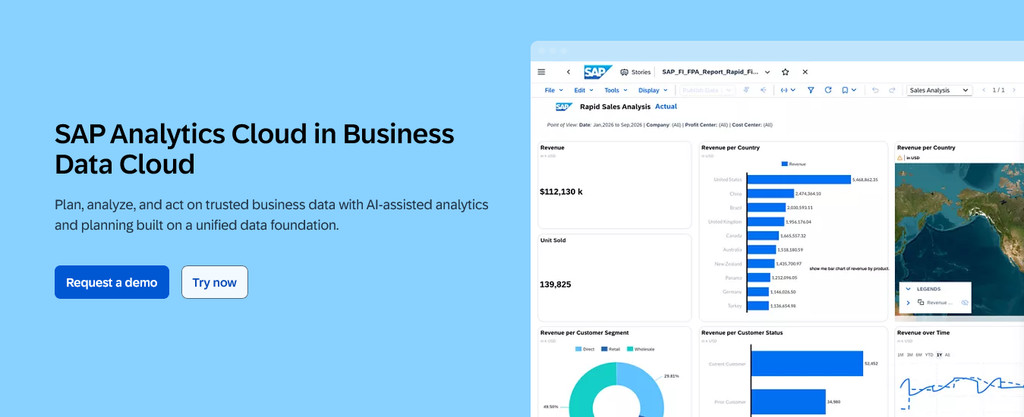
SAP Analytics Cloud combines BI with genuine planning capability in one platform, which matters a lot for finance teams that need forecasting and scenario modeling sitting alongside their reporting rather than in a separate tool entirely.
Its governance is tightly woven into SAP’s Business Technology Platform, with role-based access controls and a Q1 2026 story-versioning update tightening things further.
Inside an SAP environment, that governance is genuinely seamless.
The limitation, echoed consistently across independent analyst rankings, is that seamlessness mostly stays inside SAP’s own walls; for organizations pulling data from a lot of non-SAP sources, its governance controls are noticeably more limited than platforms built from the ground up for multi-source enterprise analytics.
Sigma

Sigma has carved out a genuinely different niche by staying warehouse-native and building its interface around the spreadsheet paradigm analysts already know cold, rather than asking them to learn a new modeling language or drag-and-drop paradigm from scratch.
That “if you can use a spreadsheet, you can use Sigma” positioning has made it a favorite specifically among analysts who think in formulas and want direct, live access to warehouse data without a separate extraction or modeling step getting in the way.
It’s a newer, smaller name than the big five above, but it’s found real traction specifically with data teams already living inside Snowflake or BigQuery who want an analytics layer that feels native to how they already think about data.
Amazon QuickSight

QuickSight is AWS’s own answer to this category, built serverless and priced on usage rather than a flat per-seat subscription, which rewards organizations with spiky, unpredictable dashboard usage the same way Textract’s pay-as-you-go model rewards spiky document-processing volume.
Its generative AI features, branded Q, let users ask questions in natural language and get grounded answers pulled from connected AWS data sources, fitting the same “obvious default for teams already building on AWS” logic that shows up constantly across that whole ecosystem.
It’s a less natural fit for an organization whose data and infrastructure live primarily outside AWS, where the deepest integration advantages simply don’t apply the same way.
IBM Cognos Analytics
Cognos has stayed the governance-first choice for large, complex enterprises running a genuine hybrid of on-premises and cloud infrastructure, a combination a lot of newer, cloud-only BI tools weren’t really built to handle gracefully.
Its AI capabilities lean into automated forecasting and natural language querying, but the platform’s real draw remains its long track record in exactly the kind of heavily regulated, legacy-system-heavy environments where a newer entrant would need years to build comparable trust.
It’s not the platform a fast-moving startup reaches for first, but for a bank or insurer running decades of on-prem infrastructure alongside newer cloud systems, that hybrid governance maturity is worth more than a flashier interface.
Domo

Domo bundles data pipeline management, visualization, and increasingly embedded AI agents into a single all-in-one cloud platform, aimed at organizations that want fewer separate vendor relationships to manage rather than assembling a best-of-breed stack from several specialized tools.
That consolidation is really the whole pitch. One contract covering data ingestion through final dashboard, with generative AI layered across the experience rather than living in just one isolated feature.
It tends to appeal most to mid-market organizations without a large dedicated data engineering team, who’d rather have one vendor handle the full pipeline than stitch together a data warehouse, a transformation tool, and a separate BI layer on their own.
Disclaimer
In line with the Trust Project guidelines, please note that the information provided on this page is not intended to be and should not be interpreted as legal, tax, investment, financial, or any other form of advice. It is important to only invest what you can afford to lose and to seek independent financial advice if you have any doubts. For further information, we suggest referring to the terms and conditions as well as the help and support pages provided by the issuer or advertiser. MetaversePost is committed to accurate, unbiased reporting, but market conditions are subject to change without notice.
About The Author
Ana O. is an editor at MPost, where she focuses on reshaping content across a wide spectrum of topics. With an eye for detail and a genuine interest in storytelling, she helps ensure that the content is both accurate and engaging. Her experience spans multiple areas, providing her with the knowledge to offer insightful contributions to various topics highlighted on the platform.
More articles
Ana O. is an editor at MPost, where she focuses on reshaping content across a wide spectrum of topics. With an eye for detail and a genuine interest in storytelling, she helps ensure that the content is both accurate and engaging. Her experience spans multiple areas, providing her with the knowledge to offer insightful contributions to various topics highlighted on the platform.