


HSC Conference Ho Chi Minh: ‘The Adoption Gap’ Panel Examines Why Mature Web3 Infrastructure Has Not Yet Reached Mass Market



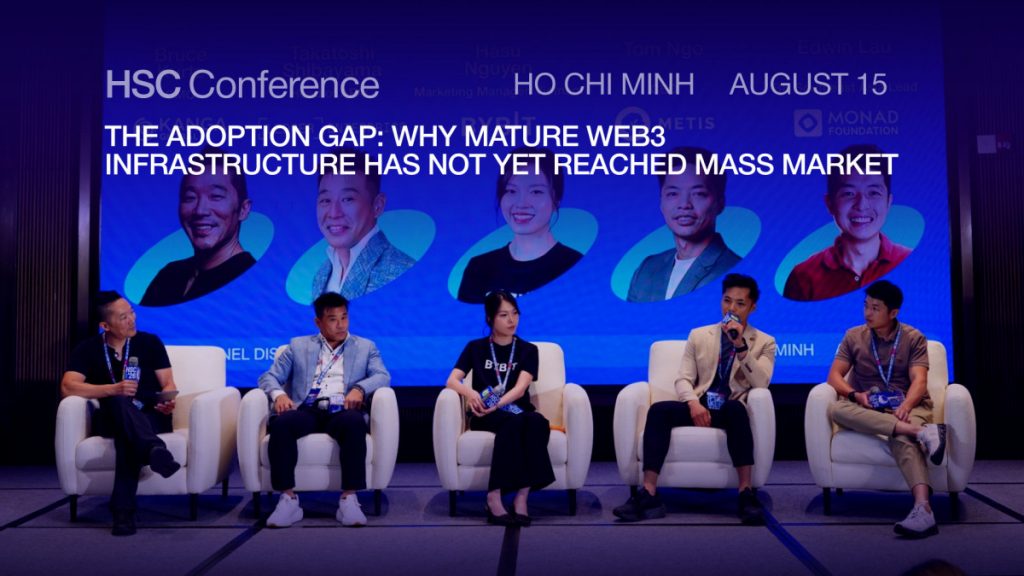
On August 15, the HSC Conference returned to Ho Chi Minh City, convening senior voices from layer-1 protocols, digital asset exchanges, and enterprise security to examine why increasingly sophisticated Web3 technology has yet to achieve mainstream consumer and enterprise adoption.
The standout session, “The Adoption Gap: Why Mature Web3 Infrastructure Has Not Yet Reached Mass Market,” was moderated by Bruce Kurtz, CMO of Kanga Global, and featured Takatoshi Shibayama, Head of APAC at Ledger Enterprise; Hasu Nguyen, Marketing Manager for Vietnam at Bybit; Tom Ngo, CEO of Metis; and Edwin Lau, BD Southeast Asia Lead at Monad.
Rather than rehearsing familiar narratives about blockchain’s transformative potential, the group dissected the persistent disconnect between robust underlying infrastructure and real-world usability—exploring where trust breaks down, why user experience remains a bottleneck, and what it will actually take to close the adoption gap. Their diagnosis began with the sector’s most fragile commodity: trust.
The Trust Deficit
The conversation quickly centred on trust as the industry’s most persistent vulnerability. Edwin observed that the sector has effectively split into two worlds: the regulated realm of stablecoins and real-world assets, where traditional institutions provide familiar safeguards, and the “wild west” of decentralised finance, where hacks and rushed deployments erode confidence. Takatoshi echoed this concern, noting that even after a decade in the space, he remains cautious when transferring funds between wallets because “there’s no safety blanket.” Tom warned that artificial intelligence has intensified the threat, with malicious actors now using AI to penetrate protocols through vectors as unexpected as RPC poisoning. Hasu added a crucial user-centric dimension, arguing that people need not only institutional trust but also self-confidence—assurance that they can navigate the technology without making irreversible mistakes.
Infrastructure and User Experience
With trust identified as the foundational barrier, the panel examined why technical progress alone has failed to produce intuitive experiences. Having moved beyond the era of prohibitive gas fees and slow finality—the panelists noted that networks like Monad now offer sub-second settlement for less than a cent—the bottleneck has shifted to design and accessibility. Hasu emphasised that attracting users requires more than trading incentives; retaining them demands seamless, all-in-one platforms where deposits, trading, earning, and spending coexist intuitively. Takatoshi drew a sharp contrast between Web3 and traditional finance institutions, explaining that while crypto startups often prioritise rapid market entry, banks submit to exhaustive security due diligence because their reputations depend on protecting clients. The consensus was clear: blockchain must become as invisible as Wi-Fi, with chain abstraction allowing users to transact without understanding the underlying infrastructure.

Regulation and Institutional Confidence
Yet even the most elegant interface cannot compensate for regulatory ambiguity, which prompted a vigorous debate on the role of licensing. Hasu and Takatoshi argued that regulatory frameworks provide essential consumer protections, localised support, and distribution channels that bridge the gap between Web2 familiarity and Web3 innovation. Edwin, however, challenged the audience to distinguish between decentralised protocols—which need no licence—and the centralised service providers that operate atop them. “Anyone that is holding other people’s money, doing payments, doing transactions—that is where there’s a blur line where license needs to come in,” he clarified. Takatoshi concluded that for non-native users, licensed on-ramps remain the most practical entry point.
The Road Ahead
Looking beyond immediate obstacles, the panelists turned to the structural and temporal horizon required for genuine mainstream integration. An audience member raised the critical issue of interoperability, prompting the panelists to affirm that cross-chain collaboration is replacing the tribalism of earlier years. When asked to predict when mass adoption would arrive, estimates ranged widely: Tom declared the process already underway and accelerating within two years; Edwin projected 2030 as the moment sandbox regulations and invisible backend integration would mature; Hasu suggested 2040, when blockchain products would no longer look like blockchain products at all; while Takatoshi argued the gap began closing the moment traditional finance giants like BlackRock entered the space. As the session closed, Bruce Kurtz captured the panel’s underlying optimism with a local aspiration: hoping to buy his egg coffee with crypto before the decade ends. For anyone seeking to understand where digital finance is heading, this candid exchange offers essential viewing.
Disclaimer
In line with the Trust Project guidelines, please note that the information provided on this page is not intended to be and should not be interpreted as legal, tax, investment, financial, or any other form of advice. It is important to only invest what you can afford to lose and to seek independent financial advice if you have any doubts. For further information, we suggest referring to the terms and conditions as well as the help and support pages provided by the issuer or advertiser. MetaversePost is committed to accurate, unbiased reporting, but market conditions are subject to change without notice.
About The Author
Alisa, a dedicated journalist at the MPost, specializes in crypto, AI, investments, and the expansive realm of Web3. With a keen eye for emerging trends and technologies, she delivers comprehensive coverage to inform and engage readers in the ever-evolving landscape of digital finance.
More articles
Alisa, a dedicated journalist at the MPost, specializes in crypto, AI, investments, and the expansive realm of Web3. With a keen eye for emerging trends and technologies, she delivers comprehensive coverage to inform and engage readers in the ever-evolving landscape of digital finance.