HSC Conference Ho Chi Minh: Stablecoins Won The Payments War—Here Is What The Industry Must Solve Next



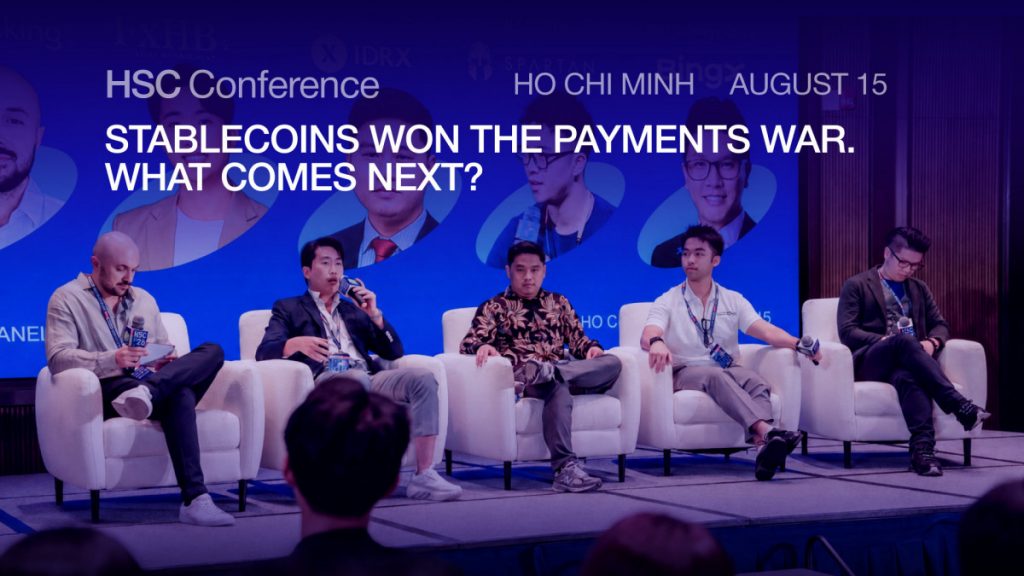
On August 15, the HSC Conference returned to Ho Chi Minh City, gathering senior voices from financial institutions, technology firms, and venture capital to debate blockchain infrastructure, digital assets, and the future of on-chain financial markets.
Among the event’s most anticipated sessions was “Stablecoins Won the Payments War. What Comes Next?,” moderated by Berken Menges, Chief Marketing Officer at CoinTracking, featuring Carney Mak, Partner at FXHB Asset Management; Nathanael Christian, Co-founder and Chief Executive Officer at IDRX; Harry Bui, Analyst at The Spartan Group; and Kevin Lee, Chief Strategy Officer at BingX.
Rather than treating stablecoins’ dominance as a settled conclusion, the panelists dissected the next frontier of monetary infrastructure—examining where stablecoins have displaced legacy payment rails versus where they remain primarily a settlement layer, why emerging markets such as Indonesia and Vietnam are advancing local-currency alternatives to mitigate dollarization and capital-flight risks, and what it will take for stablecoins to evolve from speculative instruments into fully bankable assets integrated into everyday financial life.
The Payment War: What Was Actually Won?
As the session opened, the moderator pressed the speakers to define the terms of victory itself, asking what the thesis actually meant in practice. The exchange that followed revealed a nuanced consensus.
While stablecoins have not displaced efficient domestic retail rails—Nathanael pointed to Indonesia’s QRIS and e-wallet systems as superior for local commerce—the panel agreed they have secured a more strategic foothold as a global settlement layer. “I agree stablecoin won, but not like in the way people think we are using day to day,” Harry noted. “It’s about a settlement layer. That is most important here.” Kevin added that although the infrastructure to move money instantly, 24/7, is now proven, the full “scheme of things”—from daily deposits to insurance and property payments—remains unrealized.

Transparency, Regulation, and Market Resilience
Having established where stablecoins currently stand, the panel turned to what might erode or cement that position: trust. Carney offered a candid defense of regulators, stating it is “really hard for regulators” to keep pace with an ever-mutating landscape that spans algorithmic, fiat-backed, yield-bearing, and public-backed stablecoins. She argued that true transparency requires understanding not merely whether reserves are audited, but how issuers generate yield and manage counterparty risk. Harry addressed recent de-pegging incidents involving USDE and Team Finance, framing them as painful but necessary lessons in leverage and oracle risk. “Market does really learn about it. They learn from the mistake,” he said, describing the process as a “natural transition of things when they try, they fail, and they try again.”
National Currencies Versus Dollar Dominance
Beneath the technical discussion of reserves and regulation lay a deeper geopolitical tension. A central divide emerged between dollar-pegged stablecoins and local monetary sovereignty. Nathanael outlined Indonesia’s push for a Rupiah-backed stablecoin to facilitate cross-border trade without converting through the US dollar or relying on SWIFT. Harry, meanwhile, detailed Vietnam’s forthcoming 2026 framework, which will treat crypto as a taxable asset and tie foreign exchange operations to the Vietnamese dong—a requirement that complicates entry for global platforms. Carney crystallized the stakes: “Stablecoin is global, we all know, but currency and regulatory frameworks are local.” For many nations, the priority is not fostering innovation per se, but preventing capital flight and protecting foreign reserves.
The Road Ahead
With present tensions mapped, the panelists turned to the horizon. They envisioned a future in which stablecoins fade into the background of finance. Kevin predicted that within two years, the technology would be so embedded in Apple Pay and Google Pay that consumers would no longer distinguish between crypto and fiat at the point of sale. Harry imagined on-chain credit lines bridging DeFi and traditional banking, while Carney urged the industry to make stablecoins fully “bankable”—recognized as formal assets that can collateralize property, vehicles, and daily payments. Nathanael concluded that Southeast Asia’s major fintechs will soon run on blockchain rails, even if users never know they are touching stablecoins.
Disclaimer
In line with the Trust Project guidelines, please note that the information provided on this page is not intended to be and should not be interpreted as legal, tax, investment, financial, or any other form of advice. It is important to only invest what you can afford to lose and to seek independent financial advice if you have any doubts. For further information, we suggest referring to the terms and conditions as well as the help and support pages provided by the issuer or advertiser. MetaversePost is committed to accurate, unbiased reporting, but market conditions are subject to change without notice.
About The Author
Alisa, a dedicated journalist at the MPost, specializes in crypto, AI, investments, and the expansive realm of Web3. With a keen eye for emerging trends and technologies, she delivers comprehensive coverage to inform and engage readers in the ever-evolving landscape of digital finance.
More articles
Alisa, a dedicated journalist at the MPost, specializes in crypto, AI, investments, and the expansive realm of Web3. With a keen eye for emerging trends and technologies, she delivers comprehensive coverage to inform and engage readers in the ever-evolving landscape of digital finance.