HSC Conference Panel ‘Infrastructure: Building Web3’s Rails’ Examines Interoperability, User Ownership And The Future Of Web3 Infrastructure



In Brief
HSC Conference panel “Infrastructure: Building Web3’s Rails”: why speed is table stakes and how privacy and interoperability shape Web3’s future.
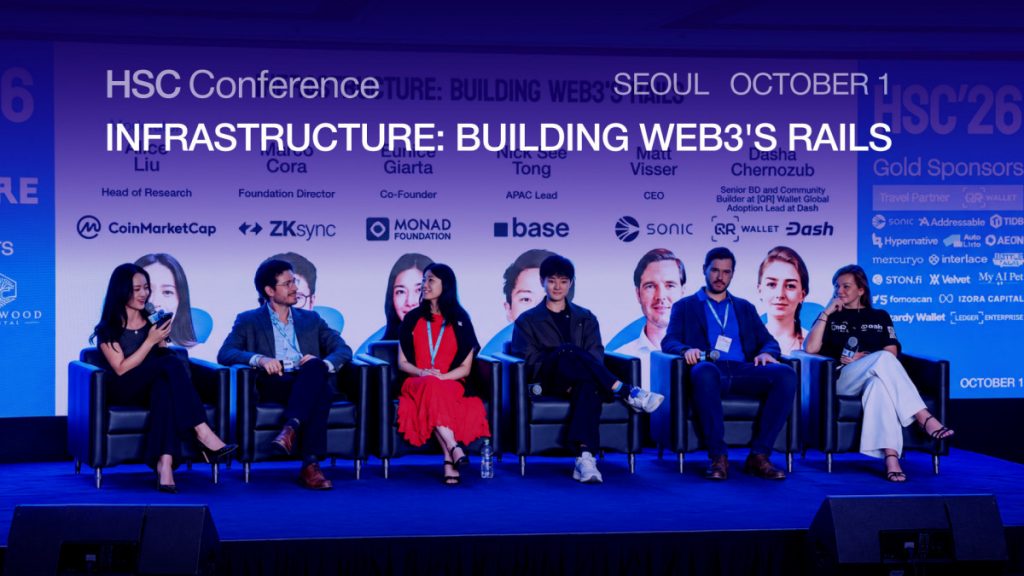
On October 1, 2026, the HSC Conference will return to Seoul, gathering senior voices from financial institutions, crypto investment funds, and technology companies to debate the future of digital finance. Hosted by Mpost Media Group in partnership with Z Venture, the event will take place at Novotel Ambassador Seoul Gangnam.
Among the event’s most anticipated discussions is “Infrastructure: Building Web3’s Rails,” featuring the builders behind Web3’s core infrastructure in a conversation on scalability, interoperability, and what it takes to support the next wave of adoption. Moderator: Alice Liu, Head of Research at CoinMarketCap. Panelists: Marco Cora, Director, Foundation at ZKsync; Eunice Giarta, Co-Founder of Monad Foundation; Nick See Tong, APAC Lead at Base; Matt Visser, CEO of Sonic Labs; Dasha Chernozub, Senior BD and Community Builder at QR Wallet and Global Adoption Lead at Dash.
Beyond Speed: The New Definition of Performance
The panel opened with a question about limits. If fast execution, cheap fees and settlement under one second have become the floor, what is the ceiling? Matt Visser argued that raw speed is no longer the differentiator, pointing to economic alignment in which most transaction cost flows back to builders, and to the difference between probabilistic finality and true finality, noting that regulators prefer assets that are actually settled rather than probably settled. Eunice Giarta agreed that speed is now table stakes, saying that “speed is not fungible” because chains can reach similar throughput while sacrificing very different properties. For her, the higher purpose of public networks comes down to fair access and composability. Dasha Chernozub added a community dimension, stressing that technology can be copied while principles cannot, and that a decentralized project endures because people believe in freedom, privacy and control over their own money. Marco Cora tied these points together, arguing that value accrues where alternatives are scarce, which is why privacy now matters: companies increasingly need it, credible options remain few, and privacy can become a real moat. This search for scarce, valuable properties led directly to the next question, namely why so many companies now prefer to build chains of their own.
Own Chains or General Purpose Networks
The conversation then turned to the wave of corporate chains, from Robinhood to Stripe and Circle. Cora framed the tradeoff as fragmentation versus differentiated block space: a specialized chain can offer a valuable property, but leaving a network with large network effects carries a cost. Nick See Tong said dedicated chains make sense for highly function driven products such as high performance trading venues, yet the deeper goal of bringing the world on chain is about ecosystem. In his words, the question is less about throughput and more about “the ecosystem of apps that are built around it,” whether an asset can be deposited as collateral, borrowed against or used across structured products. Giarta offered the intranet analogy to explain why general purpose networks still matter: institutions once ran internal networks because the open internet felt unsafe, but separated systems made collaboration hard, and the same logic now applies to private and public blockchains. Cora and Visser both stressed that the answer ultimately depends on interoperability, with Cora citing Hyperledger as an early cautionary tale and arguing that zero knowledge proofs can preserve privacy while keeping verification simple. If the future is many chains that must still connect, however, the natural next question is who captures the value, and who owns the user.
Who Owns the User
On this point the panel avoided naming a single winner. Visser gave the sharpest summary: “the wallet owns the session, the app owns the customer and the blockchain owns the warranty.” Dasha described what such sharing looks like in practice, explaining how Dash and QR Wallet exchange users across travel, payments and merchant discounts, and adding that attention itself can be owned, as communities such as Pudgy Penguins demonstrate. Giarta reframed the debate around experience, telling a story of switching ride apps in Seoul simply because the experience was better, and arguing that loyalty follows whatever serves the audience best. See Tong described the flywheel that results, in which good apps attract users, users bring assets and assets fund builders. The panel agreed that users are held at every layer at once, which set up the final and most sensitive theme: the one property that both users and institutions increasingly demand, privacy.

Privacy Moves to the Center
The panel agreed that privacy has matured from a fringe demand into an institutional requirement. Cora distinguished compliant privacy from what he called scary privacy, using Zcash as an example of opacity so complete that a historic bug could not be fully audited, while praising approaches that remain transparent internally and opaque externally. Giarta emphasized that privacy is not anonymity and pointed to selective disclosure as the model institutions actually want. Visser agreed that regulation is pulling the industry forward, and Dasha closed the theme with pride: “privacy was the narrative for 12 years and we were all alone.”
The panel concluded that modern Web3 rails are judged not by speed alone but by a combination of interoperability, user experience, credible privacy and fair access. What began as a question about the ceiling above speed ended as a broader picture of maturity, in which infrastructure wins by serving builders, institutions and everyday users at the same time.
Disclaimer
In line with the Trust Project guidelines, please note that the information provided on this page is not intended to be and should not be interpreted as legal, tax, investment, financial, or any other form of advice. It is important to only invest what you can afford to lose and to seek independent financial advice if you have any doubts. For further information, we suggest referring to the terms and conditions as well as the help and support pages provided by the issuer or advertiser. MetaversePost is committed to accurate, unbiased reporting, but market conditions are subject to change without notice.
About The Author
Alisa, a dedicated journalist at the MPost, specializes in crypto, AI, investments, and the expansive realm of Web3. With a keen eye for emerging trends and technologies, she delivers comprehensive coverage to inform and engage readers in the ever-evolving landscape of digital finance.
More articles
Alisa, a dedicated journalist at the MPost, specializes in crypto, AI, investments, and the expansive realm of Web3. With a keen eye for emerging trends and technologies, she delivers comprehensive coverage to inform and engage readers in the ever-evolving landscape of digital finance.