From Institutional Finance To Agentic AI: Inside The Lineup For HSC Conference Seoul 2026



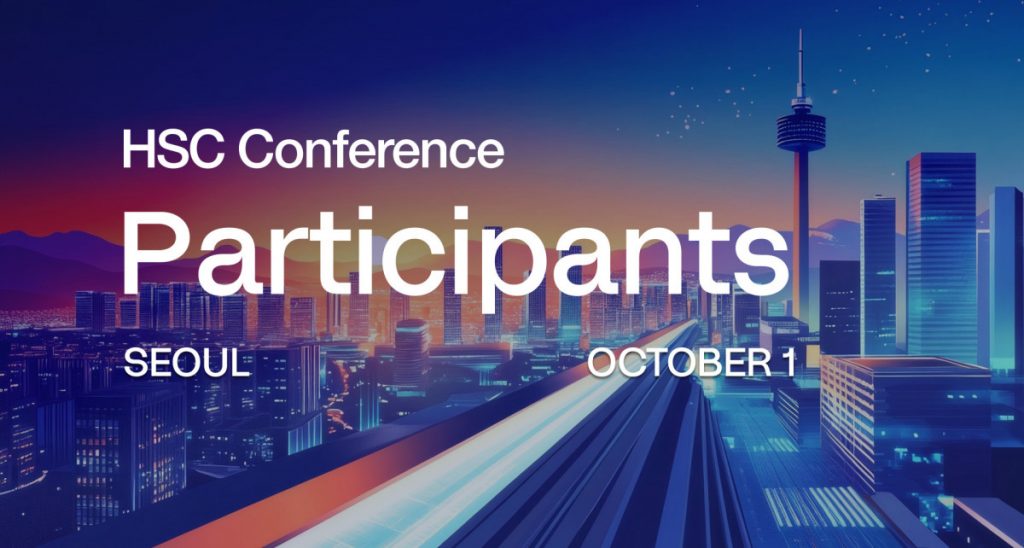
The upcoming HSC Conference in Seoul is set to bring together an exceptional roster of participants, uniting global leaders from financial institutions, crypto investment funds, and technology companies to explore the trends and opportunities defining the next phase of digital asset adoption in Asia-Pacific and beyond.
Taking place on October 1, 2026, at Novotel Ambassador Seoul Gangnam, the conference will convene founders, executives, and investors at the intersection of blockchain infrastructure, tokenization, and on-chain financial markets, examining the forces shaping the next phase of digital finance, from investment and market structure to the growing convergence of blockchain and AI.
Among the notable participating companies in the Seoul edition are S&P Global, Galaxy Digital, Ethereum Institutional, Maelstrom, Canary Capital, C² Ventures, Animoca Brands, Offchain Labs, ZKsync, Monad Foundation, Steakhouse Financial, Cactus Custody, Ledger Enterprise, Bybit, Tether, Base, BNB Chain, and Ether.fi, among many others.
Here is a look at some of the conference’s top participants.
Animoca Brands
Few companies have done more to build the infrastructure of digital ownership than Animoca Brands. The Hong Kong-based blockchain developer and crypto investor reported $314 million in revenue for 2024, a 12% year-over-year increase, with $165 million generated through its digital asset advisory business and holdings across more than 600 Web3 companies, including stakes in Consensys and Kraken. In November 2025, the company filed for a Nasdaq listing via a reverse merger with Currenc Group, a transaction expected to create what Animoca’s co-founder and executive chairman Yat Siu described as the world’s first publicly listed, diversified digital assets conglomerate, spanning DeFi, AI, NFTs, gaming, and DeSci. By May 2026, the deal carried a nominal valuation of $8.7 billion based on Currenc’s market capitalisation, with the transaction targeting a Q3 2026 close. For those focused on where Web3 investment, digital ownership, and mainstream adoption converge, Animoca Brands is as close to a definitive answer as the industry has produced.

S&P Global
No traditional financial institution has moved more deliberately into the digital asset space in 2026 than S&P Global. Recent milestones include tokenizing the iBoxx U.S. Treasuries Index on the blockchain in March 2026, the first time a major index provider made a financial benchmark available as a native digital asset, as well as launching a co-branded S&P Kaiko Digital Asset Indices suite for global, 24/7 digital asset markets in September 2026. The company has also published Stablecoin Stability Assessments and issued its first credit rating for a DeFi protocol. Most recently, S&P Global agreed to acquire smart contract security firm OpenZeppelin, expanding its digital assets strategy into onchain risk assessment, a move that brings the security standards behind the world’s leading stablecoins, tokenized funds, and DeFi protocols under the S&P umbrella. For anyone seeking to understand how institutional-grade standards are being applied to on-chain finance, S&P Global is the clearest window into that process currently operating at scale.
Galaxy Digital
Galaxy Digital listed on the Nasdaq in May 2026, ending a years-long dual-listing arrangement on the Toronto Stock Exchange that had been necessitated by U.S. regulatory caution around its crypto-centric business. Founded by Mike Novogratz, the firm has evolved from a crypto financial services company into a multi-engine platform spanning asset management, trading, and data center infrastructure. Its flagship Helios data center in West Texas is being built out for AI and high-performance computing workloads, with CoreWeave occupying significant capacity in the facility, placing Galaxy at the intersection of crypto and the AI infrastructure boom. The Nasdaq-listed firm stands to benefit from continued digital asset market recovery, an expanding ETF market, and data center revenues, a combination analysts have called a multi-engine growth model. With one of the deepest research operations in the industry and a growing institutional footprint across Asia, Galaxy Digital brings both market authority and strategic breadth to the Seoul agenda.
Maelstrom
Maelstrom is the family office of Arthur Hayes, co-founder of BitMEX, investing across the crypto and Web3 ecosystem. Co-founded with Managing Partner Akshat Vaidya in 2023, the fund takes a patient capital approach emphasizing quality projects over fast deployment, a philosophy that has defined its portfolio strategy since inception. In 2025, Maelstrom moved to raise $250 million for its debut private equity fund, Maelstrom Equity Fund I, targeting four to six acquisitions of medium-sized companies in the crypto space, with a focus on trading infrastructure, data analytics, and blockchain service providers. Entering 2026, Arthur Hayes positioned the fund at near-maximum risk exposure, betting on a liquidity wave driven by U.S. deficit spending and leaning into privacy coins and emerging DeFi tokens as his highest-conviction plays. With Arthur Hayes also delivering a solo address at HSC Conference Seoul, Maelstrom represents one of the most closely watched perspectives in active crypto investing today.
Offchain Labs
Offchain Labs is the original developer of Arbitrum, the market-leading Ethereum Layer 2 network, and in 2025 and 2026, it has been moving decisively beyond infrastructure. Arbitrum has processed over 2.1 billion lifetime transactions on Arbitrum One and reached $20 billion in total value secured in 2025, consistently ranking as the largest Ethereum Layer 2 by market share. In August 2025, Offchain Labs acquired ZeroDev, a leading smart account infrastructure provider, marking its evolution from a chain-level infrastructure company to a full-stack developer platform with smart account abstraction now central to how institutions and consumer applications onboard users. Most recently, Robinhood selected Arbitrum as its blockchain of choice for bringing tokenized U.S. stocks to European investors, a landmark vote of confidence in Arbitrum’s institutional capabilities. Co-founder Ed Felten, a former Deputy U.S. Chief Technology Officer, brings both technical depth and policy credibility to the Seoul stage.
Ethereum Institutional
Ethereum Institutional launched on July 1, 2026 as an independent nonprofit dedicated to accelerating institutional adoption of Ethereum, its Layer 2 networks, and the broader ecosystem. Founded by David Walsh, Matthew Dawson, and Marius Smith, three former members of the Ethereum Foundation’s enterprise team, the organization positions itself as a neutral, dedicated point of contact for banks, asset managers, custodians, and sovereign institutions evaluating Ethereum for tokenization, stablecoins, and on-chain finance. Anchor funding comes from BitMine, SharpLink, and Ethereum co-founder Joseph Lubin. According to Token Terminal, Ethereum holds nearly 58% of the tokenized RWA market, and the network accounts for approximately half of the $311 billion stablecoin market. Ethereum Institutional exists to translate that market dominance into institutional relationships — and its presence at HSC Conference Seoul reflects how seriously the Ethereum ecosystem is now pursuing TradFi engagement.
Who’s Coming to Seoul: A Conference Built Across Every Layer of Digital Finance
The HSC Conference Seoul 2026 will bring together a wide-ranging cast of investors, builders, protocol developers, and institutional operators, each representing a distinct layer of the digital asset economy as it converges with global capital markets.
Capital allocation and investment perspectives will anchor the opening of the day. Maelstrom and C² Ventures bring active crypto fund perspectives to the Investments Today panel alongside Canary Capital and Portal Ventures, collectively offering a direct window into how professional capital is being deployed across digital assets and emerging blockchain opportunities in the current cycle. A solo keynote address by Maelstrom’s CIO will set the intellectual tone for the day’s investment conversation.
Institutional finance and regulated infrastructure take centre stage through S&P Global, Galaxy Digital, and Ethereum Institutional, whose representatives lead DeFi and digital assets strategy, Asia institutional operations, and institutional ecosystem development respectively. Their joint presence on the Institutional Adoption of Digital Assets panel, alongside IBM Digital Asset, Ether.fi, and Soter Insure, makes it one of the most substantive conversations on the agenda, mapping how traditional financial institutions are moving from pilot programmes to operational deployment of blockchain-based financial infrastructure.
Blockchain infrastructure and protocol development are represented by a notably diverse set of participants. ZKsync, Monad Foundation, Base, Sonic Labs, and BNB Chain each bring distinct views on scalability, developer tooling, and the conditions required for Web3 infrastructure to reach mainstream throughput. Hashgraph adds an enterprise blockchain perspective to the Mainstream Web3 Adoption panel, grounding the infrastructure discussion in real institutional deployment.
The tokenisation and RWA segment draws on some of the space’s most operationally active participants. RedStone, Atom Finance, Hypernative, Dfns, and Shinhan Bank collectively approach on-chain asset infrastructure from complementary angles, from oracle-layer data integrity and tokenisation strategy to institutional security and the perspective of a major Korean bank already active in global blockchain business. Custody and key management infrastructure will be addressed by Cactus Custody and Ledger Enterprise, covering both institutional-grade custody architecture and the hardware security layer underpinning asset management at scale.
Stablecoin and payments dynamics will be explored through Tether, StraitsX, Steakhouse Financial, Stable, and makebanc, collectively mapping what comes after stablecoins’ rise to payments dominance, from regional payment rails and APAC market penetration to DeFi-native financial design. The DeFi infrastructure perspective is reinforced by STON.fi’s keynote on cross-chain liquidity, while Chainlink brings the oracle and cross-chain connectivity layer into the Mainstream Web3 Adoption discussion.
Rounding out the programme, the Agentic AI panel brings together MetaMask, AI PET, Velvet, AEON, Rewardy Wallet, and TiDB of PingCAP, grounding the trillion-dollar agentic economy thesis in real infrastructure, payment rails, and consumer application development. The roundtable on the agentic economy, featuring Animoca Brands, Offchain Labs, Zero Gravity Labs, and Serotonin, ensures that the strategic and philosophical stakes of autonomous on-chain agents are debated by those actively building the underlying conditions for them to exist.
Disclaimer
In line with the Trust Project guidelines, please note that the information provided on this page is not intended to be and should not be interpreted as legal, tax, investment, financial, or any other form of advice. It is important to only invest what you can afford to lose and to seek independent financial advice if you have any doubts. For further information, we suggest referring to the terms and conditions as well as the help and support pages provided by the issuer or advertiser. MetaversePost is committed to accurate, unbiased reporting, but market conditions are subject to change without notice.
About The Author
Alisa, a dedicated journalist at the MPost, specializes in crypto, AI, investments, and the expansive realm of Web3. With a keen eye for emerging trends and technologies, she delivers comprehensive coverage to inform and engage readers in the ever-evolving landscape of digital finance.
More articles
Alisa, a dedicated journalist at the MPost, specializes in crypto, AI, investments, and the expansive realm of Web3. With a keen eye for emerging trends and technologies, she delivers comprehensive coverage to inform and engage readers in the ever-evolving landscape of digital finance.